//

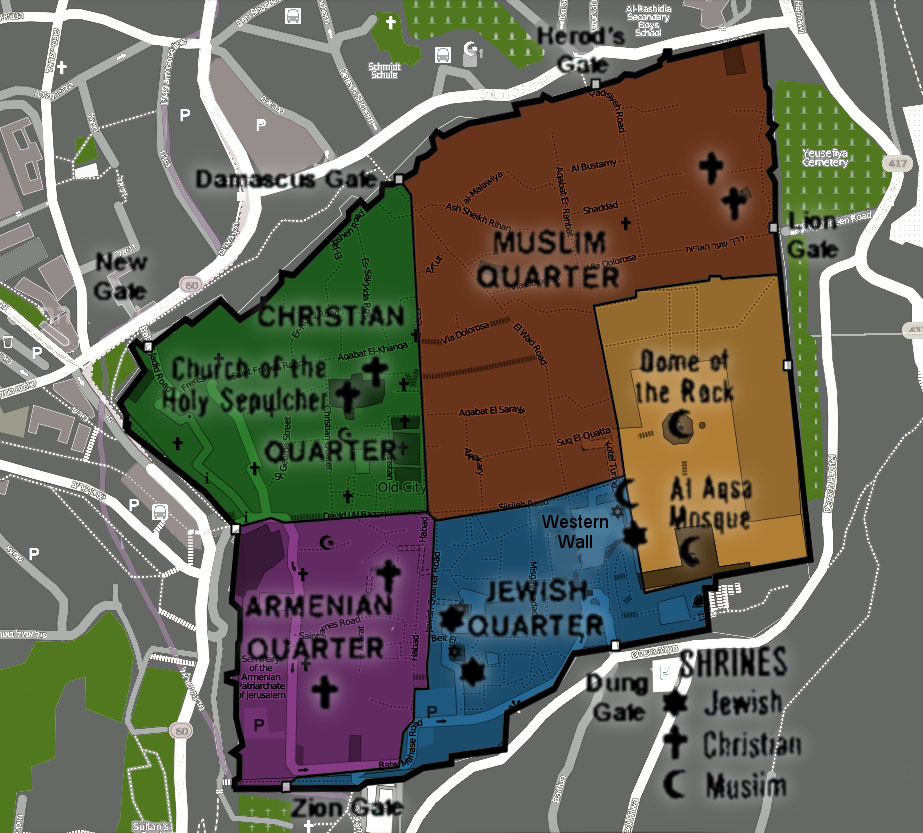
Walled area in East Jerusalem
Photo: Jerusalem_oldcity_Hebrew.jpg: *Jerusalem_oldcity_hebrew.svg: Cumulus Location_map_Jerusalem.png: Dr. Blofeld derivative work: ויקיג'אנקי Location_map_Jerusalem., CC BY-SA 3.0 via Wikimedia Commons
The Old City of Jerusalem (Hebrew: העיר העתיקה, Ha'Ir Ha'Atiqah, Arabic: البلدة القديمة, al-Balda al-Qadimah) is that part of Jerusalem surrounded by the impressive 16th-century Ottoman city walls and representing the heart of the city both historically and spiritually. In a city already divided, the Old City is further divided culturally and historically into four residential Quarters: (clockwise from the southeast) the Jewish, Armenian, Christian, and Muslim Quarters. A fifth area, the Temple Mount/Haram esh-Sharif, contains the Dome of the Rock, Al-Aqsa Mosque, and other Muslim religious sites, and was once the site of the Jewish Temple. The whole Old City is a UNESCO World Heritage site.
Located at the southern part of the Old City and has been inhabited by Jews for centuries (before the Crusades, Jews were concentrated in the northern part of the Old City). The Jewish Quarter was destroyed during the 1948 war but rebuilt by the Israeli government after 1967.
Located in the southwestern part of the Old City. It is the smallest of the four quarters and has the fewest residents. Most of the quarter consists of a closed-off private area owned by the Armenian monastery and surrounded by walls.
Located in the northwest part of the Old City. The quarter contains the Church of the Holy Sepulchre, one of Christianity's holiest places.
Located in the northeast part of the Old City, this quarter is the largest and most populated one, with mainly Muslim residents.
The holiest site in Judaism and the third-holiest site in Islam. Also known as Mount Moriah, the first and second Jewish Temples stood here for over 1000 years. During the 7th century AD, the Dome of the Rock and the Al-Aqsa Mosque were built here. Today, it is administered by a Muslim authority, with limited access to non-Muslim visitors.
From the travel guide. Select a place for details, a map and what is nearby.
Known in Hebrew as Ha-Kotel Ha-Ma'aravi- הכותל המערבי or "Kotel" for short
Part of the western retaining wall of the Temple Mount, it was built by Herod the Great during his expansion of the Temple in 20 BCE. The wall became the Jews' chief place of pilgrimage during the Ottoman Period. In this period it become known as the "Wailing Wall", where Jews lamented the destruction of the Temple by the Romans in 70 CE. This is still the closest site to the Temple where Jews can pray (many rabbis say Jews are forbidden by Jewish law from ascending the Temple Mount, and in any case secular and Muslim authorities do not allow Jews to pray on the Temple Mount). The term "Wailing Wall" is considered offensive by some and is usually only used by non-Jews. The plaza in front of the Wall is divided by a fence, with a large area for men on the left and a smaller area for women on the right. Anyone is allowed to approach the wall - complimentary kippahs are provided for men who come bare-headed, while shawls are provided for women who do not come appropriately dressed (shoulders, chest, midriff, and thighs covered). The wall acts as an outdoor synagogue with written prayers inserted into the crevices between the large stones. Photography is not allowed on the Sabbath (Friday night and Saturday until sundown). Monday and Thursday mornings many bar mitzvahs are held, drawing large crowds of families and guests. Friday night at sundown there is the welcoming of the Sabbath (Kabbalat Shabbat) which includes prayers, singing and dancing.
This is a tour of the underground parts of the Western Wall, including the evolution of the Temple Mount from the First Temple period to today. A wonderful tour for those interested in the archeology and history of the Temple Mount. You will see enormous stones underlying the Western Wall, an underground synagogue (the nearest spot to the Temple site, where Jews are allowed to pray), a pool and a water tunnel from Herod's time. The tour must be booked in advance but is well worth the advanced preparation. During the low season, you can also try your luck and join an excursion without the reservation.
The ruins of a 12th-century German Crusader Hospice within view of the Temple Mount. Worth a short visit. A Jewish art gallery/shop is to the left of the door to the hospice's church (it's pretty obvious which of the buildings is the church).
Once running nearly the entire length of the Old City from north to south, the Cardo is an excavated and partially reconstructed section of the Jerusalem's main thoroughfare in the Byzantine era. Visitors can get a good idea of how the whole once looked by descending to the 200 m (650 ft) section alongside the Jewish Quarter. The central roadway was 12.5 m (41 ft) wide and lined with shops. The pillars from that time still stand. Today in part, the Cardo contains an exclusive, covered shopping arcade.
In a maze of narrow and winding streets, Hurva Square is the heart and social center of the Jewish Quarter. Its open areas offer cafes, souvenir shops, and snack bars with outdoor seating. On the west side of the square is the site of the Hurva Synagogue (Hurva means "ruins"). Burnt down by its creditors in the 18th century, the synagogue was rebuilt in 1864 only to be destroyed during the 1948 fighting. After 1967, a lone arch was reconstructed from the remaining shell, making it a popular photographic attraction. In 2006, however, the arch was removed and reconstruction of the synagogue commenced. The synagogue was re-dedicated in 2010, and is now available for tours (must be pre-booked).
Following the 1967 Israeli victory, a vast reconstruction program in the Jewish Quarter resulted in many important archaeological finds. One of the most significant was the unearthing of the foundations of a massive wall. These fortifications, measuring 7 m (22 ft) thick and 65 m (215 ft) long, are possibly part of the fortifications built by King Hezekiah in the 8th century BC. This wall can be freely viewed outdoors.
This house was inhabited by a wealthy priestly family at the end of the Second Temple period, and burned down by the Romans in 70 CE.
Ophel Archaeological Park
This area on the southern side of the Temple Mount had been rebuilt many times over the centuries. Remains from the Herodian (34–4 BCE), Byzantine (395–661 CE) and Omayyad (661–750 CE) periods can be found on the grounds. Guided tours are available for an additional ₪16.
The Karaite Jews, numbering 30-50,000 worldwide, are a unique sect of Judaism that has been at odds with mainstream rabbinic Judaism for centuries. The Karaites reject the Talmud (Oral Law) and only rely on the Torah, Prophets, and Writings. You must call ahead for a tour of the synagogue. Tours are only in Hebrew, but it might be possible to pre-arrange English or Russian.
הכותל הקטן
Not as well-known and not as crowded as the larger part of the Western Wall, with the lower parts dating back to the Second Temple period.
Bab el-Magharibeh, Gate of Moroccan, Moor's Gate
The Herodian Quarter
Lying 3 to 7 m (10 to 22 ft) below street level, this museum offers a vivid excavation of daily life during the Herodian era 2,000 years ago, before the Romans rampaged and burned the wealthy Upper City in AD 70. Photography inside the museum is not allowed.
A fairly interesting place which has reconstructed most of the more obvious ritual tools to be used in the Temple services in the hopes of one day restoring the Temple itself. The front of the store is a bookstore/souvenir shop, while the back is a four room museum with one room set aside as a theater to show a 15 minute movie. Dress appropriately when going here - long pants and sleeves for men, and modest wear for women. The shop is a great place to find unique Jewish souvenirs and Judaica - worth browsing even if you don't plan on buying anything.
The history of the Jewish community in the Jewish Quarter of Jerusalem from the beginning of the 15th century until the fall of the Quarter in the War of Independence.
A small museum which documents the day in 1948 on which the Jewish Quarter fell to Jordanian forces.
A combination of art, sound-and-light presentation, and archaeological remains tells the story of 3,000 years of Jerusalem's history. Must reserve in advance.
A gallery of the paintings of artist Moshe Tzvi Berger, particularly a set of 150 paintings, each one representing one chapter from the book of Psalms.
Now occupied by the Tower of David Museum of the History of Jerusalem, the Citadel is an imposing fortress inside the city wall beside the Jaffa Gate. Utilized and expanded throughout the centuries as a means of protection, excavations have revealed remains dating back to the 2nd century BC and indicate that there was a fortress here in Herodian times. The museum provides visitors with 3 routes highlighting different aspects of the Citadel, namely: Exhibit, Panorama and Excavation. The routes are advisory only and provided for visitors' convenience. An 1873 model of Jerusalem is on display in an underground cistern near the exit. At night there is a sound-and-light show of Jerusalem's history, which is visually impressive but somewhat light in terms of content. Buy tickets for the show online ahead of time, it sells out.
This Armenian cathedral is one of the most beautiful of all the sacred buildings in Jerusalem. It was constructed in the 11th and 12th centuries over the traditional tomb of St James the Apostle. Attending an Armenian Orthodox vespers service is a treat, even for non-believers. Vespers is held each evening (except Sunday) at 15:00 and lasts until 15:30. It is chanted by the seminarians of the Armenian Orthodox seminary across the street from the Cathedral. The chanting is very moving and has a bitter-sweet tone to it which is unforgettably beautiful. Each afternoon the service is signaled by a priest striking wooden bars hanging from the vaulted porch. The interior is dimly lit by hundreds of oil lamps hung from the ceiling. (Make sure to find out if there is an Armenian holy day where all of the lamps will be lit up during your visit.) Rather than seats, the floors are thickly laid with Oriental rugs. The cathedral contains a chapel that supposedly holds the head of St James. Cover knees and shoulders; no clothes are provided.
The monastery is open all day, simply ring at the gate. According to tradition, this church was built on the site of the house of Mary, mother of St Mark. Every weekday the three resident monks hold the 25-minute vespers service at 16:00 for the small community of Syriac believers as well as visitors. Female visitors are not required to cover their hair during services.
Սրբոց Հրեշտակապետաց եկեղեցի, Srbots Hreštakapetats yekeğetsi
A smaller Armenian church.
Built in 1895, this is the only Maronite church in old Jerusalem.
Anglican church established in 1849, it was the original seat of the Anglican Bishop in Jerusalem until 1899.
Located slightly down the street from Saint James Cathedral, it is housed in what was once either the monastery or the guest house for the Armenian Monastery of Saint James. The museum holds an impressive and very well documented collection demonstrating the history of Armenia both religious and secular. Even for those who are not usually museum goers, it is an easily accessible, yet informative glimpse into Armenians long history. In addition, the grounds are very beautiful with a double story colonnade built around a central court yard.
The Holy Sepulchre is a large building spanning several areas in which Christ is believed by Christians to have been crucified and died, was buried, and then rose from the dead on the third day. Eastern Orthodox Christians, Roman Catholics, and Oriental Orthodox Christians are each allotted separate areas in the church dating largely to the time of Saladin. The Roman Catholics received their parts due almost purely to the Crusaders and, like all Roman Catholic shrines in the Holy Land, the Roman Catholic part is under the custodianship of the Terra Sancta (i.e. Franciscans).Parts of the Holy Sepulchre are controlled by several different branches of the Christian Church, who have historically been somewhat at odds with each other. It is important to note that the "church" is not one church in the sense of a building with an altar and podium near the front, but rather a "warehouse" of churches even for each denomination present: each has several altars and chapels. The Orthodox Church makes up the largest of the churches there and is situated in the center directly to the east and in front of the Sepulcher as well as at Golgatha. The Armenians have several smaller altars and chapels throughout the edifice as well as a fairly large church called "Saint Helen's" but often referred to as "Saint Gregory (the Illuminator of Armenia)." The Roman Catholics have two chapels, the Ethiopians have one in addition to a monastery on the roof, the Copts have a small altar behind the Sepulchre itself, and there is a small yet beautiful Syriac chapel up some stairs near the Coptic altar, though it is usually closed. There are even what are known as "ecumenical altars" set up on the sides in various areas which are apparently almost purely decoration and are rarely if ever used. There are many pathways and exploring here makes for a few hours of fun for those who love religious art and architecture.The best time to come is early in the morning and make your way out by 11:00. Even after sundown it is incredibly crowded. Be warned though, if you are wearing shorts, you might be barred access to the building itself but if not, then certainly to individual churches and without a doubt to the sepulchre. Women should have their shoulders covered, no cleavage, and dresses should go below the knee. Do not wear anything which might be considered even the slightest bit risqué. If you do not oblige, they will turn you back.Upon entering the church immediately in front of you is a stone slab set in the floor with a pillar at each corner. This is the Stone of Unction on which, it is claimed, Jesus' body was laid and prepared for burial. Turn right and ascend a steep, narrow flight of stairs to what is claimed to be Golgotha. There are altars here marking the location of the crosses on which Jesus and the two thieves were crucified. It is possible to crawl under the left-hand altar and feel a hole in the rock which is said to be the hole in which the cross was placed. Return down the stairs and go underneath Golgotha. A glass panel in the wall shows fractured rock, claimed to have been broken in the earthquake that followed Jesus' death.When you come out of this room turn right and follow around the passage. A long flight of stairs leads down to the underground Chapel of the Invention of the Cross (a slightly unfortunate name!) which is the cistern in which St Helena, mother of Constantine, found the True Cross. Note the thousands of small crosses carved into the walls flanking the staircase by Crusader period pilgrims.Come back up the stairs and continue round the passage past various chapels that mark the Stations of the Cross. This brings you to the Rotunda, beneath which is the Holy Sepulchre itself. There is usually a queue here as people line up to visit the tomb. The first small room is where the angels sat who announced the resurrection to the women who came to the tomb on Sunday morning. The second, which is a squeeze for three and impossible for four, contains a marble shelf supposed to be the spot where Jesus' body was laid. Photography - even flash photography - is allowed, but one should be discreet and respectful, as others in the room will regard this as the most holy of all sites and their visit to it as the emotional highlight of their pilgrimage.Unfortunately the tomb is almost certainly spurious, as 1st century AD tombs had a particular form exemplified by the Tombs of the Prophets on the Mount of Olives. When you come out of the Sepulchre turn left and go round behind it. A low doorway leads into the often dusty and neglected Chapel of St Nicodemus and a further doorway takes you to a small room in the wall of which are genuine 1st century AD kokhim - coffin-shaped tunnels cut into the wall. If the tomb of Christ is anywhere in this building, these are more likely to be it than the official Sepulchre outside.
This church was built by Kaiser Wilhelm II and completed in 1898. The church is most admired by tourists for its bell tower. At the top of its 177 steps, visitors are rewarded with some great views over the Old City. Below the church there are archaeological excavations and a small museum.
Along with David Street, is the quarter's main shopping thoroughfare. As with most shopping areas in the Christian Quarter, it specializes in religious items as well as handicrafts.
Just south of the Church of the Holy Sepulchre, this area was once a hospice for pilgrims from Latin-speaking countries. Today it serves as a quiet area of outdoor cafes and small shops centered around an atmospheric central fountain.
Adorned by a silvery dome, this church is visible from the Muristan even though the entrance is fairly difficult to locate. Founded in the 5th century, the church is significant as one of the most ancient churches in Jerusalem. The church was used as a hospice during the Siege of Jerusalem in 1099.
It is possible to walk above the central souk along the rooftops of the city. Visitors can climb up to the rooftops via a small staircase at the corner of St Mark's Road and Khabad Street. A second set of stairs leads up from Muristan Road and visitors can exit into the courtyard of Khan el-Sultan, which allows exit onto Chain Street. The view from the rooftops offers delightful views of the bustling streets below, as well as unusual views of the Church of the Holy Sepulchre and the Dome of the Rock.
This Crusader-era church was built between 1131 and 1138 to replace a Byzantine church. It is traditionally believed to be the spot where Anne and Joachim, the parents of the Virgin Mary, lived. the church fell into ruins until it was donated to France by the Ottomans in 1856. Outside the church are the extensive remains of curative baths as well as the ruins of a Roman temple dedicated to the god of medicine. It is widely believed that this site is the Pool of Bethesda where, according to the Gospel of John (5:1-15), Christ cured a paralysed man.
The Church of Condemnation
Owned by the Franciscans, this site is traditionally held to be where Christ was flogged by Roman soldiers prior to his crucifixion. Opposite the courtyard is the Chapel of the Condemnation, built on the site popularly identified with the trial of Christ before Pontius Pilate.
This arch, which spans the Via Dolorosa, was built by the Romans in AD 70 to support a ramp for the attack on the Antonia Fortress. The arch was reconstructed as a monument to victory when the Romans rebuilt Jerusalem in AD 135. Incorporated into the structure of the neighboring Convent of the Sisters of Zion, Christian tradition states that this is the place where Pilate presented Christ to the crowd and spoke the words, "Ecce homo" (Latin for "Behold the man").
A large quarry underneath the Old City. Used for several thousand years; the stones of the Western Wall were likely carved from here. Entrance is from just outside the Old City walls, a bit east of Damascus Gate.
Monastery and Greek Orthodox church.
(Arabic: Qubbat Al-Sakhra, Hebrew: Kippat HaSela), located in the middle of the sanctuary opposite of the Al-Aqsa Mosque, is probably the most dazzling and well-known landmark of Jerusalem, with its golden dome and octagonal blue walls adorned with calligraphy of Quranic verses. The Dome was built between 687-691 by the ninth Omayyad caliph, Abd al-Malik, atop the ruins of the Jewish Second Temple. The Dome is probably the most spectacular building in the Old City, thanks to a renovation in which dazzling gold donated by the King of Jordan in 1993 was layered over the bronze. Despite common conceptions, the Dome is not a mosque, but a shrine which protects beneath its high ceiling a large piece of rock sacred to Muslims, Jews and Christians. The rock is variously believed to be the "Foundation Stone" from which the world was created, where Abraham was asked to sacrifice his son (Isaac or Ishmael, depending on the tradition), where Mohammad left the Earth on his Night Journey (a small indentation was reportedly left by his foot), and the site of Solomon and Herod's Temples.
The point from where Mohammad is believed to have ascended to heaven. This association has made the building the third-holiest site in Islam after Mecca and Medina. Construction of the mosque began less than 20 years after the completion of the Dome of the Rock. Al-Aqsa has undergone many changes since its original construction. When the Crusaders captured Jerusalem in the 11th century, al-Aqsa became the headquarters of the Templars. The mosque's design pales in comparison to the Dome of the Rock and is permanently off-limits to non-Muslim visitors.
Housed in the Crusader-era refectory of the Knights Templar, this filled museum contains wonderful Islamic architectural remnants. An admission is required, but it is recommended that guests interested in Islamic art visit the LA Mayer Museum in the new city.
El-Marwani Mosque
on the east wall of the Temple Mount/Haram esh-Sharif. According to Jewish tradition the Messiah will arrive in the Temple via this gate, and according to Christian tradition Jesus entered through this gate on Palm Sunday. Closed by the Muslims in 810, reopened in 1102 by the Crusaders, it was walled up by Saladin after regaining Jerusalem in 1187. Ottoman Sultan Suleiman the Magnificent rebuilt it together with the city walls, but walled it up in 1541, and it stayed that way until today.
Visitors can walk along two sections of the Old City wall, from Jaffa Gate clockwise to St Stephen's Gate, and counter-clockwise from Jaffa Gate to the Dung Gate. The northern route starts from inside the old city by the Jaffa gate and circles the Christian quarter and the Muslim quarter. The southern route starts from outside the Jaffa gate and circles the Armenian quarter and the Jewish quarter. Access to the ramparts is only possible at Jaffa and Damascus gates, although walkers can descend at any gate. Hours are 09:00–16:00 (14:00 on Fridays) daily. Wear shoes suitable for hiking, as the ramparts are quite bumpy.
A 3D virtual reality tour of the Second Temple, of which the Western Wall is a remnant. Must be reserved in advance.
Known more for its scenery rather than for its food, the Quarter Cafe offers a view over the Western Wall and Temple Mount.
This restaurant is located between the Hurva Square and the Kotel. The menu consists of a wide selection of bagels and toppings, including vegetables and spreads.
At Tzaddik's you can find deli sandwiches, hot dogs, chips, a selection of drinks, and even Thanksgiving dinner during the appropriate season.
You can buy pizza, calzones, soft-serve ice cream (American ice cream) and a variety of drinks.
This cafe is actually two restaurants, one dairy and one meat. The dairy menu has fish, pastas, salads, soups, sandwiches, and cakes. The meat cafe serves hamburgers, salads, kabobs, hot deli sandwiches, fries (chips), steak, and chicken.
This cafe is in the Jewish Quarter, and is dairy-Kosher. Any combination of delicious things on a bagel is served with a smile.
Kosher.
Chicken Shnitzel, Falafel, Shawarma
Good pizza, delicious omelettes, slushies.
מאפה נאמן
They sell two "personal pizzas" for ₪20. The cheese is thin and the bread is puffy, but good. There is little or no sauce. The bakery has a good selection of pastries.
Pizza, Falafel, Ice Cream
Standard triangle pizza that Americans will be used to. It is fairly comparable in quality, however the taste is a little off. Kosher.
This friendly place, set on a quiet bazaar street at the edge of the Christian Quarter, is a good choice for a Western-style meal and a break from the bustle of the Old City. You can order chicken wings in barbecue sauce; omelets; old-fashioned chicken soup; meat lasagna; boneless, breaded chicken breast stuffed with Israeli feta cheese; a mezze of Arabic appetizers; or grilled meats. There are special touches, such as delicious carabage halab (a wonderful Arabic pastry made by the owner's family); fresh tangerine juice in season; and there's even espresso. As this is a Christian-owned establishment, there's a wine and beer list.
Traditional Middle Eastern Oriental setting and colorful divan seats. Enjoy world and local beers (Taybeh), wine, soft/hot beverages and shishas and listen to music. Internet/WiFi. Jerusalemite family business since 1954.
A lovely bistro/cafe/bar where you can enjoy and chill, listen to cool music, and watch TV. Soft drinks, beers & beverages, fresh fruit juices, snacks, munchies, full cocktail bar, tobacco & free wifi. Try the local Palestinian beer called Taybeh—only ₪18. One of the nicest and cleanest cafes in the Old City. This small indoor/outdoor cafe/restaurant/bar is a nice spot for lunch, dinner or late night snack. The atmosphere is lively, the food very good, prices reasonable, service prompt and friendly and English speaking. It is also one of the few eateries open at night in the Old City.
Traditional Armenian food in an atmospheric setting: a Crusader period arched cellar complete with indoor fountain, wooden tables and the ubiquitous hand-painted Armenian tiles. Alcoholic beverages available.
A small, simple restaurant that is known for its quality hummus and serves a variety of Middle Eastern favorites. Not kosher.
A family-owned restaurant that has been open since 1927. If you don't like the pizza it's free. Also offers shawrma, chicken shishkabab and lamb shishkabab (all are served with saldes and humus and chips) as well as natural lemon with mint juice.
Not kosher.
An excellent hole-in-the-wall shawarma place inside the Old City with delicious French fries and all the fixings you can put in your pita. Not kosher.
Very popular family owned restaurant serving excellent Arabic cuisine. There's no fixed menu, dishes change daily.
A confectionery that's been around since 1951, sells excellent Arabic sweets such as knafeh and baklava.
Gives a good impression of the religious tension here, because you always have to pass by the police and justify yourself. Usually, passage is only allowed for Muslims wanting to enter through the Chain Gate. The hostel itself is not very spacious and the staff is quite grumpy, but it is a good choice. The "10 beds dorm" for booking is actually a 13 beds one, but there are worse options out there.
Just inside Jaffa Gate with views across the Old City to the Dome of the Rock. Breakfast included.
Nice and cosy place. They have 12-bed and 8-bed dorms but the 12-bed has very good ventilation. Also the view from the roof is amazing. Though, they don't have free tea and coffee, and stay away from the 8-bed dorm downstairs, it is quite noisy.
Breakfast included in the price and has free Wi-Fi. Very near Damascus Gate and about an 8 minute walk to Jaffa Gate. Rooms are clean but tiny as you would expect for the price.
Central location in the old town with free coffee and tea. Wireless internet is ₪6 extra for the password, lockers are ₪3 extra per night and the laundry and drying is a ₪2 charge for each. There is no smoking or drinking in the hostel and there is a curfew of 2AM.
The Heritage House provides safe and comfortable lodging for young Jewish travelers and students so that they can best experience and develop their connection with Israel, Judaism, and the Jewish people. They provide guests with a warm bed, fresh bedding, laundry facilities, food options, WiFi, long-distance calling, an extensive library, and information on numerous tours and educational/service opportunities throughout Israel. Only provides beds for travelers and students ages 18-30 and Jewish.
Palm Hostel
It is a cheap place.
Österreichisches Pilger-Hospoz
High quality and comfort and a good location for the money, this hospice is popular with Catholic groups, so it is a good idea to book well in advance.
One of the oldest Christian hospices in the Old City, this location has plain, comfortable rooms and good range of services. Its location makes it very popular, so book well in advance.
Air-conditioned rooms, all of which have a cable television, private toilet and bath, telephone, and internet connection. A great 5th floor/roof view of city.
This hospice has clean and simple rooms and a great view of the Old City from the roof.
First opened in 1887, this was one of Jerusalems premier hotels in the early 20th century. The hotel closed after British occupation in 1918 but has reopened in early 2000s.
The most interesting market for tourists, full of Middle Eastern goods as well as souvenirs appealing to members of various religions.
The most prestigious shopping precinct in the Jewish Quarter. Built on the excavated remains of late Roman era Jerusalem (many of which can still be seen), the shops here specialise in arts and crafts, jewelry, Judaica, Dead Sea beauty products, quality souvenirs and T-shirts, among other things. But souvenirs here tend to be significantly more pricey than elsewhere in the Old City.
By light rail
The Jerusalem Municipality usually recommends light rail as the best way to get to the Old City, particularly on holidays when there are many visitors.
By bus
By car
If you arrive by car, be aware of the limited parking space. The streets outside the Old City walls are usually reserved for buses and taxicabs; parking of private cars is prohibited.
With a private guide
There's no doubt that Jerusalem is overwhelming not to mention scattered.
The Old City is fairly diminutive in size compared to modern-day Jerusalem. Despite its small size, or perhaps because of it, the Old City is amazing.
Read in the guideChoose an airport to see hotels, stations, taxi ranks and car rental desks around it.
Tel Aviv · International · TLV
Loading places around the airport…
Articles and travel topics about Old City and Israel.
 Culture & history
The Roman Empire was the greatest ancient empire of Europe. At the height of its power in 117 AD, it ruled over considerable parts of Europe, as well as much of North Africa and the Middle East.
Wikivoyage
 Culture & history
The Byzantine Empire or the Eastern Roman Empire is posterity's name for the eastern continuation of the Roman Empire, ruled from Constantinople (today's Istanbul) until the city fell to the Ottoman Empire in 1453.
Wikivoyage
 Culture & history
Old towns of the Middle East outlines a list of notable old towns in the Middle East. The Middle East contains many of the world's oldest cities, some of them inhabited for several thousand years, with heritage to…
Wikivoyage
 Travel tips
Buses are the most common form of public transportation in Israel for Israelis and foreigners alike. They are generally frequent and modern, but often slow.
Wikivoyage
Every section of the guide. Open one to read it in full.