//

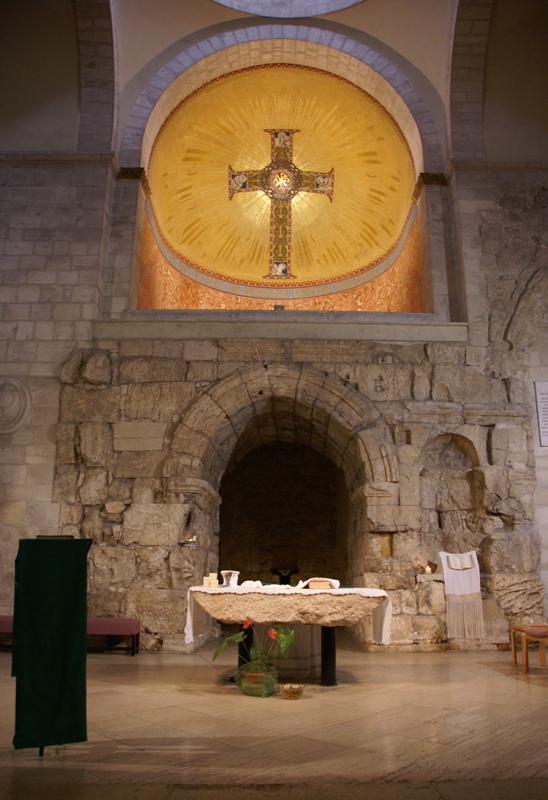
Photo: Otter, CC BY-SA 3.0 via Wikimedia Commons
This arch, which spans the Via Dolorosa, was built by the Romans in AD 70 to support a ramp for the attack on the Antonia Fortress. The arch was reconstructed as a monument to victory when the Romans rebuilt Jerusalem in AD 135. Incorporated into the structure of the neighboring Convent of the Sisters of Zion, Christian tradition states that this is the place where Pilate presented Christ to the crowd and spoke the words, "Ecce homo" (Latin for "Behold the man").
© OpenStreetMap contributors
The ruins of a 12th-century German Crusader Hospice within view of the Temple Mount. Worth a short visit. A Jewish art gallery/shop is to the left of the door to the hospice's church (it's pretty obvious which of the buildings is the church).
The Church of Condemnation
Owned by the Franciscans, this site is traditionally held to be where Christ was flogged by Roman soldiers prior to his crucifixion. Opposite the courtyard is the Chapel of the Condemnation, built on the site popularly identified with the trial of Christ before Pontius Pilate.
A large quarry underneath the Old City. Used for several thousand years; the stones of the Western Wall were likely carved from here. Entrance is from just outside the Old City walls, a bit east of Damascus Gate.
(Arabic: Qubbat Al-Sakhra, Hebrew: Kippat HaSela), located in the middle of the sanctuary opposite of the Al-Aqsa Mosque, is probably the most dazzling and well-known landmark of Jerusalem, with its golden dome and octagonal blue walls adorned with calligraphy of Quranic verses. The Dome was built between 687-691 by the ninth Omayyad caliph, Abd al-Malik, atop the ruins of the Jewish Second Temple. The Dome is probably the most spectacular building in the Old City, thanks to a renovation in which dazzling gold donated by the King of Jordan in 1993 was layered over the bronze. Despite common conceptions, the Dome is not a mosque, but a shrine which protects beneath its high ceiling a large piece of rock sacred to Muslims, Jews and Christians. The rock is variously believed to be the "Foundation Stone" from which the world was created, where Abraham was asked to sacrifice his son (Isaac or Ishmael, depending on the tradition), where Mohammad left the Earth on his Night Journey (a small indentation was reportedly left by his foot), and the site of Solomon and Herod's Temples.