//

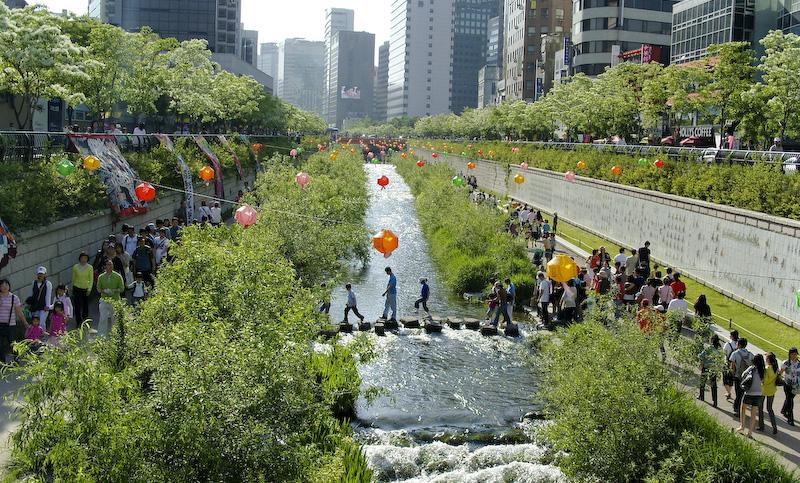
Capital and largest city of South Korea
Photo: stari4ek, CC BY-SA 2.0 via Wikimedia Commons
Seoul (서울) is the capital of South Korea. With a population of over 9 million (with over 20 million in the wider metropolitan area), Seoul is by far South Korea's largest city and one of East Asia's financial and cultural centers. A fascinating blend of ancient traditions and cutting-edge digital technology, home to endless street food vendors and vast nightlife districts, an extraordinarily high-pressure educational system and serene Buddhist temples, a dynamic trend-setting youth culture and often crushing conformism, extraordinary architecture and endless monotonous rows of grey apartment buildings, Seoul is a city filled with stark contrasts, contradictions, and paradoxes. People in Seoul can enjoy various artistic activities such as plays, musicals, and concerts.
The Joseon-era historical core of the city with the famous Joseon Palace, Gyeongbokgung. Bukchon has beautiful traditional Korean house and Insa-dong has the largest antiques market street in Seoul. Cheongyecheon has a renovated stream and park that runs through the heart of the downtown area.
This district makes up the other half of the historic core as well as the shopping districts of Myeongdong and Namdaemun Market. This area contains Seoul Station and Namsan Mountain, with the Seoul Tower at its summit.
These two districts lie immediately west of Jongro and Jung, and contain dozens of universities and colleges. As such, this area is home to some of Seoul's most active nightlife districts: Hongdae (홍대) and Sinchon (신촌).
Yongsan is home to the US Army Military Base as well as one of the huge Yongsan Electronics Market. This is also where you'll find Itaewon (이태원), perhaps the most culturally diverse area in Korea and home to dozens of restaurants featuring cuisine from the world over, numerous shops selling everything from custom-tailored suits to antiques, and several Western pubs and bars.
Covering Yeoui-do on the Han River as well as an area on the south side, this is often referred to as the 'Manhattan of Seoul'. Guro is one of the IT venture company clusters.
Famed for 'Gangnam Style', this affluent area is the glitzy center of modern Seoul, home to hundreds of glass and steel skyscrapers, neon billboards, and some of the most expensive real estate in the country.
A residential district east of Gangnam where you'll find Lotte World, Olympic Park, Seoul (Jamsil) Sports Complex, and the Sincheon nightlife district.
Northern area including Eunpyeong, Seongbuk, Gangbuk, Dobong and Nowon. Mt. Bukhansan and Mt. Dobongsan area.
Area south of the Han river including Dongjak, Gwanak and Geumcheon. This is where you can enjoy fresh seafood at the huge Noryangjin fish market.
Dongdaemun, Jungnang, Gwangjin, Seongdong with greenery and some interesting cultural sites.
Western area south of the Han river and including Gangseo and Yangcheon
From the travel guide. Select a place for details, a map and what is nearby.
Alongside the Han River through 13 districts: Gwangnaru, Jamsil, Gangdong, Ttukseom, Jamwon, Banpo, Ichon, Yeouido, Yanghwa, Mangwon, Seonyudo, Nanji, and Gangseojigu. You can see many people strolling or jogging along the trail paths, as well as in-line skaters, bicyclists, and soccer fields or basketball courts. Yeouido, Jamsil, and Ttukseom districts are especially popular because of the cruise services on the Han River.
국립중앙박물관
By train
Seoul is the northern terminus for most KTX high-speed train services. There are three main stations within city limits:
By bus
Every weekend approximately 2 million Seoulites leave the city, which explains why the city has four major bus terminals.
By boat
There are ferry services to various points in China from the neighboring port city of Incheon.
By car
No matter where in Korea you start your journey, there will be tolled expressways (Gosok Doro) and national highways (Gook Do) that lead to Seoul; the most important one is the Gyeongbu Expressway,…
By subway
In Seoul, you can visit most places by using the vast subway network. There are nine numbered lines plus a smattering of named suburban lines, all distinguished by different colors.
By bus
Seoul also has an extensive bus network. There are four different kinds of buses: yellow, green, blue, and red. Yellow buses have a short circuit usually around tourist areas.
By taxi
Deluxe taxis are black with a yellow sign and are more expensive than regular taxis but provide better and more comfortable service. Regular taxis are silver.
By Ride Share
Uber (branded as Uber Taxi) is widely available throughout Seoul and can also be used to hail regular taxis.
By car
Internationally known car rental companies can be found in Seoul; just be prepared for a driving challenge and long rush hours.
On bicycle
There are many bike rental stations in Seoul (and other cities). Seoul City government operates Seoul Bike (nicknamed 따릉이 (Ttareungyi)), and you can get around easily at little cost.
On shared electric scooters
Shared electric scooters are available for rent with a driver's license. It is mandatory to wear a helmet and you can be fined by the police if you don't.
On foot
Getting around in Seoul without a local escort (be it friend or cab driver) can be tricky, since this is one of the most densely populated cities in the world.
Choose an airport to see hotels, stations, taxi ranks and car rental desks around it.
Seoul · International · GMP
Loading places around the airport…
Articles and travel topics about Seoul and South Korea.
 Itineraries
The essential first-time South Korea itinerary covering Seoul royal palaces, Busan coastal seafood markets, Gyeongju tombs, and volcanic Jeju Island.
6 min read
 Travel tips
Complete 7-day South Korea travel budget guide covering actual costs for hotels, KTX bullet trains, food, and sightseeing across budget and luxury tiers.
7 min read
 Nature & adventure
Discover the best time to see cherry blossoms in South Korea with regional bloom calendars, top spots in Seoul and Jinhae, and travel tips.
6 min read
 Culture & history
Seoul is the city with the biggest contrast between traditional culture and modern technology. While all the traditional attractions have signposts (and sometimes robots) pointing to them.
Wikivoyage
Every section of the guide. Open one to read it in full.