//


Province in South China
Photo: yazi-swallow, CC BY 2.0 via Wikimedia Commons
Fujian (福建 Fújiàn) is a coastal province in East China. It has long been an outward-looking province, much involved in maritime trade, and is the ancestral homeland for many overseas Chinese, especially in Southeast Asia. Located just across the sea from Taiwan, it is also the ancestral homeland for most Taiwanese, and continues to share close cultural ties with the island.
East Fujian (闽东 mǐndōng) is an area of Fujian Province in China.
South Fujian (闽南 mǐnnán) is a populous region in Fujian Province that has been doing foreign trade for centuries. It is the ancestral home for many overseas Chinese.
Inland Fujian is an area of Fujian Province in China; in Chinese it is sometimes referred to as mǐnxī (闽西), West Fujian. The province's main cities are along the coast; the inland region is mainly mountains and agricultural areas.
鱼圆 yú yuán, 鱼丸
They are made of minced fish and egg white, mixed with flour. Some varieties of fish balls have pork or shrimp added, with the most famous one perhaps being the Fuzhou version. These are then cooked in boiling water.
沙茶面, sa-te-mī in Minnan, shāchá miàn in Mandarin
A specialty of Xiamen, with the broth having been inspired by the dipping sauce of the traditional Malay dish satay.
太极芋泥
Taro nut is cooked and pressed into mud, with sugar, eggs, water and oil. After the taro cools down, people sometimes add chopped kernels, cherry on the surface. It is one of Fujian’s traditional desserts.
光饼
It is made with raw material of flour, salt, sesame seeds. The shape of light cake is similar to doughnuts. It doesn’t have much taste. In Fuzhou, "light cake" refers to the version without sesame seeds, while the version with sesame seeds is called "Fuqing cake".
云吞 yúntūn
is the most common snack in Fujian. The wonton skin is thin, it cooks in a short time. The boiled dumplings would be required in the process of adding cold water 2 times. After cooked, it looks half transparent.
佛跳墙 fó tiào qiáng
A specialty of Fuzhou, it is perhaps the most famous dish in Fujian cuisine. It contains more than 30 delicacies, including shark's fin, sea slug, chicken breast, duck, pig's trotters, dried scallop, mushroom, abalone, pigeon egg. with other condiments. It's said that after the dish is cooked, the air is heavy with a strong fragrance. Legend has it that it smelt so good that a Buddhist monk forgot his vegetarian vows and leapt over the wall to have some, giving rise to its name.
The white tea is grown in various regions of Fujian including the ShuiJie and Zhenghe counties. The white tea leaves have a unique shape. White tea is a little bit fermented tea with a mild flavor but leaves a sweet taste later.
Fujian is well connected via China's domestic airline, bus, highway and train networks.
Read in the guideThe main mode of intercity travel is traditionally by bus. The standard low-cost low-speed trains are less convenient in Fujian than elsewhere because they wind around a lot in the mountainous terrain.
Read in the guideChoose an airport to see hotels, stations, taxi ranks and car rental desks around it.
Sanming (Sha) · Regional · SQJ
Loading places around the airport…

This page describes the capital of Fujian Province. For the city in Jiangxi, see Fuzhou (Jiangxi).

Longyan (龙岩; Lóngyán) is an inland city in western Fujian, China. For travellers, it is best known as a gateway to the Hakka tulou of Yongding and other rural areas of western Fujian.

Nanping (南平 Nánpíng) is an inland city in Fujian, up the Min River from Fuzhou.

Ningde (宁德) is a coastal city in the eastern part of Fujian Province, known for its rich natural resources and unique maritime culture. The city boasts beautiful beaches, mountains, islands, and abundant ecological landscapes, making it an ideal destination for tourism and vacation.

Putian (莆田 Pútián) Putian, located on the southeast coast of Fujian Province, China, is a city with a long history and rich cultural heritage, and is known as the hometown of Mazu, the "goddess of peace on the sea". It is known for its beautiful natural scenery, with famous scenic spots such as Meizhou Island and Jiuli Lake, and is the birthplace of Mazu culture and a pilgrimage center for believers from all over the world.

Quanzhou (泉州; Choân-chiu in Minnan, Quánzhōu in Mandarin) is a coastal city in Fujian Province north of Xiamen and south of Fuzhou. Older romanisations, no longer in use, include Ch'üan-chou, Chuanchow and Chinchew.

Template:PagbannerSanming (三明 Sānmíng) is a city in the mountains of Fujian Province in China.

Xiamen (厦门; Ē-mn̂g in Minnan, Xiàmén in Mandarin, former English name: Amoy) is a coastal city in Fujian Province in China. It is a very vibrant, affluent and modern place, though by Chinese standards it is a small city — only 5.1 million counting suburbs (2020).

Zhangzhou (漳州; Chiang-chiu in Minnan, Zhāngzhōu in Mandarin) is a city of 4.8 million people (2010) in the west of Fujian Province in China.

Gulangyu (鼓浪屿 Kó͘-lōng-sū in Minnan, Gǔlàngyǔ in Mandarin) is an island in Xiamen, a few minutes by ferry from downtown. It has a population around 17,000 and an area of about 2 km² (500 acres).

Mount Wuyi (武夷山 Wǔyíshān) is a very popular scenic area in Nanping prefecture, Fujian Province, China.

The Fujian tulou (Chinese: 福建土楼 Fújiàn tǔlóu; literally: "Fujian earthen buildings"), also known as Hakka tulou, Hakka earth houses or roundhouses, are rural dwellings unique to the Hakka people in the mountainous areas in southeastern China. There are also toulou in Guangdong and Guangxi, but the UNESCO World Heritage Site for toulou is 46 buildings in Fujian.

Chongwu (崇武 Chóngwǔ) is a small town in Hui'an County, Quanzhou Prefecture, Fujian.

Liu'ao (六鳌 Liù'áo) is a peninsula in Zhangpu County of Zhangzhou City, in the southern part of China’s Fujian Province.
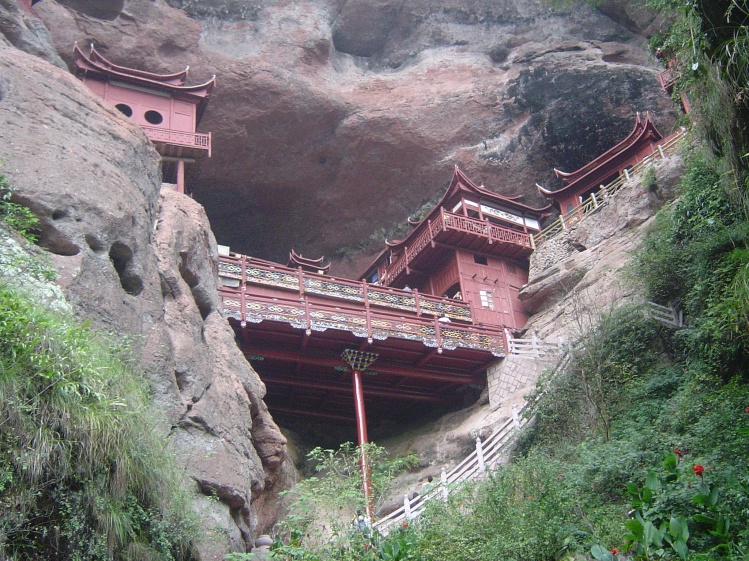
Taining (泰宁 Tàiníng) is a county in Fujian with a UNESCO Geopark nearby.
Articles and travel topics about Fujian and China.
 Travel tips
How to qualify for China's 144-hour visa-free transit, set up Alipay and WeChat Pay with foreign cards and navigate train travel as a foreigner.
6 min read
 Itineraries
How to link Beijing, Xi'an and Shanghai by high-speed bullet train, booking Great Wall hikes, Terracotta Warriors and modern urban towers.
6 min read
 Nature & adventure
How to explore Zhangjiajie's sandstone pillars, ride the Bailong Elevator and drift down the Li River through Guilin and Yangshuo karst peaks.
6 min read
 Itineraries
The Long March (长征) was a retreat by Communist forces from Kuomintang (Nationalist) armies in 1934 and 1935, and is considered a strategic feat that directly led to the foundation of today's People's Republic of China.
Wikivoyage
Every section of the guide. Open one to read it in full.