//

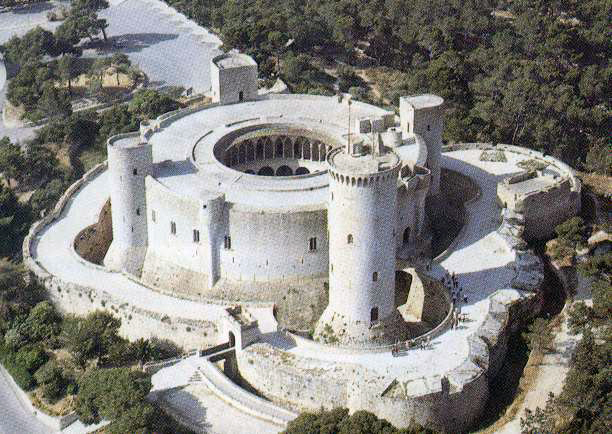
Photo: Poniol60, Public domain via Wikimedia Commons
An unusual circular castle enclosing a courtyard, built in the 14th century over a Moorish fort. A circle is not the best design in the age of artillery, but there's an outer ravelin and it withstood two sieges. Within is a museum of archaeological finds and classical sculptures. Its hilltop site commands good views of the city and the bay.
Bellver Castle is a Gothic-style castle on a hill 3 km to the west of the center of Palma de Mallorca on the island of Mallorca, Balearic Islands, Spain. It was built in the 14th century for King James II of Majorca, and is one of the few circular castles in Europe. First serving as the residence of the Kings of Majorca, and afterward long used as a military prison throughout the 18th to mid-20th century, it is now under civilian control, being one of the main tourist attractions of the island, as well as the seat for the city's History Museum.
© OpenStreetMap contributors
"Village" containing replicas of notable Spanish buildings. In season there are artisan shops, restaurants and bars within, and it's an events venue, but it's a bit hollow at other times.
Joan Miró lived mostly in Barcelona and Paris but had extended spells in Palma. His two former studios display 6000 works, and there's a sculpture garden.
Military museum in a 17th century Vauban-style bastion by the harbour.
Three-storey collection of 19th-20th century works by artists from the Balearic islands.
Sa Llotja
Medieval mercantile building with impressive architectural features, near the waterfront. It is occasionally used as event space but stands empty most of the time.
La Seu
Huge ornate cathedral, impressive outside and within. It was started in 1229 but only completed in 1601, in mostly Gothic style; Gaudí had a go at improving it but quit in a strop. The Royal Chapel is the resting place of kings Jaime II and III. You can ascend the tower for an extra €15, but it's a lot of steps. The standard ticket includes Museo de Arte Sacro (aka Museu Diocesà), with religious paintings and silverware; this has a separate entrance east.