
Wu phrasebook
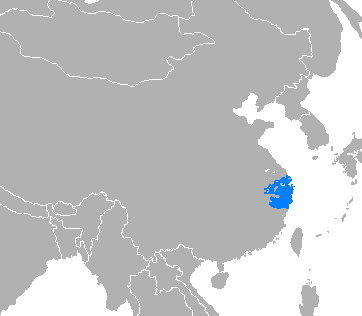
Photo: Fobos92, CC BY-SA 4.0 via Wikimedia Commons
Wú (吴语) or "Shanghai dialect" or "Shanghainese" (上海话) is the main local language for much of East China — the municipality of Shanghai, most of Zhejiang province, and the southern parts of Jiangsu province. There are also some speakers in neighbouring Chinese provinces. There are local variants of the language; the standard is that of Suzhou (an older city, capital of the Kingdom of Wu centuries back, and home to many scholars), not that of Shanghai. Mutual intelligibility between different Wu dialects varies; while someone from Shanghai will be able to understand the Suzhou dialect fairly easily, comprehension becomes harder in cities further afield like Hangzhou, while the Wenzhou dialect is completely incomprehensible. It is therefore common for Wu speakers from different cities to communicate in Mandarin instead. This is a populous region and the number of Wu speakers is large; on Wikipedia's list of world languages by number of native speakers (as of Oct 2026) it ranks 14th with 83 million, ahead of Korean, Urdu, German, French, and any other Chinese language except Mandarin and Cantonese.
Few travellers are likely to need or want to learn Wu. Throughout China, Mandarin has been the main language of government, education, media, and entertainment, for over half a century. Nearly all Wu speakers have at least some Mandarin as well, and the educated ones are generally completely fluent. Also, the major cities where Wu is the main local language — Shanghai, Suzhou, Wuxi, Ningbo and Hangzhou — are all quite prosperous and full of immigrants or temporary migrant workers who come from areas where Wu is not spoken. As anywhere else in China, Mandarin is the lingua franca for communication between people from different areas. Most foreigners living in the region choose to learn Mandarin rather than Wu.
That said, if you are spending a significant length of time in the region, then learning some Wu may be useful. It will almost certainly please and amuse the locals.
Pronunciation guideUnlike Mandarin, there is no widely-used Romanization system for Wu, and there is even no standardized Romanization system like Jyutping developed by Linguistic Society of Hong Kong for Cantonese, though some scholars…
Phrase listThe following is listed in both simplified and traditional Chinese characters, and both Suzhou and Shanghai pronunciation.
Learning more
Sources and licences
- Guide text adapted from the Wikivoyage article "Wu phrasebook" by its contributors, available under CC BY-SA 4.0. Read on Wikivoyage · Contributors · CC BY-SA 4.0
- Photo: Fobos92, CC BY-SA 4.0 via Wikimedia Commons