//


City in Greater Poland Voivodeship, Poland
Photo: Grzegorz Gołębiowski, CC BY-SA 4.0 via Wikimedia Commons
Poznań (German: Posen) is the largest city in Greater Poland, in the west of Poland, and one of the largest metropoles in the whole country. Situated roughly equidistantly between Warsaw and Berlin, it serves as a major economic hub, and a centre for industry and commerce. The Poznań International Trade Fair grounds host the most important trade fairs and exhibitions in Poland, making Poznań an important business destination, but the city has plenty of history and attractions to share besides that. Its relative compactness and easy access by road, rail and air make it a convenient tourist destination for visitors to Central Europe.
From the travel guide. Select a place for details, a map and what is nearby.
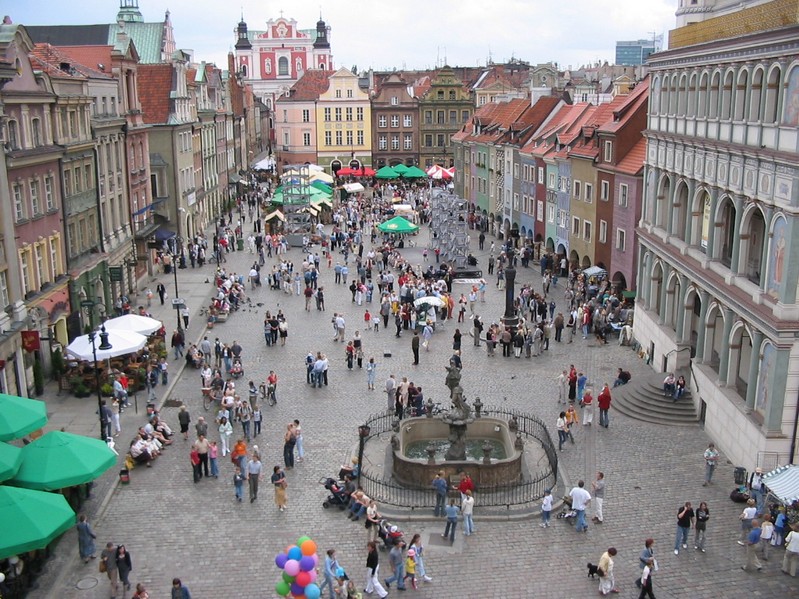
Old Market Square
The old town square, one of the finest in Europe. This is the centre of old, medieval Poznań, and has been superbly rebuilt after severe destruction in World War II. Cafés and bars line the square and it is a superb spot for ordering a drink and watching the world go by.
The Town Hall is the centrepiece of the Rynek. It was built in the Gothic style in the first years of the 14th century. It was later rebuilt in Renaissance style by Giovanni Battista di Quadro from Lugano. It is said to be the most beautiful non-church renaissance building north of the Alps. The building houses the Historical Museum of Poznań (built as the headquarters of municipal powers and the city court), displaying exhibitions about the history of the city since the 10th century. Two things to watch out for here are the ornately decorated Great Entrance Hall and the mechanical goats which appear from the roof of the building each day at noon to butt their heads together a dozen times.
Fara Poznańska
This church was reopened in 2007 after total refurbishment, one of the most beautiful baroque churches in Poland. It was built as a Jesuits' church; it is now the parish church for the Old Town. Many tourist come here for the sounds of its organs, built here in the 1870s by one of the most famous organ masters of that time: Friedrich Ladegast from Wesenfels (Germany). The organs can be heard during services (regular on Sundays and on weekdays: 03:00 or 04:00 and 13:00) and during organ concerts (each Thursday, 19:30, free entrance).
It was an old Jesuits' school build by the monk in the same period, as the neighboring church, now houses the City Office - so it's possible to get in to see the interiors, but only halls and corridors. In the early 19th century it was the quarters for emperor Napoleon I during his march toward Moscow. Few years later - the concert place for Frédéric Chopin (his original instrument is still exhibited in Poznań in the Museum of Musical Instruments - see below). In front of the City Office is the monument of two goats - the symbol of the city.
The King's Castle (Zamek Królewski) - rebuilt by King Przemysł II in 1290s, but erected by his father, Duke Przemysł I as a duke's residence for Poznań county. The only remnants of the original building are the foundations, and - what tourists mostly look is the newer part of the building dated from the second half of 18th century. Now it houses the Museum of Applied Art and from the walls you can watch the panorama of the Old Town. Poznań King's Castle was the place of the First Prussian Homage in 1492 (however more famous is the second one presented on famous picture painted by Jan Matejko). The hill was also the place, where the arms of Polish first dynasty (Piasts) - the White Eagle - became the official national symbol.
Muzeum Sztuk Użytkowych
Displays crafts, furniture, precious metals and glassware.
Kościół św. Antoniego Padewskiego
It is a rather typical church from the turn of 17th and 18th centuries, but is really worth coming here at least for a few minutes for its beautiful paintings on the vaulting and wood carvings created by two ingenious monk - brothers Adam and Antony Swach from the Czech territories. More religious visitors come here for the Sanctuary of Our Lady of Incessant Help - the Lady of Poznań (the picture in left side-aisle). The undergrounds of the church house Models of Old Poznan.
Makiety Dawnego Poznania
Main model representing Poznań is a 30-minutes recap of Poznań history from its founding at the turn of 9th and 10th century till 18th century. Another model presents the beginnings of the city and its crucial role played during the reign of two first Polish rulers. Good spot if you want to quickly learn something about the city with dynamic visuals and lighting on the model. Wide choice of several languages: Polish, English, Spanish, German, Russian and Italian. Closed on religious holidays.
With 42,432 artifacts, this is a large and fascinating museum. It specializes in the archeology of Wielkopolska and Egypt. Located in the Gorka Palace built by influential magnate family in mid-15h century, rebuilt in 16th century in Renaissance style (a marvelous portal from the eastern side).
Kościół Najświętszej Krwi Pana Jezusa
The church's erection is connected with a legend about desecration of the host done by a group of Jews. During services the priest stands backward to the people, and the church is used both by Roman Catholics and Greek Catholics (service each Sunday at noon in Ukrainian).
Zamek Cesarski w Poznaniu
Erected 1905-1910 by Franz Schwechten, the Berlin court architect of German emperor Wilhelm II. The huge neo-Romanesque building, which alludes to medieval constructions, was officially opened by the Emperor. It was the seat of Polish President in the inter-war period and Hitler's residence during World War II, when it was remodeled under the Albrecht Speer. The dominating element of the building is the Tower, originally 74-m high, after World War II was lowered (due to the damage in the lat period of the war) by about 20 m. In the Rose Courtyard (opposite site to the main entrance) one can find a fountain modeled on the 13th century lions fountain in Allhambra (Spain). The castle houses the Castle Culture Centre, the Animation Theatre and many other institutions. It's also a place of many exhibitions, meetings, concerts and festivals.
Placed in the interiors of Emperor's Castle shows exhibits connected with the Poznań workers' protest against the communist system in June 1956. On the exhibition there are photos of attendants and their personal belongings, and historical sources about the anticommunist opposition between 1945-1989. An interesting thing is a reconstructed tram, used by Protestants as a barricade. admission 4 zł, reduced 2 zł (free Saturdays).
A very unusual monument os. Stary Marych, at the very beginning of Półwiejska Str. (a shopping pedestrian zone), which is probably the only monument in the world of a man walking with a bike (all other cyclers ride). The Monumemo is dedicated to Stary Marych (Old Marych), a fictitious person, who features in local newspapers or in local radio stations (from 1983), and all his speeches about the actual problems are written (and read) in local Poznań dialect. It’s also the only monument of local dialect in Poland.
Bazylika archikatedralna Świętych Apostołów Piotra i Pawła
St. Peter's and Paul's Cathedral was the first Polish cathedral and is a burial place of 8 Polish dukes and kings from the Piast dynasty including the famous Mieszko I and his son Bolesław the Brave. It was a probable baptism place of Duke Mieszko I and the suspected baptismal font is located here. In the cathedral, pay attention to the chain of chapels around the main aisle, not touched by bombings of 1945. The most precious ones are: the Golden Chapel (with a memorial plaque of Mieszko I and Bolesław the Brave, in the sarcophagus on the right-hand side) and the Holy Cross Chapel.
Our Lady Church was built in late Gothic style (approx. 1430), not very significant for its present shape and values, but important for its role in the 10th century, when in the place the duke's palace and a small chapel were built. The chapel was probably erected one year before the official baptism of Poland. The interior (due to archaeological excavations) is closed for visitors.
Pałac Arcybiskupi
The palace was built at the same time as the cathedral, but its present shape comes from the 2nd half of 18th century. It is closed to visitors.
Placed in the former Lubrański Academy - the second oldest (after Kraków) higher school in Poland founded by bishop John Lubrański in 1518. The exhibition shows church art, mostly from the Greater Poland region, from early Middle Ages to present times, coffin portraits and a Treasury. Some interesting exhibits: baptism clothes of the Polish King Jan III Sobieski and a sword (given to the first Poznań bishop Jordan by the Pope Urban IX), used - according to the tradition - by St. Peter to cut off the ear of a Roman soldier shortly after Christ's death.
It was erected in the beginnings of 16th century (by Bishop Lubrański) as a rehearsal-place for psalter singers. They were due to sing the David's Psalms in the Cathedral the whole day round. It is now used by Christian associations.
These are mostly from 18th and 19th centuries, built for noble priest working for the Poznań Cathedral and Archbishop.
Porta Posnania
History of Cathedral Island, and the establishment of Poznań. Audioguide and interactive exhibits throughout the tour, and a nice rooftop view.
A late-Romanesque church (with some Gothic features) in the middle of Środka Market Square, nowadays a side-church for the cathedral parish. It is hard to get inside, unless you come approx. a quarter before or after services.
The first building on Polish territories built with bricks (before only wooden or stone building were erected) around the year 1188. The church was erected for the Johnnites order, who were running a hospital for the poor people nearby. The entrance is free, but as well limited to moments before or after services. This is also the only place in the city, where holy masses for dead people take place.
A fortress was built here by the Prussians in 1828; it was destroyed during fighting in 1945. It contains a cemetery for the Russian, Polish and British soldiers who lost their lives here.
Muzeum Martyrologii
One of several forts located around Poznań, this one is quite infamous as it became concentration camp during Second World War with the purpose to purge undesirables (Jews and local elite). Later it became only transient concentration camp with inmates being sent to larger locations. Museum here focuses mostly on this disturbing part of the history.
Rezerwat przyrody meteoryt Morasko
The nature reservation "The Morasko Meteorite” – one of only two places like that in Europe (the second one is in Estonia) – a system of 7 craters left after a meteorite fall several thousands years ago. The name ‘Morasko’ comes from the suburban district placed approx. 1 km away.
Sienkiewicz, who won the Nobel Prize for Literature in 1905, is best known for his work Quo Vadis?, an epic on early Christians in the Roman empire. He is Poland's most celebrated novelist, and this is the most extensive collection of items about his life and works.
Run by the Wielkopolska Motoring Club, features a range of vintage and notable vehicles.
This museum has a prominent collection of Italian, Spanish and Polish art. Many paintings have accompanying explanations in English.
Muzeum Poznania
In beautiful and original (not damaged during World War II) interiors of Poznań Town Hall, shows objects and documents from the whole city history since the 10th century.
Muzeum Instrumentów Muzycznych
With 2000 items from all over the world, this is the only exhibition of its kind in Poland. It also has an extensive collection of Chopin memorabilia.
One of the largest aquaparks in Poland with large sports swimming pool and saunas (all three are separate zones paid and visited separately). Many water slides, wave pool and other attractions. Outdoor swimming pools are available in summer and an artificial beach with umbrellas and sand. Expect huge crowds in the evening and during summer.
Huge zoo for a casual stroll located in a forest, large variety of animals (including elephants, tigers, seals and bisons) on spacious enclosures. Long distances may be a bit boring or tough on children. Zoo became popular for its focus on animal welfare and protection. You can access it also with park train (see below). Avoid restaurants inside zoo though, they are quite bad.
Park train which goes from city to the zoo close to Malta Lake. Source of amusement for many children who ride it. Some rides are completed using steam train.
"The railwaymen" play soccer in Ekstraklasa, the top tier. KKS stands for Kolejowy Klub Sportowy, railway sports club, and a splendid Ty 51 steam locomotive stands in front of the stadium. Stadion Miejski is now sponsored as Enea Stadium, capacity 42,800.
Long artificial lake with rowing track used in professional competitions. There is about 5km long path going around entire lake often used for marathon runs. Small swimming spot and leisure centre with huge children playground are located on southern side.
Small year-round dry ski slope. Training available. There is also a tobbogan run, carousel, mini-golf and children driving town.
Small artificial lake with a beach and a little culinary infrastructure and a pedalo rental. Nice green scenery and many paths around lake. Disturbing fact worth noting is that lake was built during Second World War using forced labour and paved with tombstones seized from Jewish cemeteries.
Located further from centre, beach around this lake is a bit more spacious than near Rusałka. There are some restaurants, large children playground, a field to set up barbecue and a pedalo rental.
Large, open lake located quite far off centre but still within city limits. Not much infrastructure for casual swimmers as this place is catering more for those wishing to swim on a boat, fish or do water sports like windsurfing.
Teatr Muzyczny w Poznaniu
Teatr Nowy w Poznaniu
Polski Teatr Tańca
On 11th November parade happens on Święty Marcin street. Various colorful acts including legionnary Martin on a horse, Bamberg girl and personified goose march from St. Martin church to Imperial Castle where various concerts happen. Event concludes with passing keys to the city to Martin and a fireworks display. Expect huge crowds.
Under the Arcades
One of the last remaining milk bars in Poznań. A place to eat a meal on the cheap that is not spaghetti.
For those on low budget, this is an inexpensive fast-serve place with few kinds of spaghetti or lasagne. Served almost immediately: pasta and sauce are always ready. (Tip: go for carbonara pasta).
Kitty
Very famous for its wonderful desserts and milk shakes. Don't be astonished with the interiors: it is a cafe bar, not a luxurious café.
Small selection of spaghetti and lasagne on very tight budget. There are several of them within the city; one of the most useful is on Rynkowa 1 only few steps from the Old Market Sq.
Restaurant based on popular image of American 50s restaurants. Serves burgers, hot-dogs and other American-inspired cuisine.
A cheap place on the Rynek serving Polish food. Perennially popular.
Original Mexican cuisine with live Latino music.
Posh döner kebab inspired by German originals. Higher quality than typical Polish kebab, but quite expensive. Vegan options available. Open till early morning.
Pizzeria in the Old Town + nice atmosphere = crowds.
Traditional Polish food restaurant with rustic interiors. Wide variety of pierogi, including sour, sweet, meat and vegan options. Bigos and żurek are also available.
One of the best places to get St. Martin's croissant in city centre. Expect long queues. They also sell other confectionery.
A part of the Golden Apple-Tree restaurant, where all the meals are eaten in total darkness. Several bans are essential for the guests: it's forbidden to walk without waiter's assistance, to use cell phones or any other devices, which can be a source of any light. Beware of scammers selling vouchers to the old Dark Restaurant (it does not exist anymore).
Centrally located, open from 12:00, serving mostly Polish, French and Italian meals, with a vast range of wines. Prices from €20 for a full meal, open-air tables from spring till autumn.
In the middle of Old Market Square in the building of former Weigh House, Stary Rynek 2.
Traditional and modern Polish food arranged very elegantly. Beautiful location on the Market. Has outside serving, the inside is several unique smaller rooms in old charming building.
A restaurant network stylized for a traditional old-polish peasant's house, located at the main square.
Latin music, most nights the owner gives a basic salsa-lesson early at night, before that Latin Parties with different DJs and music.
Go to pub with lots of smoke for a slower day. Brick, cosy interiors and 80s/90s Polish rock hits.
Music club mostly catering to small, cosy concerts (usually rock), good acoustics that does not hurt ears too much. Climate of old 90s bar with raw brick walls, old wood and delicate humid stench.
Chill location near river to drink a few beers and have a dance or two. Good for small groups or singles.
Wi-Fi, linen and a full breakfast included. 56 beds. From 50 zł.
Good for organized school groups, meals-ordering possible.
Respectively far (but with very good transport), close to the airport and to the stadium.
A new hotel, located just out of the city centre, most tourist attractions are accessible on foot. In the vicinity : swimming pools and tennis courts in Chwiałkowskiego str. And walking green areas at the Warta river side.
A cozy hotel on the main square, joined with a restaurant offering locally-brewed beer (the Poznań version of 'U Fleku').
Renovated hotel on the outskirts of the city, relatively close to the Strzeszyn Lake (one of a few natural lakes in the city). High standard and top customer care makes this location worth considering when going to Poznan. It is directly connected with the Rail Station via 168 bus line as well as with the city centre. The hotel complex includes parking, restaurant and separate conference rooms.
just next to the Old Brewery, 10-minutes walk from the fair areas, the central station and the Old Town.
Located in the Old Brewery Blow Up Hall 50 50 is an interactive work of art with 22 luxurious rooms, a bar and a restaurant, all offering a combination of luxury, high tech, the finest design and personal artistic experimentation
A modern (90 beds) hotel, situated 3 km from the centre, just opposite to the biggest park in Poznań – the Citadel.
A good choice of flowers, a lot of vegetables and fruit.
Mostly for the locals living in Jezyce district, a huge choice of meat, some flowers, vegetables, some clothes and shoes. Much better prices than in shops in the centre, but don't expect much English (or any other language). If you are a meat lover, just next to Jezycki, you will find Wilczura (Zdrowe Mięsa) (Poznańska 1/3), a specialized butcher offering wide range of less common meats and meat products, from horsemeat to coypu sausages. The prices are quite competitive and not much higher than more casual kinds of meat.
Also assigned mostly for locals, apart from food, flowers and clothes – some toys and electronic equipment.
Mostly flowers, vegetables-fruit and sweets, some meat.
A market similar to Jezycki Market
A shopping centre in the western parts of the city, next to the street leading to Ławica airport.
Medium-sized shopping mall in northern Poznań with usual choice of clothes, hardware, food court and the only IMAX cinema in the city. Sister shopping mall (Galeria Pestka) is located very close to the south on Al. Solidarności stop.
Gigamall in eastern Poznań not too far off city centre. Main alley in the mall is about 700-metre trip. Huge selection of fashion and a variety of many other shops. Food court is located in main entrance close to tram stop. Supermarket, building supplies, cinema.
The Old Brewery
Reconstructed buildings of the brewery built by Otto Hugger in 1870s in the city centre. Artsy, industrial vibe, broad selection of fashion, hardware, books and toys. Lots of food options. Three entrances: from Półwiejska street (east), from Kościuszki (west) or from the park between the Mall and Ogrodowa (north).
By train
Trains from Berlin or Warsaw take approximately 3 hours and cost around €20 one-way. Trains from Kraków (approx.
By bus
The Poznań coach station (Poznań PKS) is under the train station to the east. Galeria Avenida has integrated the train and bus stations with a modern shopping mall.
By bicycle
There are only a few bike rentals in Poznań. Expect to pay at least 100 zł per day for basic mountain bike. If you can bring your own bicycle, Poznań is an okayish place to cycle.
Choose an airport to see hotels, stations, taxi ranks and car rental desks around it.
Poznań · International · POZ
Loading places around the airport…
Articles and travel topics about Poznań and Poland.
 Travel tips
Discover the cheapest countries to visit in Europe in 2026. Compare daily budgets for Albania, Poland, Hungary, Bulgaria, and Portugal with real costs.
9 min read


 Itineraries
The Royal-Imperial Route in Poznań is a unique tour running through the most important parts of the city and presenting the history, culture and identity of Poznań.
Wikivoyage
 Itineraries
The E11 Hiking Trail is a 2,560 km hiking trail in Europe through the Netherlands, Germany and Poland. It is one of the eleven footpaths coordinated by the European Ramblers Organization (ERA), also known as (German)…
Wikivoyage
 Nature & adventure
The EuroVelo cycling routes are a network of 17 long-distance cycling routes connecting most parts of the continent of Europe. As of 2026, approximately 55,000 km of the planned 92,000 km are in place.
Wikivoyage
Every section of the guide. Open one to read it in full.