//

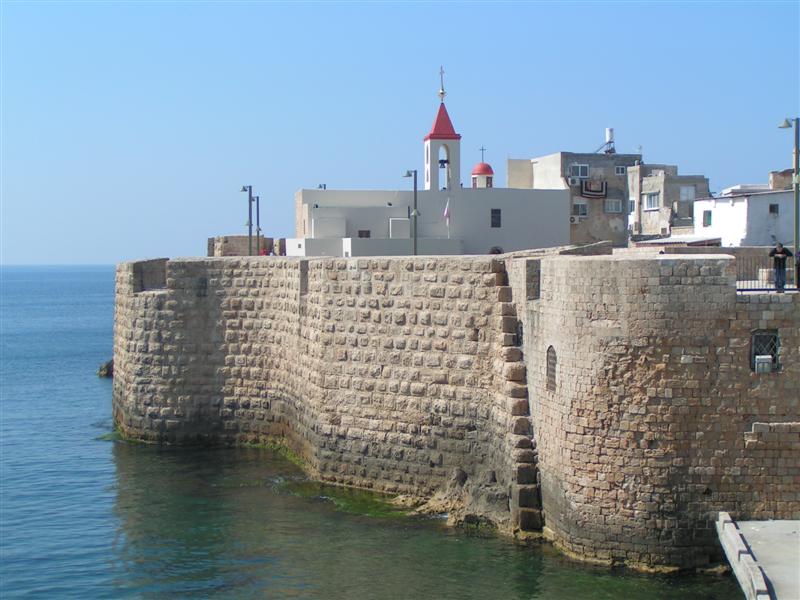
City in Israel
Photo: Arkadi voller, Public domain via Wikimedia Commons
Akko (Hebrew: עכו), also known historically to Arabs as عكّا ('Akka) and Westerners as Acre, lies on the northern edge of the Bay of Acre in northern Israel and receives many Baha'i pilgrims. On its present site, Akko possesses a long history of various cultures: Israelites, Greeks, Romans, Crusaders and Arabs. Akko is the holiest city in the Baha'i Faith and has been recognised as a as a site of extraordinary significance to the world's cultural heritage.
From the travel guide. Select a place for details, a map and what is nearby.
The wall is picturesque and fun to walk along, especially the part bordering the sea. In 1750, Daher El-Omar, the ruler of Acre, utilized the remnants of the Crusader walls as a foundation for his walls. Two gates were set in the wall, the "land gate" in the eastern wall, and the "sea gate" in the southern wall. In 1912 the Acre lighthouse was built on the south-western corner of the walls.
Under the citadel and prison of Acre, archaeological excavations revealed a complex of halls, which was built and used by the Hospitallers Knights. This complex was a part of the Hospitallers' citadel, which was combined in the northern wall of Acre. The complex includes six semi-joined halls, one large hall, a dungeon, a dining room and remains of an ancient Gothic church. Medieval European remains include the Church of Saint George and adjacent houses at the Genovese Square . There were also residential quarters and marketplaces run by merchants from Pisa and Amalfi in Crusader and medieval Acre.
An underground tunnel carved in stone by the Templar Crusaders to connect their fortress on the west side of Akko to the port on the east side. Discovered in 1994, it has been restored and you can walk through it. The location shown on the map here is the western entrance.
No longer active, you can see the remains of a port here. The adjacent area was populated by Pisans during the Crusader area. The remains are not too exciting, but you'll see them as part of a walk along the city wall.
Old Akko has several large khans (an inn enclosing a courtyard, used by caravans for accommodation) which once served the camel caravans bringing in grain from the hinterland. The grandest is the Khan al-Umdan. Its name means 'Inn of the Pillars', and it was built by Al-Jazzar in 1785. The pillars that give the khan its name were looted from the Caesarea ruins. It is a two-story structure and the ground floor would have housed the animals, while their merchant owners would have slept upstairs.
Built in 1795 by Jezzar Pasha, Acre's hammam has a series of hot rooms and a hexagonal steam room with a marble fountain. It was used by the Irgun as a bridge to break into the citadel's prison. The bathhouse kept functioning until 1950. Now it is a museum with a humorous retelling of Akko's history and the bathhouse experience.
Napoleon's Hill
Site of the ancient city of Akko, until the Hellenistic period. Later on, Napoleon used the hill as a lookout point while besieging Akko. Now, there are walking trails around the hill, and it has a nice view in all directions.
The holiest place for the Baha'is; they face towards here for their daily prayers and are buried with their feet pointing here. The Shrine of Bahá'u'lláh is composed of a central room that has a small garden at its centre, which has trees growing in it and there are layers of carpets around the walls. In the right hand corner of the central room there is a small room where Bahá'u'lláh's remains are laid to rest.
A synagogue used by the Ramchal (Rabbi Moshe Chaim Luzzatto, a 1700s kabbalist)
A Tunisian synagogue, a meticulously handcrafted spectacle of stained glass and tile mosaic entirely unique to Akko.
Built in 1781, it is one of the largest mosques in Israel. Jezzar Pasha and his successor Suleiman Pasha are buried in a small graveyard adjacent to the mosque. In a shrine on the second level of the mosque, a single hair from the prophet Mohammed's beard is kept and shown on special ceremonial occasions.
Interesting to walk around here for a few minutes, see the boats, and maybe take one.
An urban market, best known as place to buy fish. The market spreads along Marco Polo, Binyamin Metudela, and Fakhr-al-Din streets.
Around the corner from the Hamman al-Pasha is a gallery devoted to the works of Avshalom Okashi (1916-80), an influential Israeli painter and a resident of Akko for the last half of his life.
Walid's Gate Hostel
Dodgy hostel and owner indeed, but the experience is worthwhile, and very affordable. Backpackers roughing it up will enjoy a roof over their heads for such a low price. Accommodation is provided in a large dorm room with bunk and normal beds. The owner will not give you the price quoted on his website and will pretend the price of US$20 (as of Jan 2017) is actually not written there. Instead he will try to make you believe the higher price on Booking is the valid one. Make sure to agree on a price beforehand or just leave this place again.
A refurbished boutique hotel along the eastern wall of the old city. Uniquely designed rooms with high ceilings and hand made furniture, and eager-to-please innkeepers make it a great upscale option in Akko.
Situated on the coastal stretch of Israel. The Palm Beach is a unique combination of 127 modern rooms and suites with a health and sports club, a spa and superb conference facilities. The panoramic views of Haifa Bay and Akko are spectacular. Akko station is about 1 km from the hotel.
By train
By bus
Nateev Express has a slow (especially at rush hour) Take lines 251/271/272/361 from Haifa (Merkazit Hamifratz - the eastern bus station in Haifa Bay), 361 from Safed, and 500 from Kiryat Shmona.
By taxi
By boat
A foot-passenger ferry plies between Haifa and Akko on four days a week. It sails M Tu W from Akko at 10:00 and 15:00, returning from Haifa at 11:00 and 16:00.
The Old City is very small, and easily walked across. It is also within walking distance of the train and bus stations.
Read in the guideChoose an airport to see hotels, stations, taxi ranks and car rental desks around it.
Haifa · Regional · HFA
Loading places around the airport…
Articles and travel topics about Akko and Israel.
 Itineraries
Marco Polo was a Venetian traveler who went far to the East, following some of the many branches of the Silk Road. He left in 1271 and returned about 1295.
Wikivoyage
 Culture & history
An archaeological site (or archeological site) is any place with physical evidence of past human activity. Such sites might be from pre-history as well as history, and the oldest sites can be considered paleontology.
Wikivoyage
 Culture & history
The Baha'i Faith is an Abrahamic religion that originated in Persia (now called Iran) in the 19th century. It is estimated to have 4-8 million adherents spread around the world.
Wikivoyage
 Travel tips
Crusades were military campaigns sanctioned by the Catholic Church during the Middle Ages, to expand the realm of Christianity or to put down heresies within it.
Wikivoyage
Every section of the guide. Open one to read it in full.