//

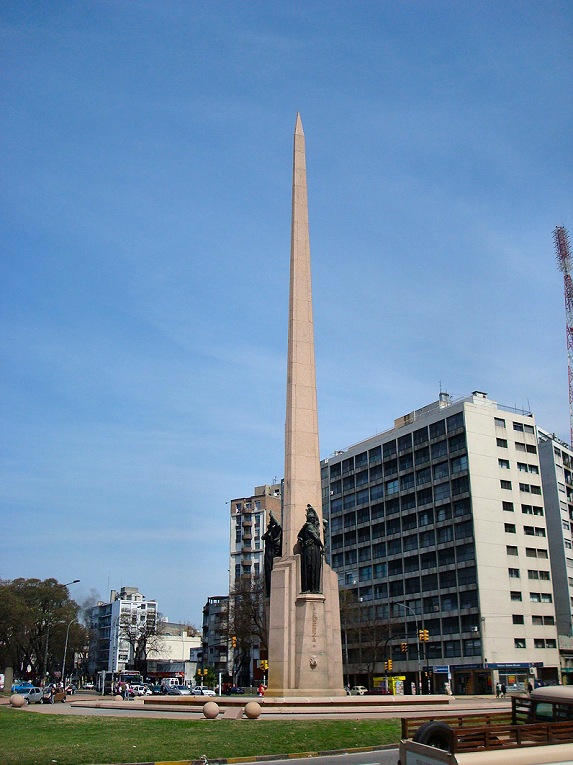
Obelisco a los Constituyentes de 1830
Photo: Hoverfish, CC BY-SA 3.0 via Wikimedia Commons
A 40-m-high obelisk that was built in 1930 to celebrate the 100th anniversary of the first Uruguayan constitution. The three statues next to the obelisk represent "law", "liberty" and "force".
The Obelisk of Montevideo, officially Obelisk to the Constituents of 1830 is a monument created by sculptor José Luis Zorrilla de San Martín (1891-1975). It is a three-sided obelisk made of granite, 40 metres (130 ft) tall with three bronze statues on its sides, representing "Law", "Liberty" and "Force". It has a hexagonal water fountain around it with six spheres on its outer circumference. It is located at the intersection of 18 de Julio and Artigas Boulevard avenues, in Montevideo, at the entrance of the Parque Batlle area. It was built in 1930 to celebrate the 100th anniversary of the first Constitution of Uruguay and is an homage to the participants of the General Assembly of the first Constitution.
© OpenStreetMap contributors
Football museum
It's in the stadium where the first football world championships were held in 1930. You can see old photos, flags, jerseys, posters, trophies, flags and such. You will also get access to the stadium itself (unless there is a game going on).
The Gran Parque Central is the stadium of Club Nacional de Fútbol, and it is the oldest football stadium in the Americas. It was also one of the venues of the 1930 FIFA World Cup. Uruguayan championship matches and international matches are played here. The price of tickets may vary depending on the type of match.
The main park of southern Montevideo, named after the writer José Enrique Rodó and there is also a memorial in the park dedicated to him. The district north of the park is also named Parque Rodó, but the park itself stretches down into Punta Carretas. That part of the park is called Parque de las Instrucciones del Año XIII in homage to the document from 1813 demanding independence for the provinces of east of Rio de la Plata (today's Uruguay) and has a nice little lake. West of Avenida Cachon there is a small hill from which you can get a good view over Montevideo. Parque Rodó also features an amusement park (closed in the Southern Hemisphere winter) as well as outdoor sports facilities and a market on Sundays.
Museo Nacional de Artes Visuales
National museum of modern Uruguayan art, exhibiting paintings. They have a permanent exhibition featuring works of Juan Blanes, Rafael Barradas, Pedro Figari and José Cuneo.
Built in 1930, Uruguayan architect Julio Vilamajó`s house has been fully restored by the local architecture university and functions as a museum. Fine example of early modernist Uruguayan architecture. The house is open just a few times per week; be sure to check beforehand on the museum`s website.
National parliament, the first one in South America and an iconic symbol of Uruguay's long lasting democracy. The building was completed in 1925, inaugurated the same year to celebrate the centenary of the country's declaration of independence. It is a National Historic Landmark and quite impressive as it stands in the middle of a large square. It houses the legislature and the general assembly.