//

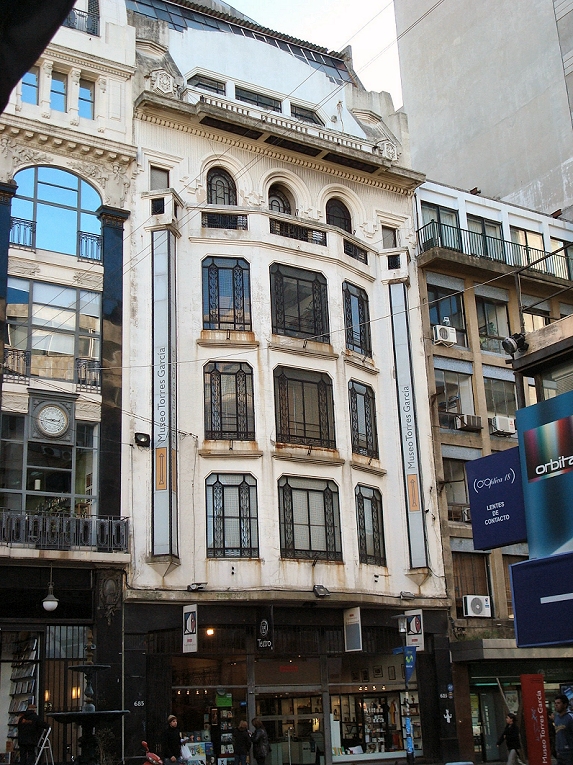
Photo: Hoverfish, CC BY-SA 3.0 via Wikimedia Commons
Displaying works by one of the most prominent Uruguayan artists, the painter and sculptor Joaquín Torres García (1874-1949).
The Museo Torres García is located in the historic Ciudad Vieja of Montevideo where unusual portraits of historical icons and cubist paintings akin to Picasso's paintings, painted by Joaquín Torres García are exhibited. The museum was established by Manolita Piña Torres, the widow of Torres Garcia after his death in 1949 who also set up the García Torres Foundation, a private non-profit organization which organizes the paintings, drawings, original writings, archives, objects and furniture designed by the painter as well as the photographs, magazines and publications related to him.
© OpenStreetMap contributors
Basically, a work of modern art, graffiti painted fences and walls, all at a side alley that should probably be avoided after dusk. It reads "Honouring diversity is honouring life; Montevideo is for the respect of all identities and sexual orientations" and was erected in 2005. It's South America's first monument dedicated to sexual diversity. Other places of interest to gay people include the Edificio Liberaij, where two gay Argentine bank robbers (featured in the 1998 movie Plata Quemada) died in 1965.
A gate to the old town; if you pass through it you're at Sarandí, Montevideo's main pedestrian street. This is one of the few remaining parts of the old city wall.
Glass-framed office building at the western end of the square with a terrifying number of air conditioning units.
This large monument in the Plaza Independencia pays tribute to José Gervasio Artigas, one of the heroes of the Uruguayan Independence. Under the monument is the mausoleum, which is open on the weekends. It contains an urn with his ashes and two honor guards keeping watch.
Cabildo de Montevideo
During the Spanish rule in the early 19th century and the first decades of independence, El Cabildo was the parliament building. Later on various governmental departments were housed there, but since 1959 the building has been a museum, Museo Histórico Municipal, displaying the city governments archives.
The current presidential office, next to the former. The Executive Tower was first planned as a courthouse in the 1960s, the project was halted several times until the house was finalized as the presidential office in 2009.