//

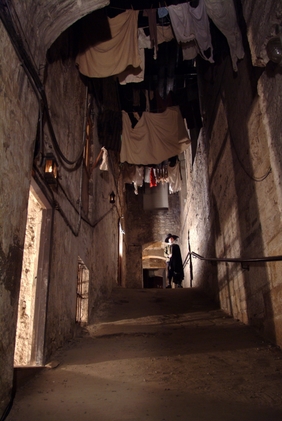
Photo: The Real Mary King's Close at en.wikipedia, Public domain via Wikimedia Commons
Mary King (1590-1644) was a clothes merchant and city burgess. She died the year before plague struck and carried off the rest of her family. In 1753 Royal Exchange, now City Chambers, was built over several closes by demolishing their upper storeys, while the lower storeys were used for storage then later blocked off. This means a warren of medieval alleys and low dwellings has been preserved, re-opened in 2003 and visited by guided tour. Almost as weighty as the Exchange is the mass of ghost stories piled on top of the close, woo-ooh! - but the real history is fascinating enough. Book ahead as it often sells out.
Mary King's Close is a historic close located under the Edinburgh City Chambers building on the Royal Mile, in the historic Old Town area of Edinburgh, Scotland. It took its name from one Mary King, a merchant burgess who resided on the Close in the 17th century. The close was partially demolished and buried due to the building of the Royal Exchange in the year 1753, and later closed to the public for many years. The area became shrouded in myths and urban legends; tales of hauntings and murders abounded. In 1897, Andrew Chesney, the last resident remaining in Mary King's close, was given a compulsory purchase order for £400 and he left the close in 1902.
© OpenStreetMap contributors
It's often called a Cathedral, but the Church of Scotland brooks no such episcopal entity, and Charles I dubbing it "cathedral" in 1633 was one reason his head was chopped off. Safer to call it "High Kirk", though they're nowadays lenient with first time offenders. The present building is from 14th century with much Victorian Gothic, notably its crowned spire. Highlight is the Chapel of the Order of the Thistle, Scotland's chivalric company of royal knights. Services are M-F at noon and 9:30AM and 11AM on Sunday, with choral music at 6PM.
"Haunted House" experience, where you take a 70 min tour through 11 shows and 2 rides loosely based on Scotland's horrible history: William Wallace, Mary King's Ghost, cannibal Sawney Bean, Burke and Hare and more.
Four-floor gallery run by the city council. They rotate artwork from their extensive Scottish collection and have changing exhibitions.
Museum about money and coins, in the basement of the Palladian pile of the former Bank of Scotland headquarters. Scotland developed a banking sector in the 18th century to support long-distance trade, and still prints its own banknotes.
Gallery of contemporary art, refurbished in 2018. From 1936 to the 1970s this was where soft fruit and veg were traded, handy for the trains and delivery vans.