//

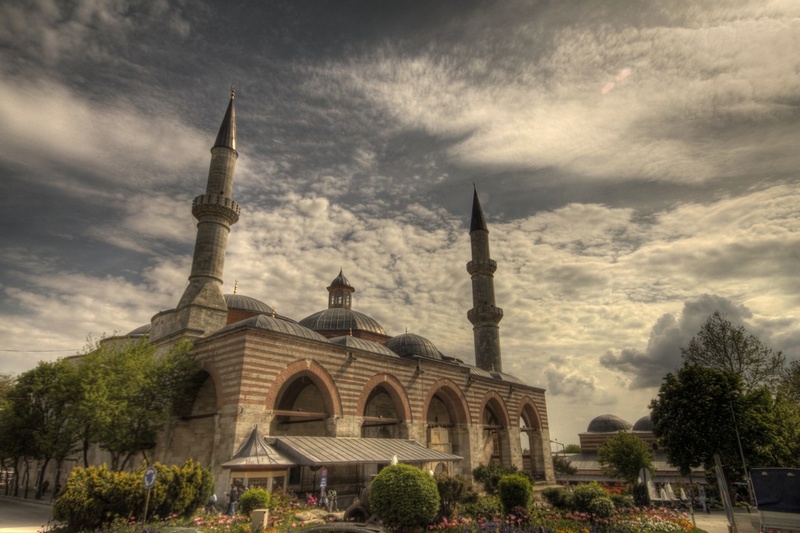
Photo: Özgür ZEYHAN, CC0 via Wikimedia Commons
This was built in the 15th century, so it's the oldest and smallest of the city's three imperial mosques. It's a low building with nine domes and two minarets, with striking calligraphy within.
The Old Mosque, also known as Grand Mosque, is an early 15th-century Ottoman mosque in Edirne, Turkey.
© OpenStreetMap contributors
Rüstempaşa Kervansaray
historic caravansaray with a magnificent courtyard, now a café and hotel
Burmalı (Serpent) Mosque
Mosque built 1438-1447, its name refers to the three balconies or galleries on its tallest minaret. The other three minarets are all of different designs. The mosque interior has a colourfully decorated central dome, surrounded by smaller domes in different colour patterns, supported by stately columns.
Bahai Evi
The 19th century house is a major Baha'i shrine; the religion's founder, Baháʼu'lláh, lived here for four years during his Ottoman exile.
Selimiye Camii
Magnificent mosque that dominates the city skyline, approach from northwest to appreciate the full effect and miss the shops. It's the masterpiece of Mimar Sinan, built 1569-75, and listed as a UNESCO World Heritage Site. The eight pillars supporting the dome are unobtrusive, so the dome hangs over a vast interior space, while 999 windows admit a flood of light. Four delicate fluted minarets soar to 70.89 m, surpassed only by Qutb Minar in Delhi. The interior is decorated with calligraphy and geometrical designs in pink and blue. The inverted tulip decoration, an emblem of Edirne, is said to acknowledge the previous landowner who was reluctant to give up his tulip garden for the mosque to be built.
The original museum from 1924 was part of the mosque complex; it moved here in 1971 as the collection expanded. The museum displays the area's eventful history, majoring on the Thracian period. The gardens have a prehistoric dolmen moved from its original site, a reconstructed ancient Thracian hut, and Roman and Ottoman tombstones.
The great fire of 1905 destroyed its predecessor, so this synagogue was opened in 1909 to serve the large Jewish population. They were mostly Sephardic, descended from those expelled from Spain in 1492 who fled to Ottoman territory. The synagogue is in Moorish Revival style and modeled on the Leopoldstädter Tempel in Vienna. It was abandoned in 1983 and fell derelict as its community left for Israel and elsewhere. It was restored and re-opened in 2015 with a service, but isn't routinely used for worship. There's a small museum within.