//

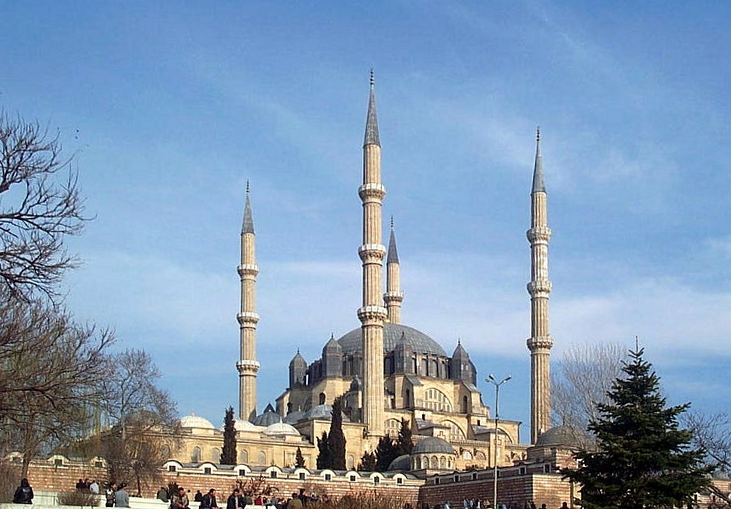
City in Edirne, Turkey
Photo: Nevit Dilmen, CC BY-SA 3.0 via Wikimedia Commons
Edirne (pronounced eh-deer-neh) is the chief city of Eastern Thrace, in the Marmara Region of northwest Turkey. It lies on the gently rolling Thracian plains at the confluence of three rivers, close to the borders with Greece and Bulgaria. Most visitors crossing those borders drive straight on east, or stay on the bus or train, to reach Istanbul. Yet Edirne was for a time the capital of the Ottoman Empire, and continued to be an imperial retreat, adorned with magnificent mosques. It's definitely among the top sights of Turkey.
From the travel guide. Select a place for details, a map and what is nearby.
Selimiye Camii
Magnificent mosque that dominates the city skyline, approach from northwest to appreciate the full effect and miss the shops. It's the masterpiece of Mimar Sinan, built 1569-75, and listed as a UNESCO World Heritage Site. The eight pillars supporting the dome are unobtrusive, so the dome hangs over a vast interior space, while 999 windows admit a flood of light. Four delicate fluted minarets soar to 70.89 m, surpassed only by Qutb Minar in Delhi. The interior is decorated with calligraphy and geometrical designs in pink and blue. The inverted tulip decoration, an emblem of Edirne, is said to acknowledge the previous landowner who was reluctant to give up his tulip garden for the mosque to be built.
Eski Cami
This was built in the 15th century, so it's the oldest and smallest of the city's three imperial mosques. It's a low building with nine domes and two minarets, with striking calligraphy within.
Burmalı (Serpent) Mosque
Mosque built 1438-1447, its name refers to the three balconies or galleries on its tallest minaret. The other three minarets are all of different designs. The mosque interior has a colourfully decorated central dome, surrounded by smaller domes in different colour patterns, supported by stately columns.
This hammam is another masterpiece by Sinan, the Grand Architect. Built in 1568-69, the baths are still open to the public, with (naturally) separate areas for men and women. The building has been well restored but cleanliness and water temperature are erratic, so it's one to "See" not "Do".
The original museum from 1924 was part of the mosque complex; it moved here in 1971 as the collection expanded. The museum displays the area's eventful history, majoring on the Thracian period. The gardens have a prehistoric dolmen moved from its original site, a reconstructed ancient Thracian hut, and Roman and Ottoman tombstones.
İslam Eserleri Müzesi
This was the original Edirne museum, in a madrassah of the mosque. The main collection moved across the street in 1971 leaving this branch, separately ticketed. You enter past a statue of Sinan the Architect. Lots of calligraphy and other fine arts and crafts.
The great fire of 1905 destroyed its predecessor, so this synagogue was opened in 1909 to serve the large Jewish population. They were mostly Sephardic, descended from those expelled from Spain in 1492 who fled to Ottoman territory. The synagogue is in Moorish Revival style and modeled on the Leopoldstädter Tempel in Vienna. It was abandoned in 1983 and fell derelict as its community left for Israel and elsewhere. It was restored and re-opened in 2015 with a service, but isn't routinely used for worship. There's a small museum within.
Monument to Rüştü Pasha, the commander defending the city during the Balkan Wars of 1913. The small museum adjacent is closed indefinitely "for restoration".
Muradiye Camii
This was built 1435 / 36 as part of a Mevlevi dervish complex but later became a stand-alone mosque. It has beautiful tile work, especially in the mihrab, probably by the "Masters of Tabriz" who decorated the mosque in Bursa and later the Üç Şerefeli mosque in Edirne. Some of the wall decoration has been whitewashed over, and the building has needed multiple repairs after earthquakes: the minaret was rebuilt in 1957. It's in a grubby neighbourhood where children pester for baksheesh.
Св. св. Константин и Елена
Bulgarian Orthodox church built in 1869.
Sv Georgi Bulgar Kilisesi
Bulgarian Orthodox church on a basilica pattern, opened in 1880 and still in use. Usually locked except for services but the caretaker might let you in. Ask also to see the upstairs museum, and (if he seems amenable) to climb the bell tower.
Bahai Evi
The 19th century house is a major Baha'i shrine; the religion's founder, Baháʼu'lláh, lived here for four years during his Ottoman exile.
Tunca köprüsü
a historic stone bridge across the river Tunca
Meriç köprüsü
historic stone bridge across the river Meriç, with some restaurants (also with outdoor seating and river view) on both sides
Rüstempaşa Kervansaray
historic caravansaray with a magnificent courtyard, now a café and hotel
on the island is an arena for oil-wrestling, with statues of past champions.
(Adalet Kasrı) by Fatih Bridge is a sturdy square tower, the last intact remnant of the palace.
and cemetery are 100 m right / east as you come off Fatih Bridge. Some 30,000 soldiers are interred here, who fell in the 1913 siege of Edirne.
north of the bridge is just scraps. It was built 1450-1475 and (you'll have to use your imagination) the seat of power of the Ottoman Empire. Even when the capital moved to Constantinople it was still a grand summer retreat and hunting lodge. But from 1718 it suffered neglect, earthquake, fire, military occupation, and finally in 1878 an ammunition depot was deliberately blown up to prevent capture. The kitchens have been restored. It's intended to build a conference hall around the Panorama Pavilion, which would be a total ersatz re-construction, and since 2018 the area has been closed off. You see enough from the street.
downstream is another bridge and causeway link from downtown.
is reached from Sarayiçi by following the road west 1 km, and from downtown by going northwest on Horozlu Bayır Sk onto the causeway (light traffic only) over another river island. The Health Museum is the only reason to linger here.
Sağlık Müzesi
This complex was founded by Sultan Bayezid II in 1484. As well as the hospital there was a medical school, mosque, guesthouse, almshouse and Turkish baths. Initially it was a general medical and surgical hospital but it came to specialise in mental health. It followed enlightened holistic methods before these were taken up in the west: instead of locking patients into cells with shackles, they used meditative music, fragrances and flower gardens. It's been incorporated into Trakya University, and the museum displays miniatures from Ottoman medical textbooks and models of patients.
is on the highway to Kapıkule, so from downtown simply follow D100 west. It was built in the 13th century and extended and rebuilt in later centuries. What you see now is a 19th century re-build, pedestrian-only, with D-100 on a modern bridge alongside. Gazi Mihal Mosque is on the west bank.
Hıdır Baba
A vast hilltop redoubt and fortress built from 1829 against Russian attack, though its finest hour was in the Balkan Wars of 1913. It had little value against 20th century weaponry and fell derelict. Restoration has been under way since 2011, with no end in sight, so the fortress remains fenced off, though you can still access Hıdır Baba park.
is a bosky park along the west riverbank, a popular weekend picnic spot.
is not where you'd expect to find the city's main railway station. But the first railway from Istanbul to Europe ran further south then wound up the Maritsa Valley, looped into the station at Karaağaç then continued up the valley towards Bulgaria. Once the Treaty of Lausanne defined the river as the border, trains (such as the Orient Express) had to enter Greece twice in transit between Turkey and Bulgaria. Not until the 1970s a new track was laid, leaving this place cut off; it became part of the university in 1998. By the old station is a small museum, a wooded park and sculpture garden, and a monument to the Treaty.
Popular fried liver restaurant, clean and friendly.
Smart efficient place for meatballs and liver.
Good central place serving meatballs and liver.
Clean modern place in the grubby town centre. Some street noise, secure parking.
Clean modern hotel a short way east of centre.
Big block of a place, rooms have air-con, satellite TV, cleaning erratic.
Clean central place, rooms have a/c, satellite TV, hot water, and free wifi.
Basic, usually clean, small rooms en suite with air-con, satellite TV, and Wi-Fi.
By bus
Buses run from Istanbul Esenler station at least hourly, taking 2 to 4 hours non-stop, for a fare of 75 TL. Metro Turizm is the main operator.
By train
As of late 2026, high-speed trains runs twice daily as far east as Çerkezköy where a change to conventional trains into Istanbul is required.
By road
The city is on the main highways between Turkey and Europe, the toll-free D100 and toll-motorway O-3 / E80. Istanbul is 224 km east, say two hours.
The centre is compact, fairly flat and walkable. The outlying districts are within a long walk, but you might prefer to take a taxi or dolmuş at least one way.
Read in the guideChoose an airport to see hotels, stations, taxi ranks and car rental desks around it.
Alexandroupolis · Regional · AXD
Loading places around the airport…
Articles and travel topics about Edirne and Türkiye.
 Travel tips
Is it safe to travel to Turkey right now? Compare safety in Istanbul, Cappadocia, and Antalya with official travel advisories, taxi tips, and scam advice.
7 min read
 Travel tips
Master public transport with our Istanbul transit and historic peninsula guide, covering the Istanbulkart, Bosphorus ferries and Hagia Sophia rules.
6 min read
 Inspiration
Our Cappadocia hot air balloon booking guide covers flight costs, seasonal weather rules, cancellations, sunrise viewpoints and safety advice.
6 min read
 Itineraries
Our Turkish Riviera Turquoise Coast guide covers gulet cruising, Lycian rock tombs, sunken cities in Kekova and coastal travel from Fethiye to Antalya.
6 min read
Every section of the guide. Open one to read it in full.