//

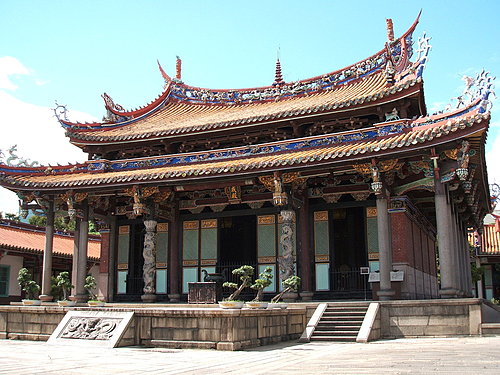
District in Taipei, Taiwan
Photo: User: (WT-shared) Trcheng at wts wikivoyage, CC BY-SA 1.0 via Wikimedia Commons
If you want to feel the real heartbeat of Taipei, one that is far removed from the skyscrapers and shopping malls of East Taipei, then Datong (大同區) and Wanhua (萬華區) in West Taipei are the places to go.
From the travel guide. Select a place for details, a map and what is nearby.
龍山寺
This temple is where countless generations of Taipei citizens have come to pray and seek guidance at times of trouble. As the temple is dedicated to Guanyin (the Buddhist representation of compassion) it is officially defined as Buddhist, but there is a great amount of folk religion mixed into the fabric of the beliefs at this temple.
紅樓劇場
Near the Ximending shopping area, the Red House was Taiwan's first modern market as well as a theater. Now, the renovated structure is home to an exhibition hall and a market selling innovative handicrafts.
北門
Of the five ancient city gates, four are still standing. But of the four, only one is a true historical relic from the Qing Dynasty: the salmon-colored north gate, whose formal name in Cheng'en Gate (承恩門). It was built in a traditional South Fujian architectural style. Its external walls were built with granolithic and brown mosaic tiles from Beitou Kiln.
剝皮寮歷史街區
One of the few, and probably best preserved, examples of Qing dynasty architecture in Taipei. The street features historic red brick buildings which have been well restored and are used for a variety of cultural purposes.
Displays some archeological remains from the Qing Dynasty. Arguably not worth a detour, but keep your eyes peeled when changing trains.
華西街夜市
This area had long been Taipei's most notorious red-light district, filled with brothels, pornography shops and snake meat restaurants in which the snakes would be killed and skinned in the street to attract potential customers. However, prostitution was banned by the Taiwanese government 1991 and the area has been thoroughly gentrified, with the last snake meat restaurant closing down in 2018. Today, it is just a regular family-friendly night market with the usual Taiwanese street food.
台灣基督長老教會大稻埕教會
The architectural design of this church represents a fusion between traditional Chinese and late 19th-century Western style architecture. It maintains a unique position in the modern architecture of Taiwan, being one of only three extant Presbyterian churches in Taipei built during the Japanese occupation period. Historically, men would enter and exit through the left door, and women would enter and exit through the right door.
貴德街
Previously called Western Houses Street, this lane once fronted the Danshui River. In the 1880s, the world famous Formosa Oolong Tea came from a nearby wharf. At the time, many wealthy merchants invested in building along the lane in order to attract international trading firms. One was Chen Tian-lai (AD 1872-1939), a Taiwanese tea merchant, who was fabulously rich for his time. His home was one of the model Taiwanese residences on this land and his neo-Baroque home is still standing. (No.73 Gui-De Street)
台北當代藝術館
MOCA Taipei is Taiwan's first art space dedicated to contemporary work. The red brick building was erected by the Japanese in 1921 and formerly served as Taipei City Hall as well as an elemantary school.
新芳春茶行
A former tea factory and storefront built in 1934 with blended east-west architecture, now a museum on the history of Taipei tea markets and Taiwanese tea production. The upstairs cafe offers introductory tea tastings.
阿嬤家-和平與女性人權館
The museum is dedicated to the comfort women during the Japanese rule of Taiwan.
大龍峒保安宮
Construction began on this temple in 1805 and was completed 25 years later. Baoan is a Taoist temple and one of the leading religious sites in Taipei. The temple's main deity is the emperor Baosheng, the god of medicine. The mural paintings and sculptures that adorn the building are considered some of the most impressive in Taiwan, and the temple won acclaim in the 2003 UNESCO Asia-Pacific Heritage Awards.
臺北孔廟
Just next to Bao'an Temple, the Confucius Temple was built in 1879 when the Qing Court changed Taipei into a prefecture of the Province of Fujian, China. It was established to serve as the largest educational center in northern Taiwan. Every September 28, a large number of people from Taiwan and abroad come here to watch a solemn Confucius birthday ceremony and eight-row dance.
陳德星堂
An ancestral shrine built in 1892
法主公廟
A 5-storey temple building built in 1878.
霞海城隍廟
This historic Taoist temple was built in 1859 to worship Xiahai, the City God (城隍爺), who watched over the citizens in the district and decided a person's fate after death. It might be small, with an area of only about 46 square meters, but it one of Taipei's most important places of worship, and is the area's religious and social center. In addition to Xiahai, this temple is dedicated to 600 gods, including his wife, the old man under the moon, the Eight Officials, civil and military judges, General Fan Xie (seven masters and eight masters), the Eight Generals, Ma Shiye and Yiyong Gong.
馬場町紀念公園
The park features an artificial mound on the approximate site where a number of people were executed during the period of marshal law. The park is dedicated to those who lost their lives during this period.
阿宗麵線
You can't miss this shop in Ximending, since crowds of people surround it all day. Standing or sitting, they slurp down hot bowls of mee soa, which are a comfort on cold days. Not quite for the faint-hearted, thin noodles are mixed with a flavorful soup, created from prolonged braising of the (thoroughly washed) large intestines of the pig. Don't forget to add the condiments provided at the side: the vinegar and minced garlic packs a punch. Other branches can be found in Shilin Night Market and Zhongxiao Fuxing.
加爾各答印度咖哩屋
Basement Level of the Wannian Shopping Complex, Ximending - One of the more popular Indian restaurants. A bit hard to find, but definitely worth it.
橋頭壽司
A traditional Taiwanese-style sushi establishment. Although the environs are rather average, the location is rather spacious. NT$25 will get you a big bowl of miso soup with tofu, which goes well with a serving of cold sushi. The sashimi sushi is also worth trying for NT$140, also with decent portion sizes.
A small number of vegetarian meals set a Nt$99. Homemade sauces. Simple and clean interior. Fast service.
美觀園
Located in Ximending Pedestrian Area. This restaurant has served authentic Japanese sushi and sashimi since 1946. (There's another restaurant opposite the road from this with exactly the same name - that's the old location of this restaurant and doesn't serve as good sushi.)
蜂大咖啡
柳隅茶舍
An unpretentious and cozy tea house. Excellent selection of teas. Owner speaks fluent English.
Hang out place for artists. A quiet space among the neon and bustle of the area. Cozy interior with lots of plants. Tasty, simple meals. Excellent coffee.
背包棧旅店
Clean. Cafe style communal area. Private and dorm rooms.
Modern hostel with an industrial vibe. Stylish communal area. Single, twin, and dorm rooms. Two minute walk from Ximen metro station.
Ximen Wow Hostel
Dorms and private rooms. Compacted, but comfortable spaces. Clean and well-maintained communal area.
西悠飯店臺北店
Next to the Ningxia Night Market, this hotel is a stone's throw away from the Shuanglian MRT station, and is geared towards both business and leisure travelers.
福君海悅大飯店
Good location and staff. Convenient to transportation, shopping, and dining.
藝宿商旅
Near the Ningxia Night Market. Rooms and bathrooms are rather small, though.
君品酒店
5-star top-notch accommodation, offering a comfortable and aesthetic environment as well as personalized, attentive services.
永樂布業商場
Established in 1928 by the Japanese, this market originally sold food, but over time it evolved into a cloth market. Today, this market contains over 100 different cloth shops selling all kinds of fabrics and cloth wares.
紅樓
The Red House is both a teahouse and a venue for small-scale theater productions. The two-story high red brick building is shaped into an octagonal cylinder. The first and second floors of the Red House now are the art exhibition, restaurants, cafes, shops, and theaters. During weekends, the outside of the Red House become somewhat of a bazaar, where several booths are set up for college students, young designers, or young musicians to show their talents and sell their creative products.
寧夏夜市
Crowded, narrow, and busy with customers including lots of tourists—Ningxia Night Market is one of the oldest night markets in Taipei, and specializes in Taiwanese snack foods, like stinky tofu and oyster and egg omelets. Most stalls have English signs as well as Chinese. Try the taro balls!
Snake Alley Night Market
Serving local snacks, and restaurants that serve traditional Taiwanese dishes and many delicacies including snake blood and meat, turtle blood and meat. Many Taiwanese have a negative view of Snake Alley, which was once a legal red-light district.
延三夜市
Small market serving traditional Taiwanese cuisine and not a tourist hot-spot like many other markets. Get the taste of sticky tofu, fried noodles and mochi ice here.
大龍街夜市
The proximity to the Confucius Temple makes it a nice stop to pick up a snack or eat at one of the old restaurants.
The area can be accessed on the green MRT line via Beimen (北門); the green and red lines via Zhongshan (中山); and the green and blue lines via Ximen (西門).
Read in the guideChoose an airport to see hotels, stations, taxi ranks and car rental desks around it.
Taipei (Songshan) · International · TSA
Loading places around the airport…
Articles and travel topics about Old Taipei and Taiwan.
 Travel tips
Full 2026 list of visa-free countries for Philippine passport holders. Check ASEAN entry rules, stay limits, and Bureau of Immigration clearance tips.
6 min read

 Itineraries
Plan your 7-day Taiwan itinerary from Taipei to Kaohsiung for 2026. High-speed rail tips, night markets, Sun Moon Lake, and realistic travel costs.
7 min read
 Inspiration
Celebrate Chinese New Year 2027 with festival dates, temple blessings, lantern displays, and top party spots across Singapore, Penang, and Taipei.
7 min read
 Culture & history
Prior to large-scale Han Chinese settlement during the Qing Dynasty, Taiwan was primarily inhabited by various Austronesian peoples.
Wikivoyage
Every section of the guide. Open one to read it in full.