//

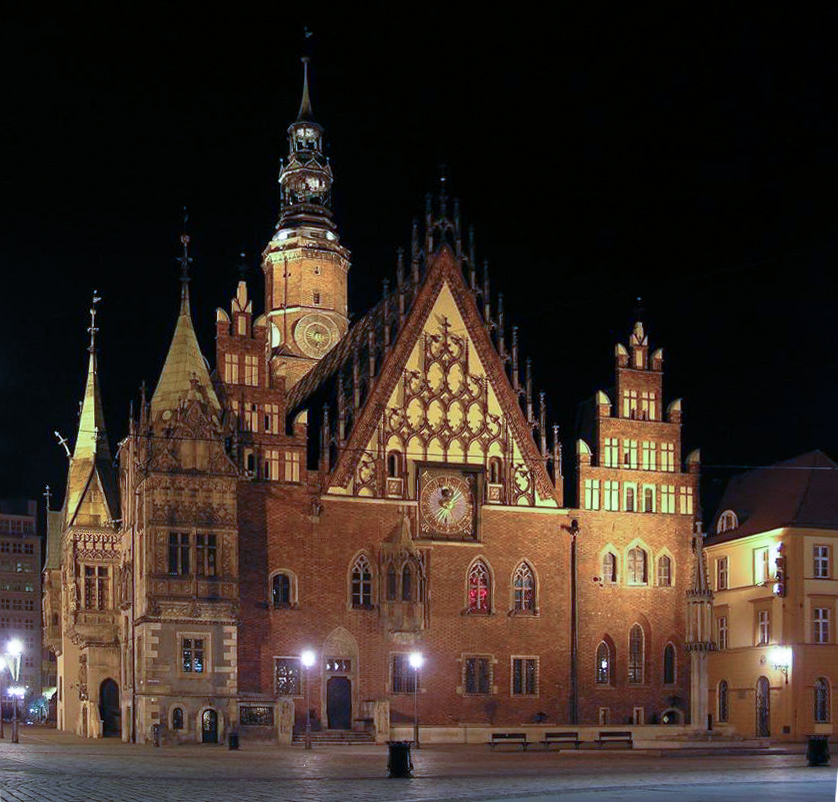
Historical capital and largest city of Silesia, located in southwestern Poland
Photo: No machine-readable author provided. Vorwerk assumed (based on copyright claims)., Public domain via Wikimedia Commons
Wrocław (pronounced v-ROTS-wahf; also known as Breslau, its German name, and English name until 1945) is the largest city in Lower Silesia in Poland. It is home to 674,000 people within the city limits (2022) and the metropolitan area has a population of 1.3 million making it the largest city in Western Poland.
From the travel guide. Select a place for details, a map and what is nearby.
Rynek
It is the architectural centre-point of Wroclaw, and its most obvious attraction. It is one of the biggest town squares in Europe, and is lined on all sides with photogenic and interesting buildings. Centre of tourist life, place where tourists drink beer.
Stary Ratusz
It now serves as the Museum of Burgeois Art. Construction of the town hall began in the 13th century. It was one of the few major buildings in Wrocław to survive World War II. The interior features stunning Gothic interiors.
Plac Solny
Formerly a salt market, now a flower market.
Ostrów Tumski
A group of islands on the Oder River with beautiful cathedrals and a few hundred year old buildings, for those who would have romantic evening, walking through mystery brick stoned streets it is a must. It is complete with hand-lit oil lamps lit nightly.
Archikatedra św. Jana Chrzciciela
Dating from the 13th century, featuring stunning architecture and the largest church organ in Poland. Has elevator to the top, so this is the one to go to if you can't climb. Good river views from the tower.
Bazylika św. Elżbiety Węgierskiej
A large and imposing medieval building with a 90m high tower with spectacular views over the old town.
Katedra św. Marii Magdaleny
The big church a block south of the Rynek, you can also climb this tower for 5 zł. Between the two towers, there is a small bridge known as the Pennants' Bridge, where you can walk along and enjoy the cityrama. Views are great, but if you can only do one, St Elizabeth is probably the one to do. However, the bridge makes a good story to tell people at home.
19th-century synagogue.
Wrocławskie Krasnale
The first dwarf statue was installed in 2001 in Świdnicka Street to commemorate the Polish anti-communist underground movement Orange Alternative, whose symbol was a dwarf. Some years later smaller dwarf statues, each with their own theme, appeared and they can now be found all over the city.
Ogród Botaniczny Uniwersytetu Wrocławskiego
Pomnik Anonimowego Przechodnia
An impressive artwork by Jerzy Kalina, this sculpture which has two parts, each to one side of Świdnicka, shows people going underground or coming from underground (depending on the side of the street you are at). The artwork builds on Kalina's 1977 installation "Transition" and was inaugurated in 2005. It likely makes reference to the martial law period in Poland and symbolizes people coming back to the public after being underground. The sculpture led to discussions and has been recognized internationally.
Hala Stulecia
A historic building, constructed according to the plans of architect Max Berg from 1911 to 1913, when the city was part of the German Empire. As an early landmark of reinforced concrete architecture, it was listed as a UNESCO World Heritage Site in 2006.
A multimedia fountain located within the Pergola next to Centennial Hall in Wrocław. The one hectare fountain incorporates about 300 jets to create a screen of water for animation display. There are also 800 lights. When frozen in winter, the fountain is a 4700-square-meter ice skating rink.
A distinctive object placed close to the Centennial Hall.
Very large, spanning over a few kilometres, it's a common place for walks. Becomes incredibly colorful in autumn and should not be missed if you travel there in late September or October.
Ogród Japoński
A remainder from the 'World Expo' of 1913 held in Wrocław, this is a large landscaped garden restored post-flooding with the assistance of the Japanese government. A part of Park Szczytnicki.
pl: Park Wschodni
On the bank of Oława river is a masterpiece of design, but left forgotten for decades. After few years of restoration it's now a true gem especially worth visiting in April when wetland flowers are blooming or autumn when vegetation turns into picturesque blend of reds, yellows and gold. As it borders semi-wild forests and has plenty of water, you may even watch swans taking care of their nests just few meters from the walking path.
Ogród Zoologiczny
Oldest zoo in Poland, having been opened in 1865 as the Breslau Zoological Garden while the city was part of Prussia. It is also the largest (in terms of the number of animals) zoo in Poland.
Wieża ciśnień przy alei Wiśniowej
A 63-m-high water tower constructed between 1904-1905 with an observation deck at 42 m. Provided water supply until mid-1980. In 1995 it was restored and converted into a restaurant. The tower has not been open to the public since 2017.
Perhaps the most-visited tourist site in Wrocław, it consists of a large canvas painting wrapped around a viewing rotunda. It creates a 360-degree view of the Battle of Racławice (1794) between Russian troops and Polish insurrectionists. The battle was a victory for the Poles, however the Russians won the war. Visits are conducted in tour groups roughly every half-hour and foreign-language audio guides are available. The ticket also allows entry to the National Museum, Ethnographic Museum and Museum of Comptemporary Arts.
Muzeum Narodowe we Wrocławiu
Features a large collection of Polish art. The Gallery of Contemporary Art is in the attic.
Muzeum Etnograficzne
Located in the former summer Palace of Wrocław Bishops. Collection concentrates on folk art.
The Four Domes Pavilion (Pawilon Czterech Kopuł) which is part of the historic Exhibition Grounds houses the collection of Polish contemporary art of the National Museum, which comprises works from 1945 until present.
Muzeum Sztuki Mieszczańskej
Muzeum Archeologiczne
Collection of mostly prehistoric artifacts.
Muzeum Militariów
Military exhibits from 19th and 20th century.
Muzeum Historyczne
Located in the Royal Palace of Hohenzollern dynasty of Prussia. Museum collection is named '1000 years of Wrocław' which hint at type of exhibits you can find here.
Muzeum Sztuki Medalierskiej
Muzeum Sztuki Cmentarnej
The Old Jewish Cemetery (Stary Cmentarz Żydowski). In Jun-Aug on Sundays at 10:00 guide is available already covered in ticket price.
Muzeum Współczesne Wrocław, MWW
Contemporary art, photography, also a club and a cafeteria with nice views.
Muzeum Architektury
Museum is located in a 15th-century post-Bernardine Gothic buildings - St Bernardine of Sienna Church and a monastic quadrangle with a garden.
Muzeum Uniwersytetu Wrocławskiego
The four halls are: Aula Leopoldina, Oratorium Marianum, Mathematical Tower (Wieża matematyczna) and Exposition (Wystawa). The first two are still used by the university for events (so they can be closed at times). Audio guides are available.
Muzeum Przyrodnicze
The museum is part of Wrocław University and has its origin in 1814. The collections display many specimens of extinct and rare species including the skeleton of a Blue Whale, the largest animal that lived on the earth.
Two additional stages are located at ul. Świdnicka 28 (Small Stage) and plac Orląt Lwowskich 20c (Świebodzki Train Station Stage).
Contemporary Theatre
Different kinds of concerts: symphonic, choral, early music, jazz, popular music.
Wroclaw Food Tour is an easy and enjoyable way to discover traditional Polish food in authentic locales alongside with other food lovers from all over the world. It is not just about eating food, but also touching upon Polish culture by finding out about the many intriguing facts concerning Polish cuisine under the guidance of an English-speaking food expert.
Kino Nowe Horyzonty
The largest arthouse cinema in Poland.
Annual event in May.
The largest beer festival in Poland and one of the largest in Europe. In June.
Nowe Horyzonty
International Film Festival. Ten days of films, concerts and exhibitions. End of July.
International Theatre Festival. October.
Oratorio and cantata music in Wroclaw's historical venues. September.
Mammoth installation inside "Park Mamuta".
a zipline and big spiderweb rope construction.
water sandbox with an Archimedes' screw, hand water pump, tiny gates and channels. Not far from water museum Hydropolis (which is paid).
Podwórko talentów Nivea
Playground with a big xylophone and a small scene.
Offers an ample and diversified menu, including meat-based dishes. Students, staff and professors of the University of Wrocław usually eat there, together with homeless people, elderly and pensioners. After entering go to the cash desk (at the left corner) and order your meal (Polish only). Turn right, go to the food counter and hand your receipt to the person serving the meals.
Restaurant inspired by prewar Warsaw. The atmosphere and decor of the place takes you to another dimension.
Delicious vegan falafels, beautiful wraps and lovely service. The falafel is fresh, yummy, flavorful and filling. Small cosy place.
Very big variety of pizzas including some rare yet delicious combinations. You can order some additional sauce to make it even tastier. Fast, attentive and kindly service.
According to many Wroclavians, the best pierogi in Wrocław. Try pierogi ruskie (with potatoes and cottage cheese) with kefir and barszcz (borscht) and "nalesniki" (crêpes) to experience what real Polish food ought to taste like. The place is small and basic, you may need to wait for a seat, but the food is top-notch.
A French bakery/cafe with delicious breakfast dishes (served all day) and other food.
A place serving authentic thin-slice Italian pizza from a proper, scorching-hot wood oven. About 15 zł for a pizza for one person. Italian owners.
Inexpensive restaurant with pizza and a variety of other dishes.
Egyptian restaurant. Kitschy interior and big portions.
A budding franchise originating from Kraków, serves Georgian food (khachapuri). Try lawasz z adżapsandałem (dough-filled with a tasty mix of tomatoes, bell peppers, aubergines, garlic and goat cheese) for about 15 zł.
As long as you are willing to eat a somewhat modified version of Mexican cuisine, you should enjoy the large, rich portions at Mexico Bar. You might want to order the "hot" (na ostro) version of your dish, as the regular dishes are surprisingly mild. This is a small, popular place, so you may have to wait for your seat at the bar. It is best to call ahead and make reservations especially on the weekends.
An Indian restaurant. The restaurant is air conditioned, has a seating capacity of 110 and is child friendly. The cuisine is Indian keeping European tastes in mind. The Xpress Lunch combo is a favourite and very reasonably priced with a free soft drink. The main menu has a wide variety of dishes to choose from including soups, salads, starters, Tandoori Grill, special Indian curries, fragrant basmati rice and Indian bread (naan). The bar at the restaurant specializes in a wide variety of eye-catching cocktails and mocktails.
French restaurant in Wrocław
Small place, genuine French cuisine, good for dates.
Offers good meals and a good selection of salads.
Organic-based pizza and pasta dishes. Reservations are necessary, but can be made a day in advance through their website.
pronounced 'Mletcharnya'
A bit further from the Town Square but still not too far, near the main courthouse in a quiet street - quite a large pub occupying the basement and ground level of an old fin-de-siecle building. It has unique dark, cozy, wooden interiors and a specific atmosphere. Music played is quite specific and varied - among the styles played are: Jewish music, jazz, progressive rock, film music and others. There are often some cultural events, like discussion clubs or film projections taking place in the basement. They also have a hostel in that same building.
Insomnia
Concerts, film screenings. Popular place.
Supposedly Communist style, well - kitschy. But open 24/7 with cheap alcohol (4 zł for a glass of beer or shot of vodka) and good meals.
See how to brew beer and how delicious it tastes.
100 Bridges Brewery
A micro-brewery and pub that opened in 2014.
Craft beer (including local ones) and food.
Cheap, comfortable accommodation in the centre of town. 19 and very spacious but cosy private rooms (for 1, 2, 3 or 4 people), and dorms (8 or 10).
Formerly called The Stranger Hostel
Just around the corner from the train station. Sheets, lockers and Internet are provided. There is a media lounge where you can watch DVD movies and play video games.
Hotel Tumski Wrocław/Na Wyspie
Newly refurbished hostel located directly opposite the town hall. Both dorms and private rooms are available. Lockers included in price, shared kitchen and bathroom.
Treading the line between hostel and cheap hotel, "U Szermierzy" has 1-, 2-, 3-, and 4-bed rooms, the more expensive ones equipped with en suites and televisions. Dilapidated but clean, and less than 1 km from the Old Town Market. Free parking available, enter via ul. Generała Romualda Traugutta, 150m east of the intersection with ul. Zygmunta Krasińskiego. Free Wi-Fi internet access.
Four-star hotel located in the heart of the city, near a beautiful Market Square. There is also a fitness centre with bodybuilding gym, sauna, Jacuzzi and swimming pool.
Is one of the newest hotels in Wroclaw, conveniently situated close to the city centre but at the same time not far from major roads, (E67 8 Wrocław - Warsaw, and E261 5 Wrocław - Poznań).
The first hotel in Poland managed by the most popular Scandinavian hotel chain, it is in the centre of Wrocław, close to the Old Town and to the railway station, easily accessible from the A4 highway.
Room prices are generally around 250 zł for a single room and 400 zł for a double room. The hotel is next door to the restored opera house.
50 metres from the Rynek Główny.
A bit farther from the Old Town, but right in front of the Panorama of Racławice.
Maps, guidebooks, travel books.
Large shopping mall, with a big supermarket in the basement floor. Free Wi-Fi.
Bookshop/cafe with a good selection of English-language books and good coffee.
Hala Targowa
For fresh vegetables, fruits, pierogi, etc.
By train
Wrocław is a major hub on the Polish rail network, with several trains a day to all large Polish cities (route planner).
By bus
All international and national buses stop at the PKS Centrum station which is located directly behind the main train station (timetable; click "Odjazdy autobusów z Dworca Centralnego PKS").
By bus or tram
Details on how to travel around Wrocław and ticket types and prices. You can also use the journey planner.
By taxi
By bicycle
Between April and November you can rent bicycles at about 70 locations throughout the city with the Wroclaw City Bike (Wrocławski Rower Miejski, WRM) system which is operated by Nextbike Polska on…
Choose an airport to see hotels, stations, taxi ranks and car rental desks around it.
Wrocław · International · WRO
Loading places around the airport…
Articles and travel topics about Wrocław and Poland.
Every section of the guide. Open one to read it in full.



