//

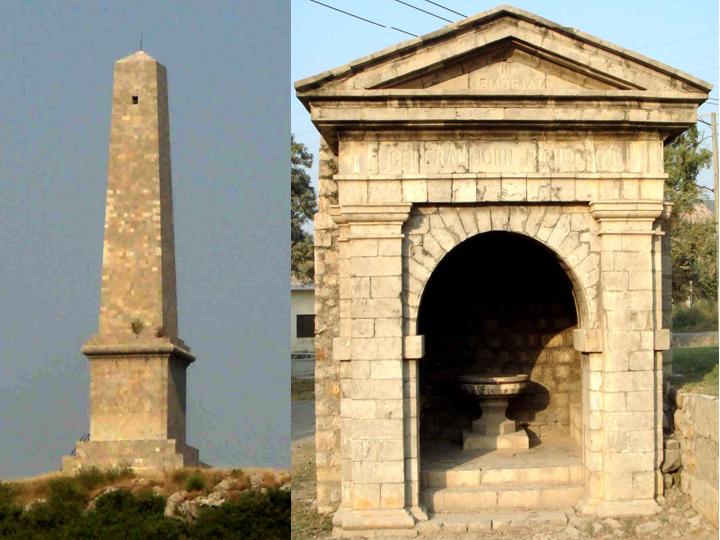
Photo: Tahir Wadood Malik, CC BY 3.0 via Wikimedia Commons
Captain John Nicholson, from Ireland, was one of the most colourful characters of the East India Company's army in Victoria's time, a decorated officer and an effective administrator, but also a bit of a madman. He hunted tigers armed with only a sword and personally went after one bandit chief, cut off his head, and kept it on his desk for months as a warning to others. At one point he learned of a plot to poison the British officers, hanged all the cooks, then calmly proceeded to dinner.
During the Mutiny of 1857 Nicholson planned a bold attack on Delhi, and bullied the aged and conservative General in charge into approving it. He was shot while leading the attack and died a few days later, aged 35, but the British took Delhi and ended the mutiny.
The British considered him a major hero, and some of the natives (much to his dismay) treated him as a rather odd sort of saint, creating a cult of "Nikal Seyn" which lasted well into the 20th century. His tomb is in Delhi and there are statues in both Delhi and Ireland, but this monument is on the frontier where he spent most of his career.
Nicholson's Obelisk, also known as Nicholson's Memorial, is an obelisk located in Rawalpindi District, Punjab, Pakistan, which was erected in 1868 in the honour of Brigadier-General John Nicholson. It is situated at the Margalla Pass of the Margalla Hills close to the twin cities of Rawalpindi–Islamabad, en route to the historical town of Taxila.
© OpenStreetMap contributors
Consists of some stupas and monastic cells as well as a few caves.
The mound of Sarai Kala has evidence of the earliest prehistoric settlement, in the Mesolithic period, and also later Bronze age and Iron age settlements. It preserves Neolithic remains going back to 3360 BC and Early Harappan (Indus Valley Civilisation) remains of 2900-2600 BC.
is an archaeological site which was once a major city founded around the 6th century BC, the oldest ruins of a city at Taxila. The oldest part of ruins, from the 5th and 6th centuries BCE, are believed to be the remains of Persian/Achaemenid Taxila. Later ruins are from the 4th century BCE, after the invasion of Alexander the Great, and the 3rd, during the time of the Maurya kings of India. There are also some ruins from after the Mauryan period.
Limited excavation shows marks of a monastery foundation.
ٹیکسلا میوزیم
This century old museum is dedicated solely to the remains of the Gandhara civilisation. It has an extensive and impressive collection of Gandhara art such as stone Buddhist sculpture, and has thousands of objects on display. Most of the artifacts were excavated around Taxila and date from the period 600 BCE to 500 CE. The museum gives a good overview of Taxila and is certainly worth a visit.
The Buddhist stupa at Dharma rajika is also known as "Chir Tope", and is the largest stupa at Taxila. It is believed that this 15-meter-high circular structure was built during the 3rd century BCE by the Maurya Emperor Ashoka The Great. The area also has Gandhara-style monasteries and some smaller stupas. It is one of the well-preserved and important sites.