//

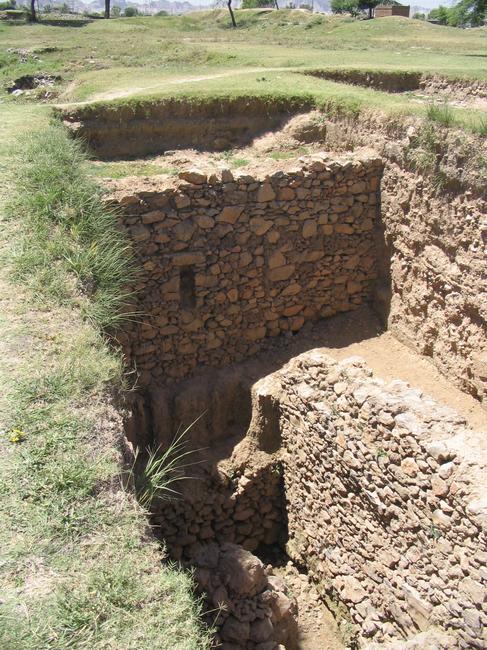
Photo: Marco Prins, CC0 via Wikimedia Commons
is an archaeological site which was once a major city founded around the 6th century BC, the oldest ruins of a city at Taxila. The oldest part of ruins, from the 5th and 6th centuries BCE, are believed to be the remains of Persian/Achaemenid Taxila. Later ruins are from the 4th century BCE, after the invasion of Alexander the Great, and the 3rd, during the time of the Maurya kings of India. There are also some ruins from after the Mauryan period.
The Bhir Mound is an archaeological site in Taxila in the Punjab province of Pakistan. It contains some of the oldest ruins of Ancient Taxila, dated to sometime around the period 800–525 BC as its earliest layers bear "grooved" Red Burnished Ware, the Bhir Mound, along with several other nearby excavations, form part of the Ruins of Taxila – inscribed as a UNESCO World Heritage Site in 1980.
© OpenStreetMap contributors
ٹیکسلا میوزیم
This century old museum is dedicated solely to the remains of the Gandhara civilisation. It has an extensive and impressive collection of Gandhara art such as stone Buddhist sculpture, and has thousands of objects on display. Most of the artifacts were excavated around Taxila and date from the period 600 BCE to 500 CE. The museum gives a good overview of Taxila and is certainly worth a visit.
contains the remains of an extensive monastery and a stupa nearby.
This was once a major thriving walled city. It was founded by the Greek king Demetrius I in the 2nd century BCE and was later rebuilt by king Menander I of the Indo-Greek kingdom. Sirkap houses a round stupa which is one of the oldest stupas in the Indian subcontinent, a large sanctuary building known as Apsidal Temple, a magnificent Double-Headed Eagle Stupa as well many houses.
The mound of Sarai Kala has evidence of the earliest prehistoric settlement, in the Mesolithic period, and also later Bronze age and Iron age settlements. It preserves Neolithic remains going back to 3360 BC and Early Harappan (Indus Valley Civilisation) remains of 2900-2600 BC.
The Buddhist stupa at Dharma rajika is also known as "Chir Tope", and is the largest stupa at Taxila. It is believed that this 15-meter-high circular structure was built during the 3rd century BCE by the Maurya Emperor Ashoka The Great. The area also has Gandhara-style monasteries and some smaller stupas. It is one of the well-preserved and important sites.
Contain the ruins of a Greek temple and is believed to have been location of a Zoroastrian (Parsi) tower.