//

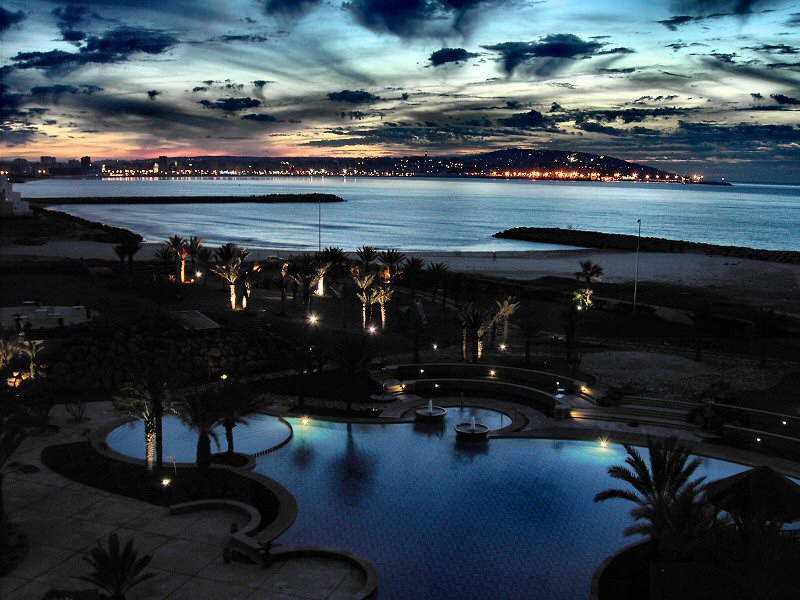
City in and capital of Tanger-Tetouan-Al Hoceima, Morocco
Photo: Aires dos Santos, Public domain via Wikimedia Commons
From the travel guide. Select a place for details, a map and what is nearby.
A large mosque built in the 17th century, with its minaret rising above the city walls towards the sea. It's not the first place of worship on that place, before the mosque there has been a cathedral and a Roman temple.
The "small market" was at one point one of the greatest market places in Morocco. In the early 20th century which was the heyday of the city, wealthy people settled in the area around petit souq, and with them came cafés, hotels and casinos but also offices of banks and other offices. These times are over, and many businesses have relocated to newer parts of the city but it can still be considered the heart of the medina, if mainly for tourists nowadays.
The Kasbah and the Kasbah Museum, the former Sultan's palace deserves to be seen not only for its collection of artefacts from the Phoenician to modern times, but also for the building and garden. There is a small entry fee (20 dirham as of 2026) and varying opening times in winter and summer. The terrace at the northern side of the Kasbah is the place to go for good views over the port, and if there isn't fog or haze, even the Spanish coast.
A 14th century famous traveller who was born in Tangier.
Cultural center, museum, conference center and library in the heart of the old medina is housed in the only historic landmark of the United States located abroad. The museum exhibits a large collection of art and historical items. It also has a Paul Bowles Wing dedicated to the writer and composer who lived most of his adult life in Tangier. (Morocco was the first country to recognize the United States, in December 1777 with the hope of promoting commerce with the new republic. This act by the Moroccan sultan was the first public recognition of the U.S. by a head of state.).
Built by the Spanish in the 1870s in modernist style, this is the main place of worship for Tangier's Christian community.
Musée de la Fondation Lorin
An art museum, or maybe rather an archive related to the history of Tangier opened in 1930 in a former synagogue. In addition to art, there are newspapers, photographs and posters on display.
Grand Socco
A large lively park-like square just southwest of the medina. Next to it there's the Sidi Bou Abib Mosque. Go to the souk on Thursday or Sunday mornings to see the Rif mountain women in their colourful costumes selling their produce and dairy products all along the wall of the St. Andrew's Church (English Church).
Built in 1917 and decorated with polychrome tiles, this is the mosque right next to the grand socco.
After the first Anglican church got too small, the current one was built behind the Sidi Bou Abib mosque. The church is built in Moorish style and the belltower is shaped like a minaret. In the graveyard next to the church rests prominent British figures in the history of the city, including the officers Sir Harry MacLean and Roy Howell with his wife Claire de Menasce, the criminal Paul Lund and writer Walter Burton Harris. There's also a plaque commemorating Emily Keene, who introduced the cholera vaccine to Morocco (her grave is elsewhere).
The continuation of the grand socco to the west, this garden features a large marble fountain and park benches.
Closed and falling to pieces but take a photo from outside the gates as you pass by on the way up to the Grand Socco.
Museum showcasing Moroccan modern art, mostly traveling exhibitions.
former Forbes Museum of Tangier, Palais Mendoub
This impressive building is nowadays a government-owned residence for visitors. Until 1990 it served as a museum of historical battles with statues of soldiers on different battlefields. The building was also featured in the James Bond movie The Living Daylights.
Built by the Spanish (who else?) in the 1940s, this is the last remaining bullring in Morocco. The last bullfight took place in 1970, after that the place has been more or less abandoned, though still a notable historic site.
Grottes d'Hercules
The caves are a place of stunning natural beauty and great archeological significance. Apparently, this is where the mythical figure, Hercules, used to rest after finishing his 12 labours. The cave also bears a mirror image resemblance to the continent of Africa.
A great place for watching the sunrise and experiencing North African countryside.
Aquatic park with a tremendous view of the coast. Open in 2005 it costs €5 for children and €10 Adults has aqua slides, karting circuits, café, romantic restaurant with excellent pancakes.
Grand Stade of Tangier, ملعب ابن بطوطة
Completed in 2011, this stadium is multi-use but primarily for soccer, with a capacity of 75,500. The home team is IR Tanger, playing in Botola Pro the top tier. The stadium often hosts internationals and in 2025 / 26 staged matches in the Africa Cup of Nations.
Jazz festival with artists from all over the world performing. It comprises both large outdoor concerts at large squares in the city and smaller ones at indoor locations. Held yearly.
The Darna organization helping women and children in difficulties is operating a restaurant, popular among the western expats in the city. You get whatever they are serving that day, which includes bread, olives, salad and a main. Drinks (10 dirham) and dessert (15 dirham) are available for extra.
Moroccan cuisine served in a modest restaurant, a popular suggestion of several nearby accommodations.
A Syrian restaurant
Moroccan cuisine
Fast food. A fabulous and cheap sandwich of kefta, egg, fries on a baguette at around 14 dirham (June 2015)
Pizzas and snacks.
A L'Anglaise
In the heart of the Kasbah on the highest peak of the Medina of Tangier with panoramic views, It has a range of veggie meals and all dishes are cooked in traditional wood oven. It is 100% organic. The juice comes huge with no additive and some fresh ginger and pomme grenade.
Restaurant Populaire
Excellent seafood and fish restaurant, served with some kind of couscous and tajine as is typical in Morocco. Fruit juice is also a speciality.
Chinese and Vietnamese restaurant with pleasant decor and friendly service. The food has received mixed reviews.
According to many reviewers the best Japanese food in Tangier, especially sushi.
Moroccan Deli & Fish Bar with nice decor and typical Moroccan dishes.
Italian and French cuisine, apparently decent food at elevated prices.
Opened in 1921, visited by famous writers and artists. View on the Straits of Gibraltar. Drink tea while looking at boats passing by.
Nice little bar for a drink in the evening or the weekend.
Café and pizzeria.
Bakery and tea house, specializing in cakes.
Quiet and very basic, hot showers, has a garage for your car or motorcycle, and costs 150 dihams/night w/20 dirham for parking. Front rooms 2nd floor have Bay of Tangiers view and cooling breeze.
Right up the hill from the port entrance, on the way up to the medina. Rooms with a shared bath start around 120 dirham but it was easily talked down. Clean, hot water, very nice atmosphere, also has Wi-Fi and satellite TV in the lobby.
Basic hostel, if you want clean sheets bring your own.
Visited by American authors of the Beat generation of the late 1950s. Is still a hotel, but is reportedly a bit run-down. This is where William S. Burroghs wrote his book Naked Lunch.
Reputedly the best campsite, also offers bungalow accommodation.
This hotel, situated in the medina and within easy reach of the port, is very much in the 'former glory' category, with past guests including Degas, Churchill, Kerouac and friends. Definitely spend extra for a nicer room if given the opportunity, it is not a lot extra and the best rooms were absolutely palatial. Get one facing the port if you can. It has a really nice terrace out front where you can enjoy mint tea with spectacular views of the harbour. Make sure not to confuse it with the Intercontinental which is a more modern hotel and not as central.
On the beachfront, clean and comfortable, cheap and cheerful (€30-35).
On the beachfront but caters mostly to package tourists. Poor service and not particularly clean or cheap. €50-60
This new guesthouse/ boutique hotel is a stone's throw from the Hotel Continental and needs to be seen. A former restaurant and gallery, the house has been amazingly restored with typical Moroccan style. The view from the large terrace and penthouse is 360 degrees, taking in the medina, the bay of Tangier, Gibraltar and Spain. The 8 rooms/suites vary in price from €45 to €120 a night.
Clean, modern and decent sized rooms with air conditioning and satellite television. A double room will set you back around 600 dirham although this can be negotiated down to 450 dirham. The reception will let you use the spare computer for internet access free of charge. Breakfast is not included.
A riad in the Kasbah.
On beachfront — 4-star hotel. Modern and reasonably priced with sea facing rooms.
Expensive but modern luxury hotel with an adjoining Casino. 5-star hotel.
Decor is traditional Moroccan arabesque. This is the most famous 5-star hotel in Tangier.
Not on the beachfront but is clean and comfortable 4-star hotel.
Good service and clean. Not part of the Intercontinental chain.
This is a 5-star hotel on the Atlantic coast, with a kilometer of clean beach. It is a little far from Tangier and an ideal secluded spot. Popular with Royalty and the discreetly rich.
Renovated 5-star hotel on the beachfront. Famous former guests include Winston Churchill and Jean Claude Van Damme.
Villa Josephine on the Old Mountain is an 11-room luxury residence with fine dining, bar and swimming pool. It is located away from the crowds downtown.
Elegant riad in the Kasbah, equipped with a hammam.
There is an infamous market 6 km outside Tangier called "casa barata" (the house of cheap things). There are bargains, but beware of forgeries and stolen goods (these are sold alongside vegetables, electronics, clothing, shoes, spices, carpets, ironmongery and everything else one can think of). You can take a grand taxi from the station next to the English Church. It's 5 minutes by taxi and the fare is 3 dirham per person.
By train
The country has an excellent railway system with 1,893 km (1,176 mi) of track and a fine intercity passenger service.
By bus
Tangier, as it's typical for Morocco, has two long distance bus stations: CTM one exclusively for CTM buses and Gare routière serving all other bus companies.
By boat
There are two ferry lines from Spain: Tarifa–Tangier and Algeciras–Tangier Med. Another option would be Algeciras–Ceuta route.
By car or motorcycle
When coming into Tangier by car, be careful of hustlers on motorbikes who will ride alongside you and attempt all manner of dodginess.
On foot
Walking is perhaps the best way to see the relatively compact Tangier.
By car
The speed limit in the city is 40 km/h. The traffic can be quite busy and chaotic with not only all kinds of vehicles but also pedestrians on the lanes.
By taxi
There are two types of taxis in Tangier. Grands taxis are cream-coloured mini-vans. Petits taxis are regular cars, painted turquoise.
By bus
Virtually all points of interest are located in or near the old town within walking distance from each other.
Choose an airport to see hotels, stations, taxi ranks and car rental desks around it.
Tangier · International · TNG
Loading places around the airport…
Articles and travel topics about Tangier and Morocco.
 Itineraries
Plan an epic 7-day Morocco itinerary for 2026. Explore Marrakech, Fes medinas, and the Erg Chebbi Sahara dunes with transit tips and real costs.
8 min read
 Itineraries
Fes, Morocco on foot: the car-free alleys of Fes el-Bali, Chouara Tannery, Bou Inania Madrasa, the best riads and the food stalls worth a queue.
8 min read
 Inspiration
Where to watch the 2 August 2027 total solar eclipse, comparing 6 minutes of totality in Luxor with southern Spain, weather and hotel bookings.
6 min read

Every section of the guide. Open one to read it in full.