//

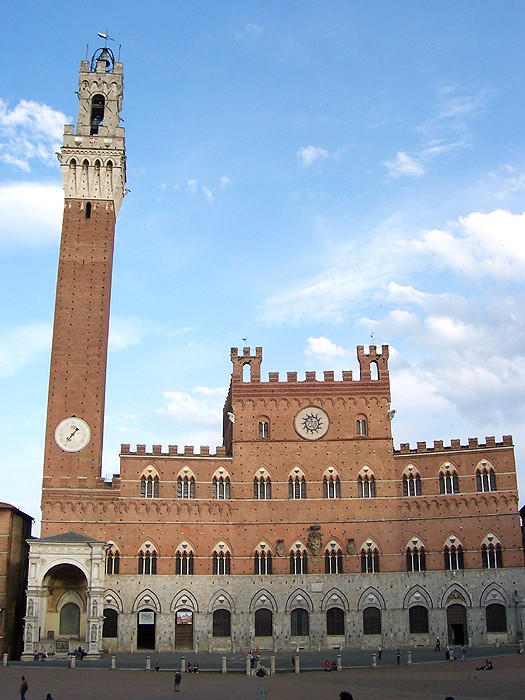
Photo: MarkusMark, Public domain via Wikimedia Commons
This striking structure has functioned as Siena's City Hall for almost 800 years and is probably the building that most recognizably represents Siena. It contains (among many other things) the famous frescoes on good and bad government by Ambrogio Lorenzetti, frescoes by Simone Martini and Duccio, and access to the Torre del Mangia, from the top of which you can view a beautiful panorama of the Sienese countryside. The frescoes on good and bad government and their effects on the city and surrounding countryside (painted 1338-1339), probably Ambrogio Lorenzetti's greatest masterpieces, are in the Sala dei Nove, where the Council of Nine who ruled the city state in the early 14th century could see them and, it was hoped, would keep them close to mind while making important decisions. These frescoes and Duccio's Maestà in the Museo dell'Opera del Duomo are the most important paintings in Siena and for many people represent highlights of a visit to this city, but there are many other beautiful things to see in the Palazzo Pubblico, so allow some time (preferably a couple of hours) to view them all. This building's exterior is equally beautiful and includes a lovely marble chapel, the Cappella di Piazza, which is at the foot of the Torre di Mangia. Built in 1352, it is dedicated to the Virgin Mary, as was the entire city after it avoided annihilation in the devastating black plague of 1348.
The Palazzo Pubblico is a historic palace in Siena, Tuscany, in central Italy. Located on the Piazza del Campo, it is one of the principal architectural landmarks of the city's historic center. Construction began in 1297 to serve as the seat of the Republic of Siena's government, which consisted of the Podestà and Council of Nine, the elected officials who performed executive functions. The palace is of medieval and Gothic architecture, and the interior is lined with frescoes--most importantly, the collection known as The Allegory of Good and Bad Government by Ambrogio Lorenzetti.
© OpenStreetMap contributors
Gaia Fountain
The fountain sculpted in 1419 by the great Sienese sculptor, Jacopo della Quercia, is a focal point of the piazza. The remains of the original sculptures can be viewed in the loggia of the Palazzo Pubblico (see above), but the appearance of the fountain, composed of copies made in 1858, is not bad and remains a major sight in this city.
Sansedoni Palace
Opposite the Palazzo Pubblico, it is another beautiful Gothic building on the Campo.
Piccolomini Palace
One of the most popular sites on the Piazza del Campo, it was built in 1459 by the well-known architect Bernardo Rossellino, disciple of Leon Battista Alberti. This Florentine-style palazzo is home to the official archives of Siena.
Accademia Chigiana
This is another Gothic palazzo, or at least its façade remains Gothic, though the interior was modernized in the late 18th and early 19th centuries. The building since 1932 has housed housed the Accademia Chigiana, the city's conservatory of music. Quite a number of beautiful paintings are part of its collection, but the rooms that house the artwork are often used for classes and rehearsals or simply locked up when not in use, so if you would like to view its holdings, you will probably need to get permission in advance and make an appointment.
Museum of the Works of the Cathedral
This museum includes the famous Maestà by Duccio and many other great works by Sienese masters. After you've seen all the art, you can also treat yourself to a beautiful panorama from Il Facciatone, the tower in this building. The view is about as good as the one from the Torre del Mangia in the Palazzo Pubblico but somewhat different, although if you are rushed for time, pick one tower to climb (either one).
Tolomei Palace
This lovely palazzo was built between 1205 and 1212 by the Tolomei family when the area was outside of the city walls. Now, it is well within the walls and on the way from the Campo to Piazza Salimbeni.