//

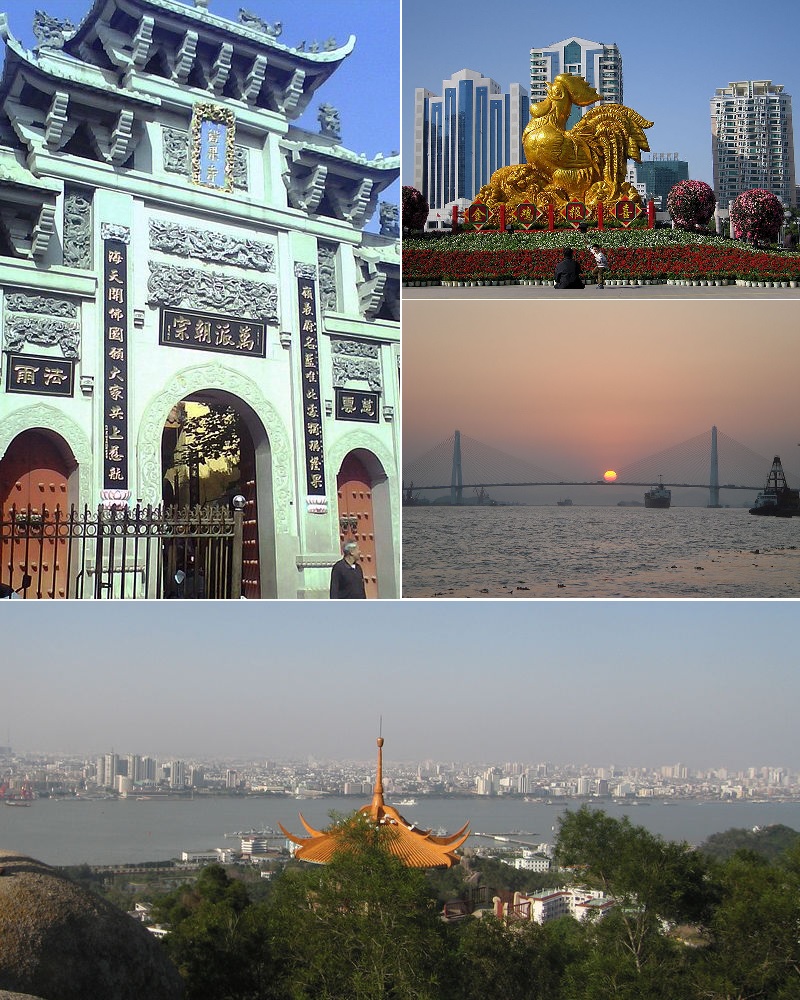
Prefecture-level city in Guangdong, China
Photo: Montage by Lzy881114, CC BY-SA 4.0 via Wikimedia Commons
Shantou, referred to as "Shan", also known as 鮀城 (Tuócheng) and 鮀岛 (Tuódao), is a prefecture-level city under the jurisdiction of Guangdong Province, a sub-central city of Guangdong, a special economic zone, located in the east of Guangdong Province, adjacent to Chaozhou and Jieyang in the north, and the South China Sea in the south. As of the end of 2024, Shantou has a permanent population of 5.56 million.
From the travel guide. Select a place for details, a map and what is nearby.
汕头老城
Most of the lovely historic buildings are so dilapidated that it seems like a European city that has been bombed, although the city has invested to keep the ground floor operating. They are slowly being torn down and replaced with ugly modern buildings, so see it while you can! The one section that is marked for preservation is the part that is next to the renovated post office and the Shantou Founding Museum (see below).
汕头博物馆 Shantou Bowuguan
This museum has the space for an impressive collection, but not all the exhibit halls are open. There are exhibits on Buddhist figurines and sculptures, paintings and calligraphy, ceramic wares, and relics recovered from a Ming Dynasty commercial vessel that was discovered in 2007 just a little way southeast of Shantou. Past temporary exhibits include photos of Shanghai of a bygone era.
汕头开埠文化陈列馆 Shantou Kaibu Wenhua Chenlieuan
Not to be confused with Shantou Museum. This museum is devoted to the establishment of Swatow (Shantou) as a treaty port in the 19th century, and its subsequent history and daily life.
汕头邮政总局大楼
A post office in European style that was built in 1922 and used for the same purpose. There is a gallery about postcards and Shantou's postal history. As a serving post office, postal stamps and postcards are also sold there.
龙眼南路
Longyan South Road is an urban street known for its high concentration of food vendors and small restaurants. Most eateries and night-time stalls operate in the evening, forming one of the commonly visited night-dining zones in the district. The street hosts a mix of traditional snacks and more contemporary casual food options, reflecting a diverse local food scene. Hygiene is poor on the street, where litter and vermin as ubiquitous as the food stalls.
塔山风景区, Tashan Scenic Area
Not to be confused with a similarly named place at the Queshi Scenic Area.
石炮台公园, Shipaotai Park
A fort by the sea, with replica cannons. You may be able to smell some interesting strains of mold inside, admire the moat and bridges, or go rollerskating in the middle of the fort (with Chinese techno music of course).
陈慈黉故居
A mansion (or a mini-palace) built in the early 20th century, still pretty much intact. It was built in traditional Chinese style, with houses from one to three stories, with sloped tile roofs. People still live in many of these houses. Outside of the tourist center and museum and the parking lot, one can wander in the alleys to feel the atmosphere. For those that pan the ubiquitous residential highrises of modern Chinese cities, they really should get a reality check here to see what unadorned traditional housing was like: small, cramped quarters with few modern amenities (do they have indoor plumbing?), outhouses here and there, with occasional pungent smell of garbage in the sweltering summer. There is access to electricity, however, and one can hear the sounds of TV and radio while wandering in the alleys, and see an occasional A/C unit here and there.
南澳岛, 汕头南澳岛旅游区 Nan'ao Island Tourism Zone
This is one of the most beautiful islands in China. It is accessible by a 9-km bridge. The island still hasn't been overdeveloped and has kept its original view. Here you can not only get the most gorgeous sea view but also a taste of the real life of fishermen in China. Besides that, it is a fantastic place to taste all kinds of seafood. On this island, one can see a Song Dynasty fresh water well right on an ocean-front beach (宋井 Song Jin, ¥16) with the accompanying beach and park. There is the ancient military headquarter of the local island and coastal defense (总兵府 Zong Bing Fu, ¥13), with a marker for the former border between Fujian and Guangdong provinces (the entire island is now in Guangdong province). Other old military facilities preserved on the island include the Changshanwei Gun Battery (长山尾炮台) and the Xiongzhen Pass (雄镇关). Also see the wind-powered turbines on the mountains. The transportation on the island is not that convenient. Bus no. 601 will take you around the coast and bus no. 602 serves the north coast. But no bus routes serve the island's interior. You can hire a car to drive you around it for whole day. The fee is usually cheap. It cost ¥200–250 a day.
青云岩
Temples and a lake on a cemetery hill. The site combines religious structures, historical grave areas, and landscaped footpaths that follow the natural slope of the hill. Visitors often walk along the terraces to view the traditional architectural features of the temples, the stone inscriptions, and the surrounding forested areas. The lake sits at a lower platform and is bordered by simple walkways and rest spots, forming a quiet environment compared with the more elevated temple courtyards. The area is generally used for worship, casual walking, and observing local cultural practices related to ancestral memorial activities. Facilities are basic, and access paths may require moderate walking, especially on uneven steps.
达濠古城
A rather small but beautiful town, enclosed by a thin ancient wall.
礐石风景区, 礐石风景名胜区
A large hilly park on the south bank of the Rong River, just opposite the city centre.
汕头小公园
Shantou small park is a key historic cultural district in the old urban area, featuring early commercial streets and arcade-style buildings. The district centers on Shengping road and Anping road, forming a fan-shaped layout with many preserved early twentieth-century arcades and commercial structures. It combines traditional Chaoshan commercial culture with modern dining businesses and is a representative area for experiencing the city’s historic streetscape.
汕头西堤公园
Shantou xidi park is a linear waterfront park built along the south bank of the Han River, featuring riverside walkways, landscaped green areas, and small leisure spots near the water. The park connects directly to surrounding urban streets and is commonly used for walking, jogging, and everyday relaxation. The park connects directly to surrounding urban streets and is commonly used for walking, jogging, and everyday relaxation. Its proximity to older neighborhoods creates a local atmosphere, and the riverside path offers open views of the water and buildings across the river. It is primarily a community-oriented public park.
汕头东海岸公园
Shantou east-coast park is a large coastal and waterfront park in the east-coast new town. The park is organized with several themed zones based on a “time concept,” offering walkways, cycling paths, waterfront decks, sports areas, and open plazas. Its design emphasizes openness, spaciousness,and access to the water, blending modern urban landscapes with coastal natural features. It is suitable for walking, cycling, and casual sightseeing, and is a popular outdoor public area for local residents.
长山尾灯塔
Changshanwei lighthouse stands on the breakwater of the harbor with the same name on the west side of Nan’ao island and serves as a recognizable coastal marker. The lighthouse supports navigation, and the surrounding breakwater area offers open views of the sea, nearby bridges, and the shoreline. Visitors often come to walk along the breakwater, enjoy the seaside, and take photos, especially during daylight and sunset hours. The area consists of breakwaters, rocky paths, and open coastal terrain, forming a natural shoreline without enclosed tourist facilities.
莲花素食府 Lianhua Sushi Fu
Vegetarian chain restaurant also found in Chaozhou and Jieyang.
On the 4th floor of International Hotel, this Chinese restaurant serves good dim sum and Hong Kong style dishes. Prices are also on par with those of Hong Kong.
A popular local hot pot restaurant known for its fresh beef and efficient service, there are often queues for meals。
The hotel is rated four stars, but is not on par with the same rank hotels in the West.
There are at least four locations throughout the city.
A Western-style mall with Pizza Hut and the first Starbucks & Haagan Daz in Shantou. There are other cafes in this mall where one can overpay for coffee.
Another western-style mall with Starbucks and a Lotus supermarket in the basement. There are other places in this mall where one can overpay for their coffee.
By train
A high-speed bullet train line connecting Xiamen to Shenzhen via Shantou is now in service. Beyond Xiamen, it continues along the coast all the way to Fuzhou, Hangzhou and Shanghai.
By bus or car
Zhuhai (8 hours, ¥160), Guangzhou, Shenzhen (4–5 hours, ¥150) or Xiamen (4 hours, ¥100).S or European expressways running between Shenzhen and Shantou (and beyond).
Shantou public buses can be unpunctual, particularly during evening festivals. Recorded announcements are announced in Mandarin and Teochew, but noise may cover announcement.
Read in the guideChoose an airport to see hotels, stations, taxi ranks and car rental desks around it.
Jieyang (Rongcheng) · International · SWA
Loading places around the airport…
Articles and travel topics about Shantou and China.
 Travel tips
Who can visit China visa-free in 2026: the 30-day list (now including the UK and Canada), the 240-hour transit rule, and how to set up mobile payments.
7 min read
 Travel tips
Find out how much does a trip to China cost in 2026. Compare realistic daily budgets for bullet trains, hotels, dining, mobile payments, and top sights.
9 min read
 Inspiration
Celebrate Chinese New Year 2027 with festival dates, temple blessings, lantern displays, and top party spots across Singapore, Penang, and Taipei.
7 min read


 Travel tips
Compare travel eSIMs for international trips in 2026. Review Airalo, Ubigi, Nomad, and Holafly for coverage in Europe, Japan, and China.
7 min read


Every section of the guide. Open one to read it in full.