//

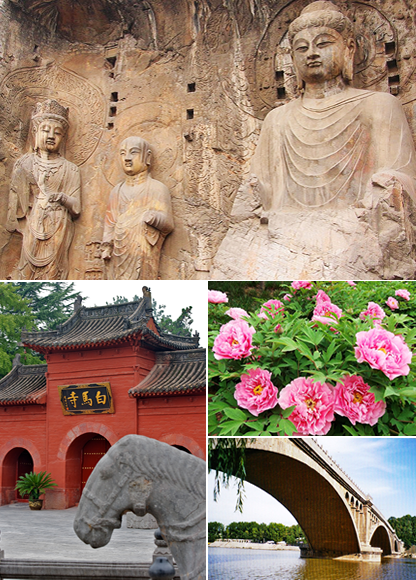
City in Henan, China
Photo: Flickrmover, CC BY-SA 2.0 via Wikimedia Commons
Luoyang (洛阳 Luòyáng) is an ancient city in West Henan province, China. Steeped in history, Luoyang draws visitors for its iconic sites: the Longmen Grottoes, White Horse Temple, and Guanlin Temple. These sites are nestled close to the city and reflect a legacy that stretches back thousands of years.
From the travel guide. Select a place for details, a map and what is nearby.
龙门石窟 Lóngmén Shíkū
One of the finest Buddhist rock sculptural sites in China and a UNESCO World Heritage Site.
白马寺 Báimǎsì; lit. White Horse Temple
A must-visit in Luoyang, White Horse Temple is revered as China’s first officially sanctioned Buddhist temple and one of the oldest in the world, dating back nearly 2,000 years. Though it has been rebuilt multiple times, it retains its historical and spiritual significance, drawing numerous domestic tourists. The temple complex also includes an international section with temples donated by Thailand, Burma, and India. The Thai Temple features a Thai marble vihara and a replica of the Chinnarat Buddha statue. The India Buddha Hall, inspired by the Sanchi Stupa and constructed with Indian marble and granite, was opened in 2008 after being proposed during Indian Prime Minister Vajpayee's visit to the temple in 2003. The Burmese-style Buddha Hall, inspired by Yangon’s Shwedagon Pagoda, was completed in 2014 with gates and walls modeled after the Mandalay Palace.
定鼎门遗址博物馆
Built during the Sui and Tang dynasties when Luoyang was the capital of the Chinese empire, the Dingding Gate was the city's main gate up until the Song Dynasty when it was gradually abandoned. The ruins are housed inside a building complex that is designed to resemble what the gate may have looked like during its heyday.
关林庙
Commemorates Guan Yu, great warrior of the Kingdom of Shu and main character from, "The Romance of the Three Kingdoms". The temple is built over the mausoleum which houses the general god's head, and contains several halls dedicated to the deified man. The side halls are all under construction.
洛阳博物馆
The museum houses historical relics from Luoyang’s era as the capital of thirteen dynasties and serves as an important site for understanding the city’s cultural history.Very well done museum featuring an extensive collection of ancient Zhou Dynasty bronzes as well as Han and Tang Dynasty porcelains, nearly all of which were made and found in the area, giving a sense of the former grandeur of the ancient capital. The museum is sparkling and features broad, uncrowded exhibit rooms and efficient air conditioning, making it a good way to beat the summer heat after the Longmen Caves. Even those with only a passing interest in porcelain will be satisfied.
老君山
Laojun Mountain, originally named Jingshi Mountain, is the main peak of the 800-li Funiu Mountain range, a remnant of the Qinling Mountains. It is a sacred Taoist site where Laozi (the founder of Taoism) is said to have retreated for cultivation . The mountain features the spectacular Golden Summit Taoist complex built in Ming-Qing imperial palace style, including Laojun Temple, Wumu Golden Hall, Liangbao Terrace, and Yuhuang Summit . Notable highlights include the "Ten-mile Gallery" (十里画屏) with unique peak forest landscapes and the breathtaking sea of clouds.
白马寺
The first Buddhist temple established in China, built in 68 AD during the Eastern Han Dynasty. It is considered the cradle of Chinese Buddhism. Visitors can see the ancient pagodas, the cool and quiet halls, as well as the neighboring Indian and Thai style temples.
洛阳古墓博物馆
The world's first museum dedicated to ancient tombs. It features restored tomb chambers from different dynasties where visitors can enter the underground palaces. It offers a unique and immersive way to learn about ancient Chinese burial customs and art.
丽景门 Lìjǐngmén
The grand reconstructed western gate of Luoyang's ancient city, complete with a moat, barbican, and upper-level temples. Climbing the battlements offers elevated views over the old town rooftops, and the gate arch leads directly into the historic pedestrian market streets.
洛邑古城
A cultural tourism area built in the style of an ancient Chinese city. It is known for its Tang Dynasty-style architecture, night views, and popularity as a Hanfu (traditional Chinese clothing) experience destination. The area includes the Wenfeng Pagoda and the site of the ancient Jin-Yuan city wall.
洛阳周公庙博物馆
A memorial temple dedicated to the Duke of Zhou, a famous statesmen and aristocrat who acted as the regent of the Zhou Dynasty from 1042 BC to 1035 BC. The temple was commissioned in 618 AD by the Sui Dynasty general Wang Shichong and rebuilt during the Ming Dynasty.
八路军驻洛办事处纪念馆
The museum is inside a traditional Chinese mansion built in 1831 that was originally the home of a wealthy merchant. Between 1938 and 1942, the mansion served as the Luoyang office of the Eighth Route Army, a Communist controlled group army that was created from the Red Army when the Communists and the Nationalists formed the Second United Front against Japan.
洛阳古代艺术博物馆, previously known as the Luoyang Ancient Tombs Museum 洛阳古墓博物馆
As of August 2020, the museum is closed for renovations. Fascinating museum with reconstructed and unearthed tombs from the Western Han dynasty to the Northern Song Dynasty
洛阳民俗博物馆
Luoyang Weiqi Museum, 洛阳围棋博物馆
A private museum about go (围棋 wéiqí), a classic Chinese board game. The museum is owned by a devoted player who also runs a company which produces go equipment.
上清宫森林公园, Shangqing Palace Forest Park
The centerpiece of the park is the Shangqing Temple, a Taoist Temple that was founded in the Tang Dynasty. The temple has been rebuilt and renovated many times, partly due to damage caused by numerous disasters such as an earthquake in the 16th century and a Japanese bombing raid in World War II.
隋唐大运河文化博物馆
When most people think of the Grand Canal of China, they usually think of the Beijing-Hangzhou canal. In fact, during the Sui and Tang dynasties, the Grand Canal ran all the way to Luoyang. It was only during the Yuan Dynasty, after the capital was moved to Beijing, that Luoyang was cut from the route. This museum displays artifacts from the time when Luoyang was the northern terminus of the canal. The main highlight is two sunken ships that were discovered in 2013. Visitors are required to make a booking on the museum’s WeChat account before visiting the museum, though this requirement is waived if you happen to be over 60 years old. You must also show your ID card or passport before being allowed to enter and the information on your ID card or passport must be consistent with the information you provided when making the booking.
天子驾六博物馆
A small archaeological museum on the site of a Zhou Dynasty king's tomb. As the museum's name indicates, the most notable feature of the tomb is the horse and chariot pits. Most striking of all is Pit No. 5, which contains the actual chariot ridden by the king and includes the remains of the six horses that pulled the chariot.
王城公园
One site of the Luoyang Peony Festival in April, something not to be missed.
A stunning historical reconstruction of the grand south gate of Luoyang City from the Sui and Tang Dynasties, restored in 2016. The gate is particularly impressive at night, illuminated by golden lights, creating a lively atmosphere with many cosplayers and visitors exploring the area.
杜甫墓
This is allegedly the tomb of Du Fu (712-770 AD), a great poet of the Tang Dynasty who wrote more than 3000 poems during his lifetime. According to some historical records, Du Fu was originally buried in Hunan Province but about 40 years later, his grandson Du Siye reburied his coffin at this location, so that he could lay beside the graves of his ancestors. Whether Du Fu is actually buried here, however, is a mystery. There are in fact no less than eight tombs in China that all claim to be Du Fu's Tomb.
二里头夏都遗址博物馆
The ancient bronze age city of Erlitou is claimed by some archaeologists and historians to have been the capital of the Xia Dynasty, China's legendary first dynasty. Around 2000 artefacts from the site are displayed in this museum, which opened in October 2019.
汉原陵, 汉光武帝陵 Tomb of Emperor Guangwu
Located outside the city limits, this is the tomb of Emperor Guangwu, the first emperor of the Eastern Han Dynasty, who restored the Han Dynasty in AD 25 after it had been deposed by court official Wang Mang in AD 9.
老君山
Located in Luanchuan County (栾川县), covers 26.66 square kilometers and is known for its stunning landscapes and rich geological history, dating back 1.9 billion years. The mountain records significant tectonic activity over the ages, making it a fascinating destination for geologists and nature enthusiasts. However, due to sensitive sites in the area, foreign tourists are not allowed to visit.
丽景门景区
Stroll along West Street from Lijingmeng Gate to the Luoyi Ancient City. Plenty of bustling restaurants and lively atmosphere. Beautiful especially at night.
Luoyang Tang Sancai Art Immersion Workshop
Go beyond just viewing and try your hand at creating a piece of Tang Sancai (tri-colored glazed pottery). This in-depth workshop covers the history, demonstrates the glazing process, and allows you to paint a pre-fired piece to take home.
Famous for duck of course, but has many other delicious entrees.
This is not so much a restaurant as it is a dirty street where they sell barbecue and other foods 24 hours a day. In daylight hours it doubles as a spice market, at night there are more food options, and after midnight it is the best option for late-night meals in all of Luoyang (though the city does have a few all-night McDonalds [Shanghai Shichuang], a 24-hour KFC [Wangfujing], and a steak restaurant that never closes [xinduhui] as well as various street vendors). The barbecue here is not the best in Luoyang, but it is better than what you'd find in many other cities. Adventurous eating is recommended: local favorites are sheep eyes, kidneys, and testicles. Throughout the day a large number of people eat here so the meat is generally very fresh, and the meat is cooked over an open flame so don't worry about food poisoning, but it's essentially a dirty street where drunk people go to eat spicy, greasy, salty food before they go home. Awesome food. Nobody speaks English here, but the vendors are accustomed to foreigners so just point at what you want and they will cook it for you.
小街天府
This "late-night eatery," frequented by locals in Luoyang, is a 24-hour food stall offering a wide variety of affordable snacks. From dan dan noodles to specialty hot pot tripe, the selection is extensive, making it perfect for tourists who want to try a variety of Luoyang delicacies in one go.
洛阳万豪酒店
Standard hotel suitable for both business and leisure travelers.
洛阳国际大酒店
Rooms suitable for both family and business stays.
华阳广场国际大饭店
Hotel located centrally, convenient for tourists and business travelers.
洛阳希尔顿酒店
Hotel offering rooms and conference facilities.
Luoyang Yijia, in the center of China’s ancient capital Luoyang, is a special and well-equipped hostel with its own cultural background features and art taste. There you will get the chance to meet people from all over the world and make friends with various travellers. There are five kinds of available rooms: Private Twin Room, Double Bed Room, Triple Room, Family Room, and Dorm. All of them equipped with air conditioners and the former four type rooms also enjoy its own bathroom and TV. For the Dorm, the hostel provide guests with public bathroom.
A nice hostel that looks very much like a hotel. Clean rooms with air conditioning and breakfast included.
Not a hostel per se but more a homestay in a clean, well organised private apartment. The neighbourhood is a real, non-touristy and friendly area with a lot of atmosphere to explore in the day and in the evening (local restaurants abound, including franchises such as Mr. Lee 10 min walk north on Xiyuan Rd). Rooms with shared facilities (hot water shower) and free Internet/Wi-Fi. Guest kitchen, washing machine, safety box and café available. The owner is a very nice person with generous coffee but his English is very basic. It is somewhat far from the train station (40 min by bus ¥1, 15 min by taxi ¥19) but do not try to find it alone, the owner or his son will kindly pick you up. If visiting during the winter be prepared for the cold night because there is not an ambient heater. However the owner will provide you with a comfortable heated blanket which will be more than enough for a nice evening sleep.
Simple 2-star, a great non-touristy location in west Luoyang. Clean rooms with air conditioning. Easy access to old town by bus 8.
洛阳南苑快捷酒店 Luòyáng Nányuàn Kuàijiéjiǔdiàn
Rooms with free internet and electric kettle. Ticket office, fitness and massage available.
洛阳小浪底宾馆 Luòyáng xiǎolàngdǐ Bīnguǎn
Three-star hotel with rooms with free internet. Business center, gift shop, ticket office, billards and fitness available. Chinese restaurant.
洛阳神都大厦 Luòyáng Shéndū Dàshà
Three-star hotel with large rooms with free internet. Business center, ticket office, table tennis, fitness and massage available. Chinese restaurant and room service.
洛阳钼都利豪国际饭店 Luòyáng Mùdūlìháoguójì Fàndiàn
Five-star hotel with rooms with free internet. Business center, currency exchange, gift shop, beauty salon, ticket office, table tennis, fitness, tennis and indoor swimming pool available. Chinese and Western restaurants as well as coffee shop and bar.
洛阳东山宾馆 Luòyáng Dōngshān Bīnguǎn
Rooms with free internet. Business center, currency exchange, gift shop, ticket office, billards, table tennis, fitness, tennis, basketball, indoor swimming pool, massage and water sports available. Chinese and Western restaurants as well as coffee shop and bar.
Opened in mid-2024, this standard Marriott hotel features a 26th-floor lounge overlooking Kaiyuan Lake for an additional fee. Light meal service begins at 17:30 in the lounge. There is a large seafood buffet available on Friday and Saturday evenings at the ground floor restaurant.
上海市场
A long street where you can find a lot of stuff such shoes (some very cheap), clothes, sports, and DVDs. All along the street there are mini malls at both sides of the street where you can find endless stuff such as electronic devices, mobiles, clothes, accessories, and packages.
沃尔玛
Many western products.
A big mall like any you can find in Europe.
By train
There are two train stations in Luoyang: Luoyang Station (northern end of Jinguyuan Road) and Luoyang Longmen (south of Luoyang).
By bus
Luoyang has two major bus stations. The main bus station is across the plaza Luoyang train station, at the corner of Jinguyuan Road and Daonan Road.
By subway
The Luoyang Subway operates two lines. Line 1 runs through the old town, passing several scenic spots, while Line 2 links the new town with the old town.
Choose an airport to see hotels, stations, taxi ranks and car rental desks around it.
Luoyang (Laocheng) · International · LYA
Loading places around the airport…
Articles and travel topics about Luoyang and China.
 Travel tips
Who can visit China visa-free in 2026: the 30-day list (now including the UK and Canada), the 240-hour transit rule, and how to set up mobile payments.
7 min read
 Travel tips
Find out how much does a trip to China cost in 2026. Compare realistic daily budgets for bullet trains, hotels, dining, mobile payments, and top sights.
9 min read
 Inspiration
Celebrate Chinese New Year 2027 with festival dates, temple blessings, lantern displays, and top party spots across Singapore, Penang, and Taipei.
7 min read

 Travel tips
Compare travel eSIMs for international trips in 2026. Review Airalo, Ubigi, Nomad, and Holafly for coverage in Europe, Japan, and China.
7 min read


Every section of the guide. Open one to read it in full.