//

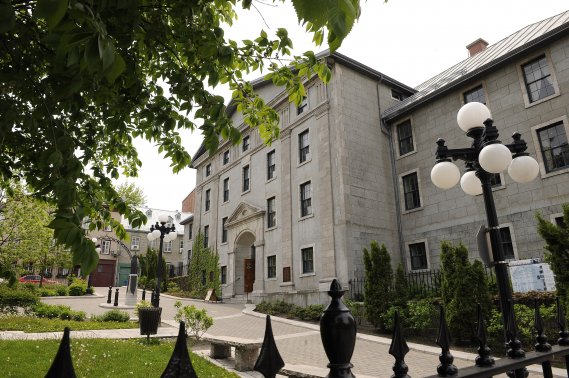
Photo: Morrin Centre, CC BY-SA 3.0 via Wikimedia Commons
English-language culture centre in the southwestern corner of the old town. The building is a national historical site.
The Morrin Centre is a cultural centre in the Old Quebec neighbourhood of Quebec City, Quebec, Canada. It is designed to educate the public about the historic contribution and present-day culture of local English-speakers. The centre contains the private English-language library of the Literary and Historical Society of Quebec, heritage spaces for events, and interpretation services. The English-language library has been located in the Morrin Centre since 1868. The Library is the repository of the LHSQ's collection of historical documents, including copies of the society's journal, Transactions. These documents include original, scientific, historical, and literary articles from the nineteenth century, as well as reprints of older historical primary sources found in archives around the world. In order to access these materials, one must be a member of the library.
© OpenStreetMap contributors
Leads to the west of the city, and was constructed as the last of the city gates in 1878-79, but is the only one that has retained its original shape.
The official residence of the premier of Quebec is the only skyscraper within the city walls. It has 18 floors and was built during the 1930s.
Leading to the west, also this gate to the city has been rebuilt several times, the current version is from 1939-40.
Monastère des Ursulines de Québec
The monastery comprises a whole block in the old town, though only the chapel and the museum are open to visitors. It was founded in 1639 by the French nun Marie de l'Incarnacion (later canonized) as the first female Catholic order in the Americas. The chapel dates from 1730 and is with its wooden altar considered a masterpiece of Franco-Canadian woodwork. In the museum you can learn about the activities of the Ursuline order in Quebec throughout history, and on display there are things related to its curriculum such as embroidery and musical instruments. Also the museum, in a building from 1687, has beautiful details preserved since construction including wooden staircases and windows.
In the 18th century the site of fortifications, later a garrison and until 1964 a munitions factory, there are two buildings left in this National Historic Park. In the former brick foundry there's a museum exhibiting the history of the city, and in the former building of the arsenal there's a weapon exhibition. Another attraction in the park is a Celtic cross commemorating the Irish famine and Irish immigration to North America.
With roots in the 17th century, this is one of the oldest streets in Quebec, but there are few buildings left from that time. It's named after the gate of Saint-Louis, which the street connects to Place d'Armes. Albeit touristy, walking along it is still an interesting experience.