//


Province of Canada
Photo: User:The Great Badlands, CC BY-SA 3.0 via Wikimedia Commons
Alberta spans great, contrasting sceneries of mountains, forests and prairies. It offers the visitor six UNESCO World Heritage sites, preserving mountain vistas (Banff and Jasper National Parks), the world's largest inland delta and largest protected boreal forest (Wood Buffalo National Park), one of the world's great dinosaur fossil beds (Dinosaur Provincial Park), historic Indigenous rock art (Writing-on-Stone Provincial Park), and ancient buffalo hunting sites (Head Smashed In Buffalo Jump). And for sports fans, this is the home to one of the world's greatest rodeos every July in Calgary, two famous professional ice hockey teams, and one of the longest ski seasons in the northern hemisphere. Like colder versions of other oil towns (Houston comes to mind), the burgeoning cities of Edmonton and Calgary are adding new skyscrapers, museums, art galleries, concert venues, and libraries as these cities are still very much in their youth.
World-renowned beauty and the resort towns of Banff, Lake Louise, Jasper and Canmore. Plenty of things to do for the adventurer, city-dweller and everyone in between. More than just busy tourist hubs, the Rockies are so vast it's easy to find a place where you can feel like you're the only one on the planet.
Housing Alberta's largest city of one million or so, Calgary, and the closest international airport to the Rockies, this is the gateway to the national parks. In this fast-growing region you can experience big-city life while still being less than an hour from complete isolation.
Where wild horses run free, this mostly rural region features rolling hills, prairie, and occasional forest. The most densely populated region of the province apart from Edmonton and Calgary, there are many towns and smaller cities. The region's centre is the city of Red Deer.
Alberta's capital city of Edmonton and its suburbs together have a population of over one million and growing. Being a big capital city, there's lots to do in terms of culture (notably theatre and sports), but nearby Elk Island National Park is renowned for its abundance of wild hoofed animals, including bison.
In this vast, sparsely-populated region, there are numerous small towns which could serve as a base for wilderness activities, as well as Canada's newest dinosaur museum. There is a large oil industry presence centred around the oil sands at Fort McMurray.
This region features visually striking landscapes. It features valleys and plains shaped by thousands of years of erosion, farms, and Waterton Lakes National Park, where the Rockies suddenly emerge from the prairie without much transition. The largest cities are Lethbridge and Medicine Hat.
By train
By bus
By car
There are land border crossing with the United States at (form west to east) Chief Mountain, Carway, Del Bonita, Coutts, Aden, and Wild Horse.
By thumb
Hitchhiking is illegal and rare in Alberta, so this is not recommended, but it is possible if you're willing to take your chances.
By bicycle
The vast distances make cycling across Western Canada all but impossible, the lack of dedicated infrastructure also makes it relatively dangerous, and the sparsity of things to see in the spaces…
By car
Driving regulations are the same as in most of Canada. Turning right (far right lane into far right lane) on a red light is allowed.
By bus
Choose an airport to see hotels, stations, taxi ranks and car rental desks around it.
Whitecourt · Regional · YZU
Loading places around the airport…
the capital city of Alberta and the second largest urban population (1,010,899 city; 1,418,118 metro region). Known for the largest urban parks system in North America, North America's largest indoor shopping mall, and is self-proclaimed as "Canada's Festival City". Also home to Western Canada's largest indoor museum (since 2018), a huge outdoor museum, the provincial art gallery, a science centre, and an iconic pyramid-shaped plant conservatory.

Alberta's largest city (1,306,784 city; 1,481,806 metro region). It is home to a beautiful river, nice museum, high-rise architecture, a world class zoo, and shopping. Famous for the 1988 Winter Olympics and the annual Calgary Stampede.

vacation destination in the Rockies offering a variety of outdoor activities. By far the busiest resort town in Alberta and one of the most popular in all of North America.

the dinosaur-lover's mecca, site of the Royal Tyrell Museum, the largest paleontology museum in Canada, set in the desert-like "badlands" landscape.

Banff's northerly neighbour - less visited than Banff but no less stunning.
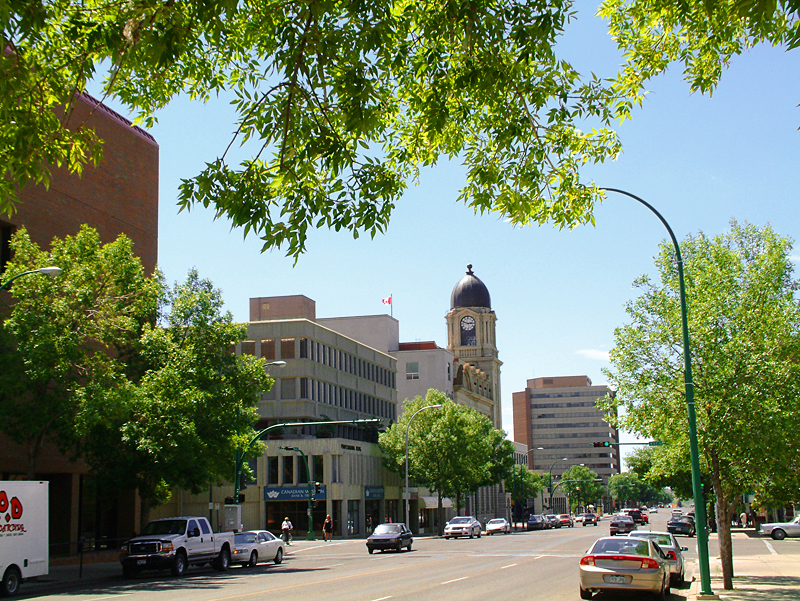
a city in southern Alberta with a population of about 93,000 and most famous for "coulees" (canyons) and proximity to four world heritage sites.

is in southern Alberta with a population nearing 60,000. The main stop on the Trans-Canada Highway between Calgary and Regina, Saskatchewan and jumping-off point for the Cypress Hills.

midway between Edmonton and Calgary and, with about 100,000 people, the third largest city in the province behind those two. The main centre for tourist services in Central Alberta.

the oldest and most famous of all of Canada's national parks, and home to the town of Banff which holds unique shopping and entertainment. Outside that, there's Lake Louise and world class skiing, hiking, and camping

free ranging bison ("buffalo") and wapiti near Edmonton

a series of parks, campgrounds, and rustic lodges, along Highway 11 between Red Deer and the Rocky Mountains.

beautiful mountain and shopping attractions without the hustle of Banff

Alberta's Ukrainian ethnic enclave in Edmonton's eastern hinterland

major natural recreation area in southern Alberta at the foot of the Rockies south of Calgary

a true natural gem in the Rockies in Alberta's extreme southwest

the largest national park in Canada home to the world's largest freshwater delta and free-ranging wood bison ("buffalo")
Articles and travel topics about Alberta and Canada.
 Travel tips
Discover how to use AI to find cheap flights. Learn prompt strategies, smart fare engines, open-jaw routings, and error-fare booking techniques.
6 min read

 Itineraries
The Trans Canada Trail is the world's longest network of recreational trails that are available for walking/hiking, cycling, paddling, horseback riding, cross-country skiing and snowmobiling.
Wikivoyage
 Itineraries
The Trans-Canada Highway (TCH) is a series of provincial highways which join all ten provinces of Canada. Following 8,030 km (just under 5,000 miles) of Trans-Canada Highway across all ten provinces is one of the three…
Wikivoyage
 Culture & history
The indigenous peoples of North America are the tribes and nations whose ancestors were already on the continent when European explorers and colonizers arrived.
Wikivoyage
Every section of the guide. Open one to read it in full.