//


Region of Western Canada
Photo: Sergey Pesterev, CC BY-SA 4.0 via Wikimedia Commons
The Prairies are a region in the centre of Canada, made up of three provinces: Alberta, Saskatchewan, and Manitoba. Though the word "prairie" means grassland, this region also contains mountains, hills, lakes, shoreline, and metropolitan cities.
By car
You can enter from the United States at numerous land crossings. Roads through the Rockies include Highway 1 (Trans-Canada Highway), Highway 3 (Crowsnest Highway), and Highway 16 (Yellowhead Highway).
By bus
By train
By train
Aside from trains listed under "Get in" above within the "By train" section, there is a train that travels between Winnipeg and Churchill.
By bus
Choose an airport to see hotels, stations, taxi ranks and car rental desks around it.
La Ronge · Regional · YVC
Loading places around the airport…

known for the annual Calgary Stampede (a combination rodeo and fair) and one of the biggest international airports in Canada. The largest city in the Prairies, but more influenced by the Rockies. It has a river and is close to the mountains, and is thus full of people who do outdoor activities.
the largest shopping mall east of Asia and Canada's largest outdoor museum are two of the big attractions. It also has a lush river valley which is the largest urban park area in North America and is dubbed Canada's festival city. It is the capital of Alberta and home to the largest university in the Prairies.
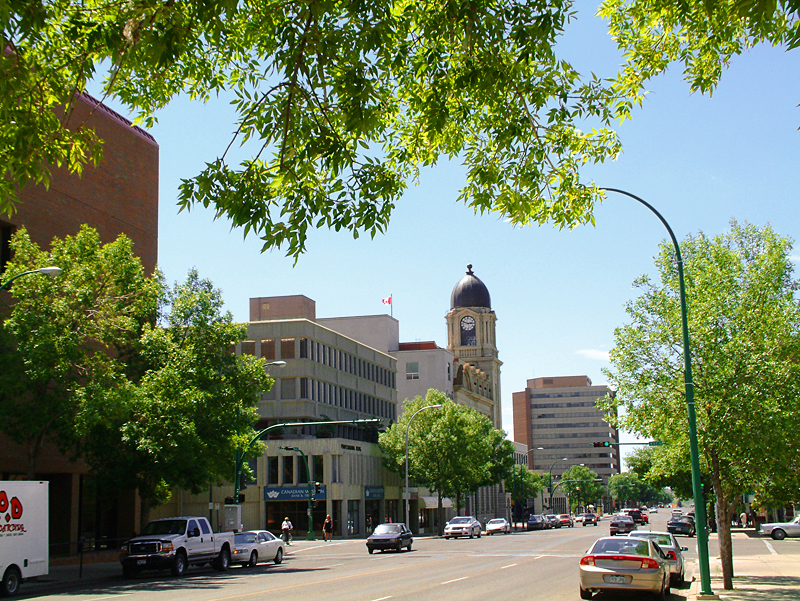
the third largest city in Alberta, and sixth in the Prairies, it is the hub for Southern Alberta. A leafy university town in a river valley surrounded by treeless plains, it is also the nearest city to three UNESCO World Heritage Sites: scenic Waterton Lakes National Park, historic Head Smashed In Buffalo Jump, and unique Writing-on-Stone Provincial Park.

compact capital of Saskatchewan.

largest city and economic hub of Saskatchewan.

the historic and cultural capital of the prairies. Those interested in architecture, art, museums, and culture would do well in Winnipeg. Also home to the largest French-speaking community in the Prairies.

a hilly island surrounded by a sea of grasslands, straddling the Alberta-Saskatchewan border, as well as the famous dinosaur museum at Drumheller, and the World Heritage dig site at Dinosaur Provincial Park near Brooks.

Banff National Park is in the Alberta Rockies region of Alberta. Together with six other national parks it makes up the UNESCO World Heritage site "Canadian Rocky Mountain Parks".

Riding Mountain National Park is in the Prairie Mountain region of Manitoba. The park was established in 1929 to protect an area of 2,969 km² of prairie parkland, and designated as part of a UNESCO Biosphere Reserve in 1986.

home to the rare wood bison or "buffalo", the largest national park in Canada and UNESCO World Heritage Site, mostly inaccessible by road, but great for trekking or canoe camping.

The Interlake is a region in Manitoba. Situated north of Winnipeg, between Lake Winnipeg and Lake Manitoba, the Interlake offers visitors parks, beaches and outdoor recreation.

claimed as the Polar Bear and Beluga Whale Watching Capital of World, this is where the cold Arctic waters of Hudson Bay touch the Prairie provinces. Go here for a cold-weather safari.
Articles and travel topics about Prairies and Canada.
 Itineraries
The Yellowhead Highway, part of the Trans-Canada Highway, is in western Canada (the Prairies and British Columbia).
Wikivoyage
 Itineraries
The Canadian (French: Le Canadien) is a 4,466 km (2,775 mi) passenger train route operated by VIA Rail Canada running between Toronto and Vancouver, with numerous intermediate stops including Winnipeg, Saskatoon,…
Wikivoyage
 Culture & history
The British Empire was, at its peak, the largest empire in history; it controlled just short of a quarter of the world's land area and a quarter of the population.
Wikivoyage
 Nature & adventure
The National Parks of Canada, and some of the National Historic Sites of Canada, are managed by Parks Canada, an agency of the Government of Canada.
Wikivoyage
Every section of the guide. Open one to read it in full.