//

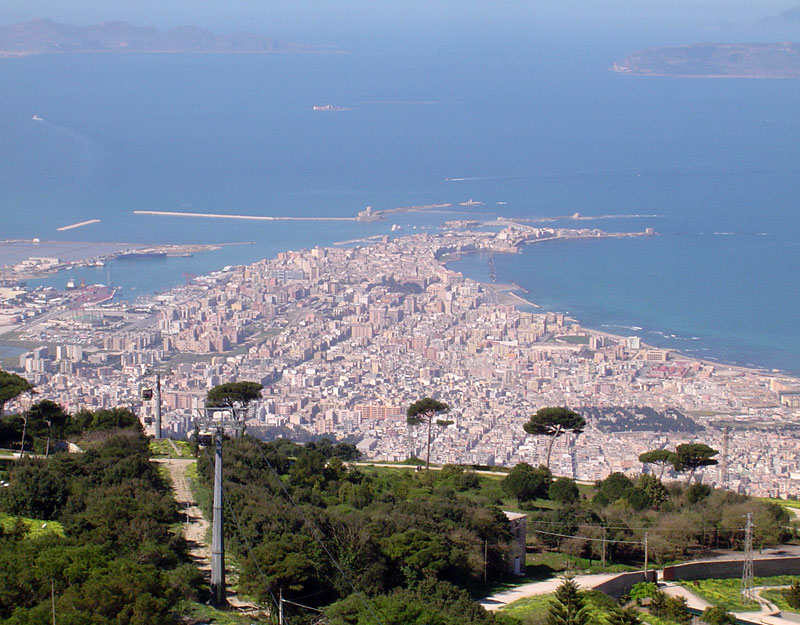
Comune in Sicily, Italy
Photo: ChrisO, CC BY-SA 3.0 via Wikimedia Commons
Trapani occupies a narrow peninsula stretching between two seas, where the Tyrrhenian and Mediterranean meet. Its historic centre extends directly into the water, framed by old city walls, beaches, and a working port. As the capital of the surrounding province, Trapani has long balanced maritime trade with civic and administrative importance. Fishing boats, ferries, and cruise ships still shape daily life, while the seafront promenade along the Tramontana walls offers some of the city’s most distinctive views.
From the travel guide. Select a place for details, a map and what is nearby.
Castello della Colombaia
An ancient coastal fortress on a small island about 600 metres west of Trapani's harbour, historically used for maritime defence and later as a prison.
Museo Civico Torre di Ligny
A coastal tower museum exhibiting prehistoric artefacts and maritime finds from Trapani's seabed, with panoramic rooftop views.
Castello di terra
A former medieval fortress; today only sections of the seaward walls remain beside modern administrative buildings.
Bastione dell'Impossibile
A 16th-century bastion built on marshy ground once considered impossible to develop, now planned for reopening as a cultural and public heritage site.
Ex fabbrica del ghiaccio
A former gunpowder store and later ice factory near the Mura di Tramontana, now abandoned and protected as a historic structure within Trapani’s old town.
Torre dell’Orologio
A medieval city gate surmounted by a 16th-century astronomical clock displaying solar time and lunar phases.
Santuario Madonna di Trapani
A Gothic basilica housing the venerated marble Madonna of Trapani statue, traditionally attributed to Nino Pisano.
Cattedrale di San Lorenzo
A former parish church transformed in Baroque style in the 18th century and elevated to cathedral status in 1844.
Anime Sante del Purgatorio
A Baroque church best known for housing the Misteri di Trapani sculptural groups used in the city's annual Good Friday procession.
Chiesa del Collegio dei Gesuiti
A Baroque Jesuit church and former college complex dedicated to the Immaculate Conception, now preserved as a historic institutional site.
Chiesa di San Domenico
A medieval Dominican church founded in the 13th century, preserving Gothic architectural features and traces of its former role as a burial site for notable local families.
Chiesa di San Francesco d'Assisi
A church and former Franciscan convent whose dome is a prominent feature of the Trapani skyline.
Chiesa di Santa Lucia
A former medieval church associated with Trapani's fishing and coral-fishing community, now disused but historically linked to the city's maritime economy.
Chiesa di San Liberale
A former 17th-century church built by Trapani's coral fishermen and dedicated to Saint Liberale, now surviving only in fragmentary condition near Torre di Ligny.
Chiesa di Santa Maria di Gesù
A historic Franciscan church founded in the 15th century by the Friars Minor Observants, noted for its Renaissance and Baroque artistic heritage.
Chiesa di San Pietro
Long regarded as one of Trapani’s largest churches, noted for its basilica layout and important Renaissance and Baroque artworks.
Chiesa di Santa Maria dell'Itria
A church associated with the Shoeless Augustinian order. Its former convent complex is now the Liceo Scientifico Vincenzo Fardella.
Basilica di San Nicolò
A historic basilica shaped by the patronage of the medieval Chiaramonte family, noted for its layered architectural history and artistic heritage.
Badia Nuova
A Benedictine monastic complex with a Baroque church and a former convent now serving as the Palazzo delle Finanze.
Chiesa e Monastero della SS. Trinità, known locally as Badia Grande
A former Franciscan convent complex dating from the 16th century, later enlarged in the Baroque period.
Museo Regionale Agostino Pepoli
Sicily's principal regional museum, housing collections of coral art, sculpture, ceramics, jewellery, and religious and decorative works.
Museo di arte contemporanea San Rocco
A contemporary art museum housed in the restored 17th-century Palazzo San Rocco, presenting permanent and temporary works on cultural, spiritual, and social themes.
Chiesa di Sant'Agostino
A medieval Gothic church with a notable rose window, now housing the diocesan Polo Espositivo Sant'Agostino exhibition space.
Sala Laurentina
A multipurpose pastoral hall best known for housing Specus Corallii, a contemporary architectural installation inspired by Trapani's coral and maritime heritage.
Museo delle Illusioni Ottiche di Trapani
A museum dedicated to optical and perceptual illusions, established in 2017 and noted as Italy's first institution focused exclusively on optical-illusion phenomena.
Palazzo Cavarretta
A Baroque civic palace built on the site of the former Loggia dei Pisani, historically serving as Trapani's seat of senate and magistracy.
Municipio
A neoclassical palace built as a private residence in the late 19th century and serving as Trapani's town hall since 1948.
Palazzo Ciambra
A historic palazzo representing late medieval and early Renaissance domestic architecture in Trapani's former Jewish quarter.
Antico Mercato del Pesce
A restored historic fish market on the seafront, now used as a public gathering space for cultural and social events.
Archivio di Stato di Trapani
The provincial state archive preserving government, judicial, and administrative records of Trapani, now housed in the former convent of Sant’Anna.
Ex-St. Anthony's Hospital
A former 15th-century hospital later known as Palazzo Lucatelli, now undergoing restoration for cultural reuse after decades of abandonment.
Biblioteca Fardelliana
The city’s historic public library, housed in the former Church of San Giacomo.
Palazzo delle Poste
An early 20th-century Liberty-style post office designed by Francesco La Grassa, forming a prominent civic landmark on a trapezoidal urban block.
Casa del Mutilato
A 1930s public building constructed as the headquarters of Trapani's war-disabled veterans' association, and an example of interwar modern architecture.
An early 20th-century Liberty-style palazzo attributed to Francesco La Grassa, reflecting Trapani’s architectural renewal of the period.
A late 19th-century seaside villa built for politician Nunzio Nasi, noted for its eclectic Liberty-style architecture and prominent coastal setting.
Chalet Fiorino
A Liberty-style pavilion attributed to Francesco La Grassa, overlooking the Port of Trapani and used as a venue for cultural and public events.
Fontana di Saturno
Historic fountain that was linked to the city's medieval aqueduct system. The fountain is topped by a statue of Saturn, traditionally associated with the mythical founding of Trapani.
Fontana del Tritone
A monumental mid-20th-century fountain by Domenico Li Muli depicting a Triton with marine figures.
A seafront promenade running along Trapani’s historic sea walls, offering views of the Aegadian Islands and access to a beach below the walls.
Trapani’s main urban beach, with sandy shoreline, shallow waters, and seasonal bathing facilities.
A sandy beach in Erice’s Casa Santa district, known for bathing facilities and summer beach-club activity.
A late 19th-century public garden containing the Padiglione Liberty and Teatro Giuseppe Di Stefano.
Trapani’s basketball club, playing home matches at the PalaShark arena.
Trapani’s football club, playing home matches at the Stadio Polisportivo Provinciale.
A modern municipal theatre operated by the Luglio Musicale Trapanese, hosting opera, concerts, dance, and theatrical performances.
A protected salt-pan landscape with historic windmills, saline basins, and migratory birdlife, including the Museo del Sale in a restored 17th-century mill.
A rural wine-growing area known for its native Sicilian grape varieties, with vineyards, historic farm estates, and wine-tasting facilities.
Italian language school: year-round Italian language classes, summer intensive group courses, Italian/Sicilian cookery lessons, excursions.
Restaurant offering contemporary interpretations of Sicilian cuisine, including seafood and meat dishes.
Restaurant and guest house specialising in modern Sicilian cuisine, particularly seafood and couscous dishes. It received a Gambero Rosso Forchetta award in 2025.
Waterfront restaurant and pizzeria serving Trapani-style pizza, seafood, and traditional Sicilian dishes.
Deli-style eatery offering sandwiches, cured meats, seafood, and vegetarian dishes based on local ingredients.
Roman-style trattoria specialising in traditional pasta dishes from central Italian cuisine.
Café known for its cappuccino art, offering sweet and savoury breakfasts, light lunches, fresh fruit juices, and aperitifs.
Small seafood restaurant serving simple fish and shellfish dishes prepared with local ingredients.
Portside eatery specialising in traditional Sicilian street food, including panelle and potato croquettes.
A small, family-run trattoria offering rustic, traditional seafood dishes, including fish, local pasta specialities, and couscous.
A historic restaurant known for its traditional fish couscous, featured in Stanley Tucci's 2026 TV series, in which he explored the North African influences on Sicily's cuisine.
Seafood and Mediterranean restaurant serving Sicilian fish dishes, pasta and couscous. Outdoor seating with sea views.
Seafood restaurant serving traditional and contemporary Sicilian dishes. Tasting menus and gluten-free options available. Indoor and outdoor seating.
Serves pizza alongside a range of traditional Sicilian meat and seafood dishes, accompanied by local wines. The dining room features historic décor, and sidewalk seating is available.
Sunset terrace bar and restaurant on the seafront promenade with views of the Aegadian Islands.
Seaside restaurant and lounge bar offering sunset aperitifs, seafood dishes, and live-music events on a panoramic terrace.
A serviced residence offering studio and junior-suite apartments with kitchen facilities, some with sea views or terraces.
A serviced apartment residence offering studio apartments, some with sea-facing balconies.
A hotel with 36 suites and apartments, featuring an on-site restaurant and rooftop bar, with some rooms offering balconies or private terraces.
A serviced residence offering five contemporary apartments, reception services, and optional airport transfers.
A boutique hotel housed in the early-20th-century Palazzo Platamone, offering rooms and suites, with an on-site restaurant, rooftop pool, and terrace with panoramic views.
An art hotel in a restored 18th-century palace, offering individually decorated rooms, spa facilities, a wine cellar with tastings, and a rooftop terrace.
A guesthouse in the restored 19th-century Palazzo d’Alì-Staiti, offering rooms and apartments, some with sea-view terraces, and an on-site restaurant overlooking the bay.
A budget, eco-friendly, family-run B&B, offering a vegetarian breakfast, bicycle rental, a shared lounge, and a terrace.
A boutique guesthouse in a restored historic building, preserving original architectural features and offering an on-site restaurant specialising in contemporary Sicilian cuisine.
A hotel with breakfast, bar, and parking. Reception can arrange airport transfers and the hire of boats, bikes, or equipment for diving, climbing, or windsurfing.
Boutique B&B occupying a restored late-19th-century Liberty villa that was built as a leisure residence for the Adragna barons. Set within a large historic garden with a pool.
Hotel occupying a restored early-20th-century villa built for the Adragna d'Altavilla family. Former agricultural buildings have been converted into guest apartments. Set within extensive gardens with a pool and hot tub.
A large store offering clothing and accessories for men and women from multiple brands, essentially functioning as a multibrand department store for fashion.
An Italian fashion brand store offering clothing, accessories, bags, and footwear from its own collections.
Italian fashion boutique known for high-quality coats, tailoring and women's ready-to-wear clothing.
A store specialising in handmade leather footwear for men, women, and children, inspired by traditional Turkish design, in an interior designed by architect Salvatore Oddo.
A homeware boutique specialising in furniture, tableware, and decorative objects for contemporary interior design.
Historic bookshop with a distinctive Liberty-style shopfront, offering a selection of books on Trapani and Sicily.
By plane
By ship
By rail
By bus
Long-distance buses are the most reliable public transport in western Sicily, with frequent services from Palermo, Palermo Airport, Marsala, Mazara del Vallo, Alcamo, and Castellammare del Golfo.
By car
Trapani is connected to Palermo by the A29 motorway (about 1½ hours). A car is useful for visiting beaches, countryside, and archaeological sites, though parking in the historic centre is limited.
By cable car
By bus
Local buses connect the old town with suburbs, beaches, and the Erice cable-car station. Taxis are available in limited numbers and are best booked by phone.
By taxi
Ranks near the port, station, and main squares. Uber and other app-based ride services operate in Trapani alongside traditional taxis.
Visitor information
Choose an airport to see hotels, stations, taxi ranks and car rental desks around it.
Trapani (TP) · Regional · TPS
Loading places around the airport…
Articles and travel topics about Trapani and Italy.
 Travel tips
Understand travel insurance for a Schengen visa in 2026. Learn mandatory €30,000 medical coverage, zero deductible rules, and embassy-approved policies.
7 min read


 Travel tips
Complete 2026 guide to global tourist taxes and access fees. Compare entry fees in Venice, Bali, Bhutan, Kyoto, and Edinburgh, and learn how to pay them.
8 min read
 Travel tips
Find out how much does a trip to Italy cost in 2026. Compare realistic daily budgets for hotels, food, trains, and museum entry across three travel styles.
8 min read
 Travel tips
Estimate your Europe trip cost for 2 weeks in 2026. Compare realistic budgets for lodging, Eurail trains, dining, and sightseeing across three styles.
8 min read
Every section of the guide. Open one to read it in full.