//


Province of Poland
Photo: Monika Towiańska, CC BY-SA 4.0 via Wikimedia Commons
Małopolskie Province is in the south of Poland, on the border with Slovakia. Its name is often rendered in English as "Lesser Poland". Geographically it has the heights of the Tatras Mountains, rolling countryside of woodlands and farms, and the strange depths of its salt mines. Culturally its span is even more extreme: from the fascinating old city of Kraków, and the village wooden churches and dwellings, to the 20th-century hell that was Auschwitz.
By plane: The province's only commercial airport Kraków (KRK) has a good range of flights across Europe. You could also fly in to Warsaw or Katowice and travel on by road or rail but there's seldom reason to do so.
Read in the guideThere is good railway and bus transport along the lowland corridor, so from Kraków you can easily day-trip to Oświęcim / Auschwitz and to Wieliczka. There are also trains and frequent buses to Zakopane in the mountains.
Read in the guideChoose an airport to see hotels, stations, taxi ranks and car rental desks around it.
Balice · International · KRK
Loading places around the airport…

Kraków (IPA: [ˈkrakuf]) is the chief city of Małopolskie Province in the south of Poland and was the capital of the country during the Middle Ages. At its core is a beautifully-preserved medieval town on the banks of the River Wisła or Vistula, and it's Poland's top tourist draw.

Oświęcim is a town in Małopolskie Province in southern Poland, 60 km west of Kraków. It's better known by its German name of Auschwitz, and from 1940 to 1945 over a million people, mostly Jews, were slain in the nearby camps.
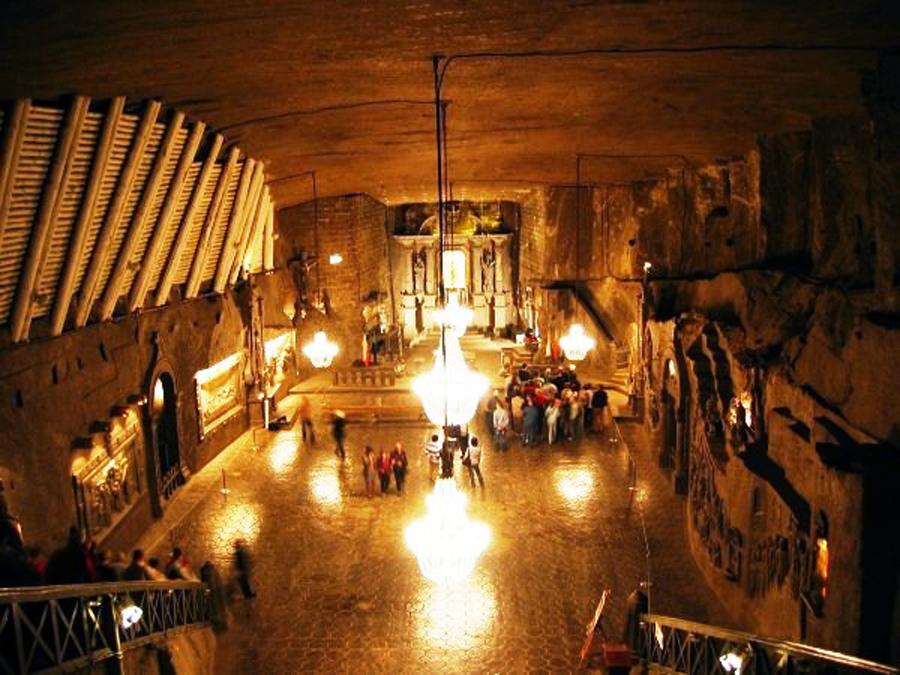
Wieliczka is a town near Kraków in Małopolskie Province in southern Poland. It's best known for its ancient salt mines, which are now a museum.

Niepołomice is a town in Małopolskie Province in the south of Poland, 25 km southeast of Kraków. Its big attraction is the Royal Castle.

Bochnia is a town of almost 30,000 people (2021) in Małopolskie Province in southern Poland, 40 km southeast of Kraków. It has a pleasant old town centre but the big attraction is its salt mine, worked since medieval times.

Tarnów is a historic city in Małopolskie Province in southern Poland, 80 km east of Kraków. The city has a little over 100,000 inhabitants and is an important centre in the region.
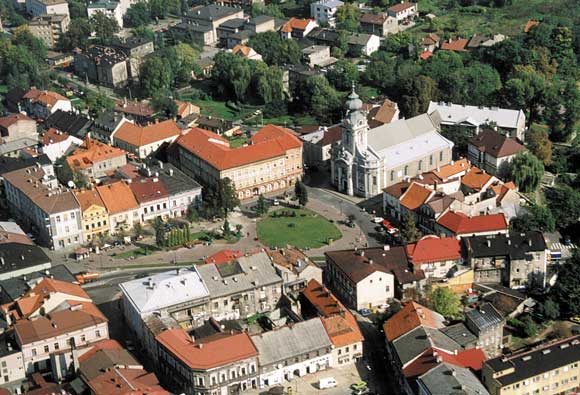
Wadowice is a small town in Małopolskie Province in southern Poland. It's best known as the 1920 birthplace of Karol Wojtyła, Pope John Paul II. Wadowice and the nearby monastery at Kalwaria Zebrzydowska have become pilgrimage sites, easily reached on a day-trip from Kraków.

Kalwaria Zebrzydowska is a small town in Małopolskie Province in southern Poland, with a beautiful UNESCO-listed monastery. It's easily reached on a day-trip from Kraków, often combined with nearby Wadowice the birthplace of Pope John Paul II (open in the mornings).

Sucha Beskidzka is a small town in Małopolskie Province in southern Poland, with a beautiful Renaissance Castle. Famous for its rich natural and architectural heritage, it serves as a popular gateway for hiking and exploring the region.

Zawoja is a straggling village in Małopolskie Province in southern Poland. It's known as the longest village in Poland.

Rabka is a mountain resort and spa in Małopolskie Province in southern Poland, 70 km south of Kraków. Zdrój means "spa" hence the town's longer name of Rabka-Zdrój.

Chochołów is a village in Małopolskie Province in southern Poland, on the border with Slovakia. It has an array of old wooden houses along its main street.

Dębno is a small mountain village in Malopolskie Province in southern Poland. It's sometimes spelled out as Dębno Podhalańskie - the Dębno that's in Podhale region, to distinguish it from the oil town of Dębno in West Pomerania, the tiny Dębno k Lezajska near Rzeszów, and the almost microscopic Dębno near Kielce.

Niedzica is a small town in Małopolskie Province, in the Pieniny mountains of southern Poland.

Szczawnica is a spa town in Małopolskie Province in the mountains of southern Poland.
Biecz is a village at the eastern edge of Małopolskie Province, 125 km east of Kraków (and not to be confused with Biecz near the German border). Like Kraków, its heyday was in medieval times, but it declined as the powerbase moved to Warsaw then Poland fell under foreign occupation.
Krynica is a spa town in Małopolskie Province in the Beskid mountains of southern Poland. Zdrój means "spa" so the town is sometimes spelled out as Krynica-Zdrój.

Limanowa is a small town in Małopolskie Province, in the Beskid mountains of southern Poland.

Nowy Sacz is a historic town in Małopolskie Province, in the Beskid mountains of southern Poland. It is one of the largest towns in the region.
Podkarpackie is a mountainous province in the southeastern corner of Poland. Its name, which can be rendered in English as Subcarpathian, refers to its location at the foot of the Carpathian Mountains.

Zakopane is a large, year-round mountain resort in Małopolskie Province in southern Poland. It's set in the Polish Tatra National Park which is part of the Tatra mountains, the natural frontier between Poland and Slovakia.
Articles and travel topics about Małopolskie and Poland.
 Travel tips
Discover the cheapest countries to visit in Europe in 2026. Compare daily budgets for Albania, Poland, Hungary, Bulgaria, and Portugal with real costs.
8 min read


 Culture & history
The Austro-Hungarian Empire (German: Österreichisch-Ungarische Monarchie, Hungarian: Osztrák–Magyar Monarchia) or Austria-Hungary was a constitutional dual monarchy that existed from 1867 to 1918.
Wikivoyage
 Travel tips
Amusement parks are destinations where there are grouped rides and attractions, with the aim of having as much sensible fun as law, safety and common sense allows.
Wikivoyage
 Nature & adventure
As of 2023 the UNESCO World Network of Biosphere Reserves is made up of 738 reserves in 134 countries of which 22 are transboundary.
Wikivoyage
Every section of the guide. Open one to read it in full.