//

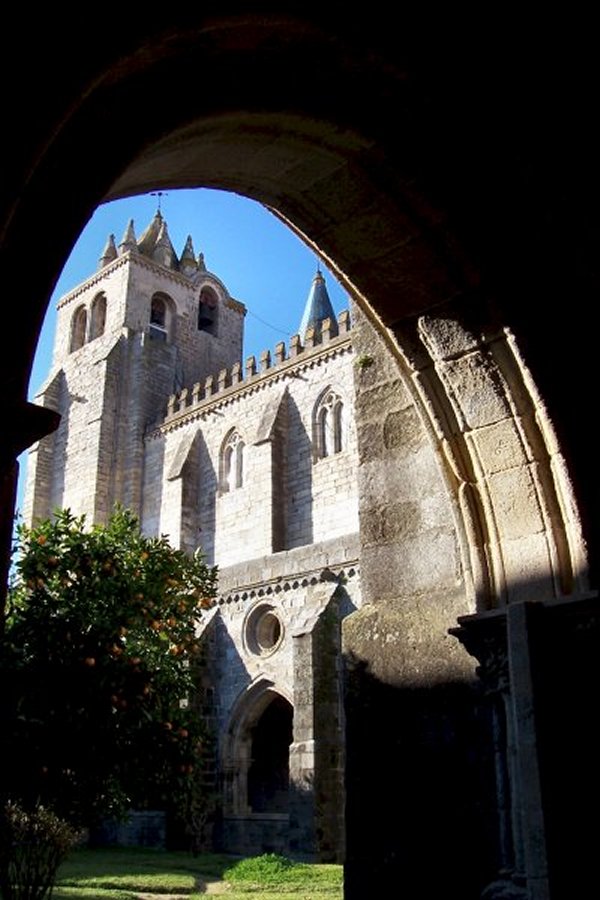
UNESCO World Heritage Site
Photo: David Cross - User: (WT-shared) Davidx at wts wikivoyage, CC BY-SA 4.0 via Wikimedia Commons
Évora is a city and a municipality in the district of Évora, in the Alto Alentejo region of southern Portugal. Due to its well-preserved old town centre, still partially enclosed by medieval walls, and many monuments dating from various historical periods, including a Roman temple, Évora is a UNESCO World Heritage site. It is also a member of the Most Ancient European Towns Network.
From the travel guide. Select a place for details, a map and what is nearby.
Templo romano de Évora
Improperly referred to as the Temple of Diana, was a 1st-century (in some references 2nd or 3rd century) temple, dedicated to the cult of Emperor Augustus, that was incorporated into mediaeval building and, thus, survived destruction. Évora's most famous landmark, it is constructed of 7.68 m (25.20 ft) Corinthian columns and fourteen granite columns, and whose base, capitals and the architraves of marble excavated from Estremoz.
Basílica Sé de Nossa Senhora da Assunção, Catedral de Évora, Sé de Évora
Mainly built between 1280 and 1340, it is one of the most important gothic monuments of Portugal. The cathedral has a notable main portal with statues of the Apostles (around 1335) and a beautiful nave and cloister. One transept chapel is Manueline and the outstanding main chapel is Baroque. The pipeorgan and choir stalls are renaissance (around 1566).
Igreja de São Francisco
Built between the end of the 15th and the early 16th centuries in mixed Gothic-Manueline styles. The wide nave is a masterpiece of late Gothic architecture. Contains many chapels decorated in Baroque style, including the Chapel of Bones (Capela dos Ossos), totally covered with human bones.
Chapel of Bones
Totally ornamented with human bones, surreal, perhaps creepy to some but a must-see. Contrary to what is often said, it is not unique.
Ermida de São Brás
Built around 1480, it is a good example of Mudéjar-Gothic with cylindrical buttresses. Only open for prayer.
Aqueduto da Água de Prata
Designed by military architect Francisco de Arruda (who previously designed the Belém Tower, it was built during the reign of by King João III between 1531 and 1537, the huge arches which stretched 9 km (6 miles) to supply water from the interior to Évora. The aqueduct extended to the Praça do Giraldo, and bisected the city, resulting in the construction of houses, shops and cafés built between the arches (such as in the areas of Rua da Cano, Travessa das Nunes and Rua do Salvador street). A segment of the Roman wall and foundations of period buildings are preserved along Travessa Alcárcova de Cima, a narrow lane in the historic center. This structure was mentioned in the epic poem Os Lusíadas by Luís de Camões.
Chafariz das Portas de Moura, Fonte da Porta de Moura
The Renaissance fountain (in the Largo das Portas de Moura) was built in 1556, and an original design that includes globe surrounded by water (referencing the Age of Discovery).
Colégio do Espírito Santo, Colégio da Companhia de Jesus, Universidade de Évora
Today a nucleus of the University of Évora, the former Jesuit college was ordered constructed by Cardinal-King Henrique in 1559, and includes 16th-century Mannerist elements, in addition to academic buildings constructed between the 17th-18th century (including cloister).
Palácio de Dom Manuel
Remnants of a palace built by King Manuel I in Gothic-Renaissance style. According to some chroniclers, it was in this palace, in 1497, that Vasco da Gama was given the command of the squadron he would lead on his maritime journey to India.
Palácio dos Condes de Basto, Paço de São Miguel da Freiria, Palácio do Pátio de São Miguel
A primitive Moorish castle and later residence of the Afonsine dynastic kings. Its outer architecture displays features of Gothic, Manueline, Mudéjar and Renaissance styles.
Paço dos Duques de Cadaval, Palácio dos Duques de Cadaval
a 17th-century palace, built from the remains of an old castle (burnt down in 1384), and later serving as Governors and Royal residences. The palace includes Manueline-Moorish architectural elements (including the Tower of the Five Shields), and whose first-floor houses a collection of manuscripts, family portraits and religious art from the 16th century.
Igreja dos Lóios
Built in the 15th century, contains a number of tombs; the church and the cloister are Gothic in style, with a Manueline chapterhouse with a magnificent portal. The church interior is covered in azulejos (ceramic tiles) from the 18th century. In 1965 it has been converted into a top-end pousada.
Cromeleque dos Almendres
Megalithic complex, an important megalithic monument in the Iberian Peninsula. It is the largest extant group of structured menhirs in the Iberian Peninsula, and one of the largest in Europe. It's about 10 km from Évora, going by Guadalupe.
Anta Grande do Zambujeiro
Very unusual by its size.
Regional Alentejano cuisine.
Traditional Alentejan cooking specializing in roast suckling pig.
Rustic tavern serving simple, traditional Portuguese cooking.
Small, friendly restaurant serving authentic Alentejan cuisine.
Artisanal hamburgers made using local and national ingredients and global flavours.
Four-star, 22-room hotel in a 16th-century olive oil mill with bar, room service, free breakfast, and free Wi-Fi.
Guest house with free Wi-Fi.
Five star, 92-room hotel in a renovated 15th-century convent with three swimming pools, spa, fitness centre, restaurants, bars, free Wi-Fi, and free parking.
Four-star, 69-room hotel with indoor and outdoor swimming pools, fitness centre, massage rooms, restaurant, bar, meeting facilities, free Wi-Fi, and free parking.
Three-star, 87-room hotel with bar, meeting rooms, free Wi-Fi, and free parking.
Four-star, 36-room pousada in the heart of the historic centre. The inn was originally a convent, Convento dos Lóios. It has an outdoor swimming pool, restaurant, bar, free Wi-Fi, free parking.
Four-star, 185-room hotel with outdoor swimming pool with water slides, heated indoor pool, spa, sauna, Turkish bath, fitness centre, convention centre, two restaurants, bar, and free Wi-Fi.
One of the nicer ways to see the city is by horse carriage ride. You can find them near the cathedral.
Read in the guideChoose an airport to see hotels, stations, taxi ranks and car rental desks around it.
Lisbon · International · LIS
Loading places around the airport…
Articles and travel topics about Évora and Portugal.
 Travel tips
Discover the cheapest countries to visit in Europe in 2026. Compare daily budgets for Albania, Poland, Hungary, Bulgaria, and Portugal with real costs.
8 min read


 Travel tips
Find the cheapest countries to fly to from the US and UK in 2026. Compare realistic round-trip flight deals, budget airlines, and prime booking windows.
8 min read


 Itineraries
Explore Lisbon, Sintra, and Porto with this 7-day Portugal itinerary for 2026. Practical train tips, palace timings, wine tastings, and costs.
8 min read
 Itineraries
Decide between São Miguel and Terceira in the Azores. Compare crater lakes, thermal hot springs, UNESCO heritage, local cuisine, and direct flights.
8 min read
Every section of the guide. Open one to read it in full.