//


Historical region in Croatia and Montenegro
Photo: Niels Elgaard Larsen - (WT-en) Elgaard at English Wikivoyage, CC BY-SA 1.0 via Wikimedia Commons
The highlight is Dubrovnik. Until 2022 this was an "exclave" separated from the rest of Croatia by a strip of Bosnia and Herzegovina. The main islands of this county are Mljet, Korčula and Lastovo.
Makarska is the lively beach resort along the Riveria, hemmed in by mountains. Split is the big attraction and has the airport, with Trogir nearby. The county's main islands are Brač, Hvar and Vis.
This area is the least developed for tourism yet is very scenic; it comprises the counties of Zadar and of Šibenik-Knin. There are many small islands as the coastal mountain range plunges into the Adriatic: two that are close inshore are Murter and Pašman.
By plane: Dubrovnik and Split are the best connected to western Europe, with many package and budget flights in summer. Zadar has fewer international flights but these include London Stansted, Brussels and Düsseldorf.
Read in the guideBy road: there are frequent buses between the main coastal towns.g. the mountain villages, or around the larger islands.
Read in the guideChoose an airport to see hotels, stations, taxi ranks and car rental desks around it.
Split · International · SPU
Loading places around the airport…
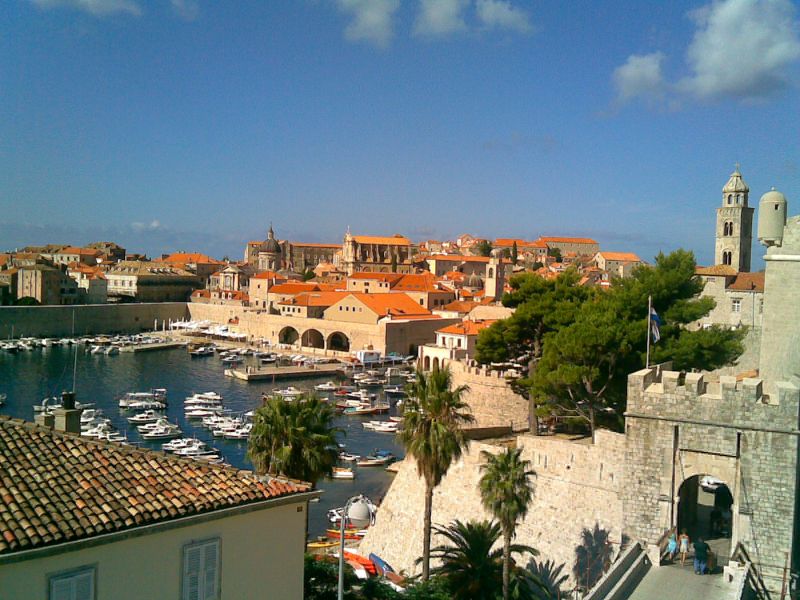
Dubrovnik is a historic walled city on the Adriatic Sea coast in the extreme south of Croatia. It is one of the most prominent tourist destinations in the Mediterranean, a seaport and the centre of the Dubrovnik-Neretva County.

Makarska is the main city and resort of the Makarska Riviera in Split-Dalmatia, between Split and Dubrovnik on the Adriatic coast of Croatia. It's backed by the rugged Biokovo mountains, a national park, and looks out across a channel to Brač island.

Split is a city in Central Dalmatia, Croatia, and the seat of the Split-Dalmatia county. The city was built around the Diocletian palace (a palace/fort built for the retired Roman emperor Diocletian) where the locals sought refuge centuries ago.

Trogir is a preserved medieval town and harbour on the Adriatic coast in Croatia, with a population of approximately 13,000 (2011). The medieval town is a popular day trip from Split, as it is within its metropolitan area.

Šibenik is a city (pop. ~37,000) in Šibenik-Knin County, in northern Dalmatia, Croatia.

Zadar is the biggest city, cultural, economic and transit center of northern Dalmatia and the oldest continuously inhabited city in Croatia. Zadar is today one of the most popular Croatian tourist destinations, named "entertainment center of the Adriatic" by The Times and "Croatia's new capital of cool" by The Guardian in 2017.
Articles and travel topics about Dalmatia and Croatia.
 Culture & history
Where to stand, what it costs and when to go for five of the most famous filming locations on screen, from King's Landing to Arrakis.
7 min read

 Culture & history
The Roman Empire was the greatest ancient empire of Europe. At the height of its power in 117 AD, it ruled over considerable parts of Europe, as well as much of North Africa and the Middle East.
Wikivoyage
 Culture & history
The Austro-Hungarian Empire (German: Österreichisch-Ungarische Monarchie, Hungarian: Osztrák–Magyar Monarchia) or Austria-Hungary was a constitutional dual monarchy that existed from 1867 to 1918.
Wikivoyage
 Nature & adventure
UNESCO Global Geoparks are single, unified geographical areas where sites and landscapes of international geological significance are managed with a holistic concept of protection, education and sustainable development.
Wikivoyage
Every section of the guide. Open one to read it in full.