//

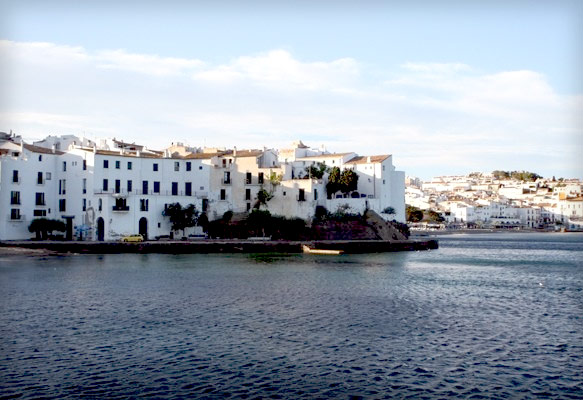
Municipality in Catalonia
Photo: User: (WT-shared) Primecoordinator at wts wikivoyage, CC BY-SA 3.0 via Wikimedia Commons
Cadaqués is a picturesque whitewashed fishing town on the northern Costa Brava, set in a wide bay on the Cap de Creus peninsula in Alt Empordà, Catalonia. Once relatively isolated behind coastal hills, it has preserved a compact historic centre of narrow cobbled streets and low houses clustered around the church of Santa Maria. The town is famous for its association with Salvador Dalí and other artists, and serves as a relaxed base for exploring the coves and landscapes of Cap de Creus Natural Park.
From the travel guide. Select a place for details, a map and what is nearby.
Port Lligat Museum-House
Dali spent many summers in Cadaques and had constructed a house which is now a museum. This house is located in Port LLigat, which is approximately 15–20 minutes walk from the centre of Cadaques. If you want to visit, you have to book your time slot in advance, as only about 10 people every 10 minutes are allowed to enter.
Castell de Sant Jaume
Ruins of a fortress dating back to the 17th century. It was destroyed by the English and rebuilt by the French during the Napoleonic Wars in the 19th century. During its early history it had no defensive role but was only used for observation and signalling, but in later years it adopted a more defensive role.
Santa Maria de Cadaqués
It has a length of 10 m and a width of 10 m, made up of stones and rocks, and sediments from the Sant Pius V creek that flows into it. The beach is accessible to dogs.
it is oriented to the east, with a tendency to the southeast. It has a length of 100 m and an average width of 11 m, made of gravel, with a steep entrance to the water. Nudism is practiced there. To the right of the beach there is a signposted path of about 3.5 kilometers that leads to the Calanans lighthouse.
It has a length of 50 m and an average width of 10 m, consisting of coarse gray sand mixed with pebbles. The slope at the entrance to the sea is not very steep. The beach is accessible to dogs. In front of it is the Island of Sortell, which is accessed by the Pont des Sortell, a picturesque stone bridge, which allows you to reach Es Mirador, the highest point, at 10.5 meters above sea level, where there are panoramic views of the bay.
It is oriented to the east. It has a length of 69 m and an average width of 18 m, made up of sand, gravel and pebbles. There are usually a large number of small boats stranded on the sand. On the first line of the sea is the Costa house, from the beginning of the 20th century, with a tower that characterizes it.
Oriented to the east, it has a length of 93 m and an average width of 18 m, made up of sand, gravel and pebbles. On this beach is the family house of Salvador Dalí, where he spent many summers. Federico Garcia Lorca also visited him.
it is an urban beach. Oriented to the southeast, it has a length of 56.5 m and an average width of 19.4 m, made up of stones and thick dark-colored sand. There are always fishing boats stranded on the sand.
located in the center of the town. It is the largest in the bay of Cadaqués, hence its name. It has a length of 205 m and an average width of 20 m, consisting of sand, gravel and pebbles. The beach receives three different names: Portal in the western section, sa Platja in the central section and Portitxó in the eastern section. In the central section there are two historic bars, El Marítim and El Boia.
in the center of the town, it is delimited by the street that runs along the coast of the Oliguera peninsula. It has very good views of the town. It faces south, with a southwest trend, has a length of 30 m and an average width of 10 m, made up of stones and coarse sand, with a gentle entrance slope to the water, and is protected from swell It is usually occupied by stranded fishing boats.
It is oriented to the southwest, with very good views of the town. It has a length of 40 m and an average width of 10 m, consisting of stones and coarse dark-colored sand, with a gentle entrance slope to the water, and is protected from the swell. It is usually occupied by stranded fishing boats.
Oriented to the south, it has a length of 100 m and a width of 10 m, it is made up of sand and pebbles, with a moderate entrance slope to the water. It is usually full of boats stranded on the sand.
Oriented to the west, it has a length of 80 m and a width of 8 m, made up of sand and pebbles, with an entrance slope to the soft water. The name of en ros comes from a capital of a 16th century brig that plyed the Cadaqués-Barcelona route and was also the owner of the vineyard behind the beach.
Oriented to the south, it has a length of 70 m and a width of 10 m, made up of stones and coarse sand. Nudism is practiced there.
It is very common to find small fishing boats on the shore of the beach. It is 24 m long and 12.5 m wide, made up of fine sand, gravel and pebbles.
It has a length of 24 m and an average width of 12 m, of fine sand, gravel and pebbles. It is surrounded by the dirt track that borders the sea front. Submerged in the water you can find the remains of a shipwreck from 1921, it is the boiler of the French pailebot Douaumont.
Oriented to the east - southeast, it is 12 m long and 32 m wide, made up of gravel and pebbles. The entrance to the water is complicated by the abundance of rock formations that surface at water level or remain at a shallow depth.
It is oriented to the south-southeast, has a length of 40 m, formed mainly by pebbles. The beach has a row of stones that divides it in two. In front of the beach, at a depth of about 15 m, there are the remains of the ship Llanisshen, a British steamer that sank after being torpedoed by a German submarine in 1917, in the middle of the First World War.
located in the south of the island of Portlligat. It has a length of 76 m and an average width of 11 m, made up of gravel and pebbles. It is the largest beach on the island. It can be accessed by walking from Pep Ton beach, in the bay of Portlligat, through the shallow waters of the Passage de ses Boquelles, a channel about 30 m wide that separates the island from land firm
located in the bay of Portlligat, in an environment with few buildings, in front of the island of Portlligat, separated from it by the passage of Ses Boquelles. It has a length of 31 m and an average width of 6 m, consisting of coarse sand, gravel and pebbles. The beach is accessible for dogs.
It is oriented to the northwest. Its waters are very sheltered and shallow. Its name betrays that it is a hot place, despite its orientation. It consists of two beaches of 28 m length each and an average width of 6 m, made up of coarse sand, gravel and pebbles.
Oriented to the east, it is very protected by the peninsula of s'Oliguera and the island of Portlligat. It has a length of 186 m and an average width of 21 m, consisting of coarse sand and stones, with a shallow entrance to the water, and a shallow bay. Part of the beach area, closest to the houses, is occupied by fishing boats. It doesn't have any services, but there are two bars and kayaks are rented in the summer.
It has a length of 66 m and an average width of 14 m, consisting of coarse sand and stones, with an entrance slope to the gentle water. There are often fishing boats stranded on the sand.
Platja S'Alqueria Petita
Oriented to the east southeast, it has a length of 30 m and an average width of 7 m, made up of coarse sand and pebbles. Sheltered and lonely, it usually has calm waters, even when the north wind blows. The name of the beach refers to the surname of the local rector and owner of a nearby vineyard.
Oriented to the southeast, it has a length of 59 m and an average width of 20 m, formed by flattened pebbles. In front of the beach is the islet of s'Alqueria, near the tip of the same name. Nudism is practiced there.
One of the rare places where you can eat full meals between 16:00 and 20:30, when most cafes are closed. Gaspatzo and pizza are good; fish is not.
Owned and run by the Martin Faixo family, it offers fresh sea-food and a recommended paella.
Serves local cuisine in a cute hidden street. It has not many places outside, hence reservation recommended.
The restaurant serves reasonably priced special food. Be patient for the service.
The restaurant serves fresh sea-food of the day, no menu. Due to small space you will be seated with other guests at a large table in the small dining room.
Mateu Casañas and Eduard Xatruch opened the place in 2012. They used to work in the famous El Bulli restaurant. Compartir means sharing in Catalan. All plates are put in the middle on the table to share. The entrees including the oyster or the tuna on liquid salad are extremely good as the desserts. The service is extremely friendly and strikes for perfection.
A traditional and popular meeting place in the town center.
Wonderful little restaurant on promenade that serves local dishes and has wonderful ambiance.
Arrels Hotel Cadaqués
The Arrels Hotel is situated within a 35 000 square meter property above the entrance to the village of Cadaqués. An incomparable place with an emphasis to detail, tranquility, personal attention and spectacular views that help create a unique atmosphere as well as a romantic and exclusive setting. It is an ideal place for couples and exclusively for over 18 year olds.
Hotel Arrels, during the sixties, was emblematic and also the meeting place for the “ Gauche Divine” (the much talked about in the media heterogeneous movement). A melting pot of culture and history where intellectual discussions thrived but also creativity and artistic thoughts abounded. It was also one of the first open air discotheques in the country, the favourite haunt of painters such as Dali, writers like Rosa Regas, architects such as Ricardo Bofill and Oscar Tusquets.
Directly on the sea-side.
By train
There's no direct train connection to Cadaqués, but you can make the first part of your ride by train.
By bus
The company Sarfa operates a daily service direct from Barcelona to Cadaqués. The timetable changes depending on the season.
By boat
It is possible to catch a ferry from the nearby town of Roses. During much of the year these ferries travel several times a day.
By car
Arriving by car is quite easy; there are several free parkings in the city. One of them is left side from the downtown when you arrive by car, close to the beach (open 09:00-20:00).
By foot
Because of the geography surrounding the town of Cadaqués, the traditional way for the town people to travel was walking, by boat (rowing or sailing) or by "Tartana".
Choose an airport to see hotels, stations, taxi ranks and car rental desks around it.
Girona · International · GRO
Loading places around the airport…
Articles and travel topics about Cadaqués and Spain.
 Travel tips
Understand travel insurance for a Schengen visa in 2026. Learn mandatory €30,000 medical coverage, zero deductible rules, and embassy-approved policies.
7 min read


 Travel tips
Estimate your Europe trip cost for 2 weeks in 2026. Compare realistic budgets for lodging, Eurail trains, dining, and sightseeing across three styles.
8 min read
 Travel tips
Find the cheapest countries to fly to from the US and UK in 2026. Compare realistic round-trip flight deals, budget airlines, and prime booking windows.
8 min read


 Inspiration
Explore the best places to visit in November across autumn foliage, mild desert warmth, southern spring blooms, and off-peak travel bargains.
7 min read
Every section of the guide. Open one to read it in full.