Money and payments
Cards and cash
DTB bank, Ecobank, CRDB, and KCB have ATMs in Burundi where you can get a cash withdrawal with Visa Card or MasterCard.


 Africa · Eastern AfricaOutline guide
Country in East Africa
Photo: The original uploader was Luna04 at French Wikipedia. Later versions were uploaded by Nécropotame at fr.wikipedia., Public domain via Wikimedia Commons
Burundi is a small country in East Africa, although it has some cultural and geographical ties with Central Africa. It is surrounded by Rwanda, Tanzania and the Democratic Republic of the Congo. Although the country is rich in culture and history, the country has been in a state of instability since gaining independence in the 1960s. Burundi is one of the world's poorest and least developed countries and has a myriad of social, political, and economic problems.
Answers to what travellers most often look up about Burundi.
Cards and cash
DTB bank, Ecobank, CRDB, and KCB have ATMs in Burundi where you can get a cash withdrawal with Visa Card or MasterCard.
French, Kirundi
Although most travellers will find that they can get around passingly well with a working knowledge of French and increasingly English, some familiarity with Swahili or the related local language, Kirundi, is helpful,…
Be careful of kiosk foods and avoid unboiled water. Also ensure you have been vaccinated.
As is the case in all African countries, Burundi is a hierarchial society, which means that respect for elders is important.
Attractions, food, stays and travel essentials, with ratings, reviews, opening hours and directions.
the capital and second largest city, in the middle of the country

the largest city and longtime capital, situated on the north-eastern shore of Lake Tanganyika
southern city
north-western city
Kabezi is in the western part of Burundi. It is one of the communes of the province of Bujumbura and is on the shores of Lake Tanganyika.

The Natural reserve of Bururi is a 3300 ha expanse of altitude damp forest. The town of Bururi offers visitors this wonderful panorama, to visit the park first go to the INECN office in Bururi, it's not common knowledge among Bururians that you have to do this first. If you are told that there is no entry fee and no guides are available, this is not true. At the office you can pay the entry fee (FBu5,000) and arrange a guide FBu5,000. In this place there are about 117 species of birds and 25 species of mammals have been identified in a forestland surrounding of multifarious vegetation. On a walking circuit along the botanical lanes and trails of this forest the visitor will fully enjoy the wild coolness of our mountains densely covered with trees of many different species. This region is 33 km from Roumonge. The road through it will drive you from the lakes along miles of hallucinating and breathtaking panoramas.

Kibira National Park (French: Parc national de Kibira) is a vital national park located in northwestern Burundi. Covering approximately 400 km² (150 sq mi) and spanning four provinces, it lies atop the mountains of the Congo-Nile Divide.
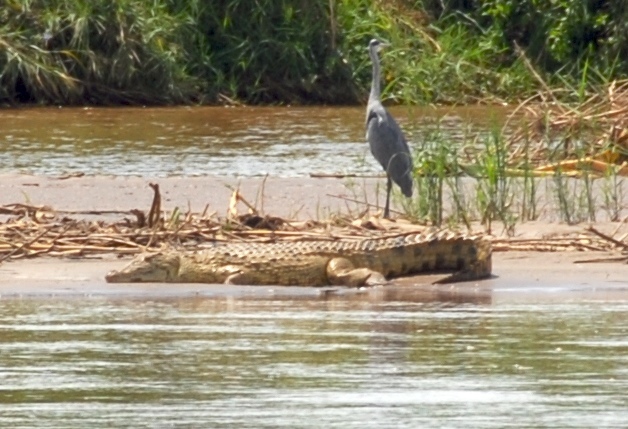
Home to Gustave, the infamous man-eating crocodile, Rusizi National Park will be your first visit in Burundi for the simple reason that it is very near the capital city of Bujumbura. The River Delta extends over 500 ha of vegetation made of Phragmites mauritianus. It is a natural shelter for few families of antelopes and hippopotamuses that come here in quest of grazing land. At the end of the track if you are lucky enough you may meet with a few crocodiles fast asleep on the golden sand of the river banks. The Rusizi palm groves (situated on the Cibitoke road 10 km away from Bujumbura) is also an exceptional landscape that will no doubt make your mind drift away from your day to day preoccupations. It offers to the visitor a rich vegetation completely adapted environment gratified by only a few sparse rains, made of euphorbia, thorny bushes and tall palm trees of the Hyphaena bengalensis var ventricosa species. Right in the deepest part of the reserve you will be able to admire the natural ponds left by the Rusizi meanders. This place is a paradise for birds which come by the hundred and feed themselves by dive-fishing. If you are patient enough you will be able to see some hippopotamuses paddling in the shallow waters.
Public transport and paid services in Burundi.
By bus
There are buses between Bujumbura and other cities in the country.
By taxi
Taxi is an option for intercity travel as well. For example a roundtrip between Bujumbura and Gitega by taxi would cost you around $50 including the fuel.
By car
Traffic culture is moderate, but motorists should be careful. Beware of pedestrians walking in the middle of the road, don't be afraid to use the horn.
Apps for booking a taxi or a ride in Burundi.
Finding apps for Burundi…
Choose an airport to see hotels, stations, taxi ranks and car rental desks around it.
Bujumbura · International · BJM
Loading places around the airport…
Calculated from climate averages: mild daytime highs and lower rainfall. It does not account for festivals, crowds or prices.
Average conditions in Gitega
| Jan | Feb | Mar | Apr | May | Jun | Jul | Aug | Sep | Oct | Nov | Dec | |
|---|---|---|---|---|---|---|---|---|---|---|---|---|
| Avg. high | 25° | 26° | 26° | 25° | 25° | 24° | 25° | 26° | 27° | 26° | 25° | 25° |
| Avg. low | 17° | 18° | 18° | 17° | 17° | 15° | 15° | 16° | 17° | 18° | 17° | 17° |
| Rainfall (mm) | 202 | 168 | 219 | 213 | 94 | 29 | 15 | 42 | 94 | 172 | 341 | 219 |
| Humidity | 76% | 74% | 76% | 79% | 76% | 70% | 63% | 60% | 61% | 67% | 76% | 77% |
Choose your passport and destination to see whether you need a visa.
Budget
$45
Per person, per day
Mid-range
$130
Per person, per day
Luxury
$350
Per person, per day
| Budget | Mid-range | Luxury | |
|---|---|---|---|
| Accommodation | $25 | $75 | $205 |
| Food and drink | $10 | $25 | $65 |
| Local transport | $5 | $10 | $30 |
| Activities | $5 | $20 | $50 |
Estimate from World Bank price levels (2025). Actual costs vary by city and season. World Bank
—
We do not label countries as safe or unsafe. Below is the official advice from two governments, with the date it was last updated. Always read the full advice before you travel.
US Department of State
Level 3 of 4Reconsider travel
Reconsider travelto Burundi due to political violence, crime, and health. Some areas have increased risk. Read the entire Travel Advisory. The possibility for political violence exists throughout Burundi. Police and military checkpoints are common and can limit movement. Police may search private homes for weapons. The borders may close without notice. Violent crimes like assault, carjacking, home invasion, grenade attacks, and armed robbery are possible. Criminals may target foreigners and residents suspected of having large sums of cash. Local police lack the resources and training to respond effectively to crimes. Medical services in Burundi fall well below U.S. standards, and there are no adequate trauma services in the country. Emergency medical and fire services are limited or non-existent in some areas of the country. Even relatively minor health problems may necessitate a medical evacuation at the traveler’s expense. Medical evacuation insurance valid for travel to Burundi is strongly recommended. Due to the risks, the U.S. government has limited ability to provide emergency services to U.S. citizens throughout Burundi. U.S. Embassy staff are subject to restrictions when traveling in certain areas of Burundi and may be subject to other constraints as security conditions warrant. U.S. government employees working in Burundi are prohibited from travelling outside Bujumbura Mairie during hours of darkness (typically 6:00 p.m. to 6:00 a.m.). Due to the risks, the U.S. government may be unable to provide emergency services to U.S. citizens in the following areas: The…
UK Foreign, Commonwealth & Development Office
Advises against all travel to parts of the country
Your travel insurance could be invalidated if you travel against advice from the Foreign, Commonwealth & Development Office (FCDO). Areas where FCDO advises against travel Parts of Bujumbura Province FCDO advises against all travel to Mugina, Cibitoke, Bukinyayana, Bubanza and Mpanda communes due to the risk of the presence of a rebel group in the Kibira National Park and possible armed incursions from the Democratic Republic of the Congo (DRC). FCDO advises against all travel to parts of Ntahangwa commune, specifically the RN5 road north of Melchior Ndadaye International Airport in Bujumbura towards Cibitoke and west of the Rusizi river towards the border with DRC, including Rusizi National Park (also known as Rusizi Delta Nature Reserve). This is due to possible armed incursions from DRC. Parts of Butanyerera Province FCDO advises against all travel on the main RN6 and RN10 roads running west from Kayanza through the Kibira National Park towards Cibitoke, due to the risk of the presence of a rebel group and possible armed incursions from DRC. Find out more about why FCDO advises against travel. Burundi-DRC border Armed group activity and conflict along the border between Burundi and DRC has increased. Be cautious and keep up to date with developments through local media, given heightened insecurity. Armed group activity and the movement of military and refugees in Democratic Republic of Congo (DRC) could affect people on the Burundian side of the border, in Bujumbura Province. The security situation in DRC near to Burundi’s border is unstable (see Democratic Republic…
Stories, itineraries and practical advice for travelling in Burundi.
 Itineraries
The Nile (Arabic: النيل, an-Nīl), is Africa's longest river, and by most definitions the longest in the world at 6,695 kilometers (4,132 miles) from its source White Nile in Burundi/Rwanda to its mouth at the Egyptian…
Wikivoyage
 Itineraries
This itinerary describes the overland route from Cairo, Egypt, to Nairobi, Kenya, by public transport. This is more or less the only surface route from North Africa to East Africa accessible to Westerners, and so most…
Wikivoyage
 Culture & history
World War I, usually called the First World War in the Commonwealth and called The Great War in its time, was one of the largest armed conflicts in history.
Wikivoyage
 Travel tips
The world has over 5,000 different languages, of which more than twenty have 50 million or more speakers. Travel can bring you into contact with any of these.
Wikivoyage
Every section of the guide. Open one to read it in full.