Money and payments
Cards and cash
ATMs exist mostly all over the country, particularly in urban areas.
Tipping
Tipping taxi drivers is not customary.


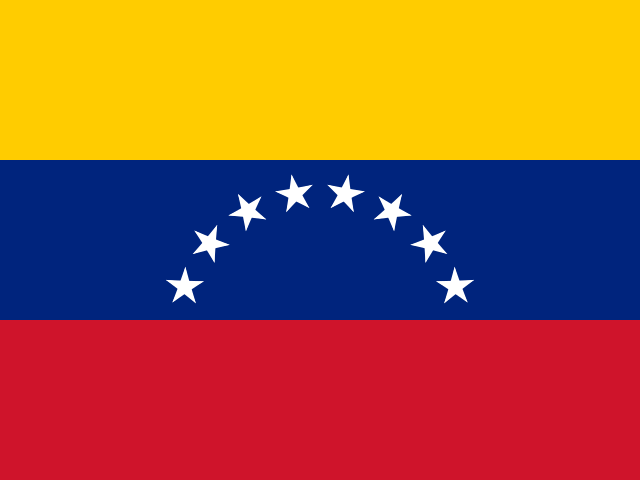 Americas · South AmericaOutline guide
Country in South America
Photo: Elias Rodriguez Azcarate, CC BY-SA 3.0 via Wikimedia Commons
Venezuela is replete with stunning natural wonders and sights such as countless national parks, magnificent waterfalls, and three s. The world's tallest waterfall, the Angel Falls (Kerepakupai Vená), is found here.
Answers to what travellers most often look up about Venezuela.
Cards and cash
ATMs exist mostly all over the country, particularly in urban areas.
Tipping
Tipping taxi drivers is not customary.
Spanish
Spanish is the official language of Venezuela, accompanied by numerous indigenous languages (usually never heard except in the Amazon region).
You should preferably buy bottled water and not drink from the tap, but iced drinks and salads are generally fine (depending on the water supply quality of your native country).
There is a severe shortage of medical supplies in Venezuela, so you may have difficulty getting adequate treatment in an emergency.
Most Venezuelans are laid-back regarding racial issues, since white or creole persons blend naturally with natives and Afro-Venezuelans in everyday life (education, living, politics, marriage).
Attractions, food, stays and travel essentials, with ratings, reviews, opening hours and directions.

Being the capital and the largest city in Venezuela, Caracas is known for being one of the most cosmopolitan and modern cities in South America. There are lots of places to visit, such as theaters, malls, museums, art galleries, parks, well-conserved colonial architecture and even gourmet restaurants.

The first capital of Venezuela and a city of rich colonial architecture, a unique natural scenery and tourist attractions. Its historical downtown is considered as a cultural World Heritage Site.

Stop-off point for flights to Angel Falls, and a comfortable stopover to Brazil.

Dominated by heavy industry, it is Venezuela´s most organized city and the main gateway to the Orinoco Delta and the Gran Sabana. It is locally still known as either Puerto Ordaz or San Félix.

Venezuela's second largest city, swelteringly hot and built on oil.

Once the capital of Venezuela, now home to the main military garrison.

A charming university town in the Andes mountains, popular for outdoor activities.

The city to go to if you want to visit the beaches in Eastern Venezuela.

the world's highest waterfall.

Choroní is a popular beach destination in Aragua state in Central Venezuela.

Archipelago de Los Roques is a chain of islands and coral reefs in the Caribbean Sea about 166 km north of the Venezuelan mainland. Administratively, they are part of Venezuela's Federal Dependencies.

Margarita Island (Spanish: Isla de Margarita) is in the Venezuelan state of Nueva Esparta, off the northeastern coast of the mainland and to the northeast of the country's capital Caracas.

Mochima National Park is in Sucre state, off the Northeast of Venezuela.

Morrocoy is in the state of Falcón in Northwest Venezuela.

Los Llanos is the vast plains region covering much of central and southwestern Venezuela.

La Gran Sabana is a region in the Bolívar State of South-east Venezuela.
Places in Venezuela on the World Heritage List.

Canaima National Park
Listed 1994

University City of Caracas
Listed 2000

Coro and its Port
List from Wikidata (CC0). Photos from Wikimedia Commons.
Mountainous and picturesque, this region is made up of the states of Mérida, Táchira and Trujillo.
With more than 600 islands and smaller formations, many of the best beaches can be found here. It is composed of the Federal Dependencies and Nueva Esparta.
Thew most populous part of Venezuela enjoys great beaches and big cities, from Caracas and the nearby commuter towns in Miranda and Vargas out to the states of Aragua and Carabobo.
The immense and largely uninhabited area south of the Orinoco River, which makes up around half of Venezuela's national territory, includes rainforest in Amazonas, table-top mountains in the Gran Sabana and Bolívar state, and the flat marshlands extending out to Delta Amacuro.
Vast open plains, home to cattle-ranching and amazing wildlife, made up of the states of Apure, Barinas, Cojedes, Guárico and Portuguesa.
Stunning deserted beaches in Anzoátegui and Sucre, as well as hills and caves in Monagas state.
Rich with oil from Zulia state, the Northwest also boasts more beaches in Falcón state and a lush agricultural countryside in Yaracuy and Lara states.
Public transport and paid services in Venezuela.
By train
As of 2026, there is only a single line of some 40 km operated by the state railway connecting Caracas and Cúa via Charallave.
By bus
The bus system is extensive and extremely affordable (in part due to the low price of fuel).
By road
As the majority of the region, Venezuelan traffic is left-driving. A large and paved road network (which comprises approx.
Apps for booking a taxi or a ride in Venezuela.
Finding apps for Venezuela…
Other ways to travel:In cities
Choose an airport to see hotels, stations, taxi ranks and car rental desks around it.
Maiquetía · International · CCS
Loading places around the airport…
Calculated from climate averages: mild daytime highs and lower rainfall. It does not account for festivals, crowds or prices.
Average conditions in Caracas
| Jan | Feb | Mar | Apr | May | Jun | Jul | Aug | Sep | Oct | Nov | Dec | |
|---|---|---|---|---|---|---|---|---|---|---|---|---|
| Avg. high | 29° | 31° | 32° | 30° | 28° | 27° | 27° | 27° | 28° | 27° | 27° | 28° |
| Avg. low | 19° | 20° | 21° | 22° | 21° | 21° | 20° | 21° | 21° | 21° | 21° | 20° |
| Rainfall (mm) | 19 | 17 | 49 | 124 | 154 | 157 | 142 | 149 | 148 | 144 | 93 | 38 |
| Humidity | 67% | 60% | 59% | 70% | 78% | 83% | 84% | 84% | 82% | 83% | 83% | 74% |
Choose your passport and destination to see whether you need a visa.
Budget
$25
Per person, per day
Mid-range
$55
Per person, per day
Luxury
$140
Per person, per day
| Budget | Mid-range | Luxury | |
|---|---|---|---|
| Accommodation | $10 | $30 | $85 |
| Food and drink | $5 | $10 | $20 |
| Local transport | $5 | $5 | $10 |
| Activities | $5 | $10 | $25 |
Estimate from World Bank price levels (2011). Actual costs vary by city and season. World Bank
—
We do not label countries as safe or unsafe. Below is the official advice from two governments, with the date it was last updated. Always read the full advice before you travel.
US Department of State
Level 3 of 4Reconsider travel
Reconsider travelto Venezuela due to risk of crime, kidnapping, terrorism, and poor health infrastructure and natural disaster. Some areas have increased risk. Read the entire Travel Advisory. Natural disaster On June 24, 2026, Venezuela experienced a powerful foreshock and earthquake in rapid succession. These caused extensive damage and disruption to transportation, infrastructure, and emergency services. The Consular Section at the U.S. Embassy in Caracas is currently providing emergency services only to U.S. citizens. Review the U.S. embassy website for the latest updates. Review information about staying safe during and after an earthquake. Stay in touch with transportation companies and advice from local authorities. U.S. embassy operations In March 2026, the U.S. Embassy in Caracas resumed operations, including the provision of limited consular services for U.S. citizens in Venezuela. The Consular Section at the U.S. Embassy in Caracas is currently providing emergency American Citizens Services only. The U.S. Embassy in Caracas can only provide limited emergency services to U.S. citizens outside of Caracas. Visa services in Venezuela remain suspended. Visa services are provided through the U.S. Embassy in Bogota, Colombia. Crime and kidnapping Conditions in some parts of Venezuela remain dangerous. Violent crimes such as homicide, armed robbery, and kidnapping occur. Travelers face increased risk using unregulated taxis from Maiquetia Simon Bolivar International Airport serving Caracas. Security risks are also present when using ATMs near the airport. Nighttime…
UK Foreign, Commonwealth & Development Office
Advises against all travel to parts of the country
Your travel insurance could be invalidated if you travel against advice from the Foreign, Commonwealth & Development Office (FCDO). Areas where FCDO advises against all travel Border areas FCDO advises against all travel to: within 40km (25 miles) of the border with Colombia within 40km (25 miles) of the border with Brazil within 40km (25 miles) of the border with Guyana Amazonas FCDO advises against all travel to Amazonas state. Bolívar FCDO advises against all travel to the Orinoco Mining Arc (‘Arco Minero’) region to the south of the Orinoco river. This includes: all of Cedeño Municipality the northern part of Sucre Municipality, from the Orinoco river to 80km south of the Troncal 19 road the northern part of Raul Leoni Municipality, north of the Rio Paragua all of Piar Municipality all of Roscio Municipality all of El Callo Municipality all of Sifontes Municipality Delta Amacuro FCDO advises against all travel to the area to the south of the Orinoco river. The FCDO advises against all but essential travel to the remaining areas of Venezuela including Zulia state, Maracaibo and the eastern shore of Lake Maracaibo. If you are a British national already living or travelling in Venezuela, you should be prepared to change your plans quickly if necessary. You should have a ‘personal emergency plan’, including practical steps for leaving the country or staying safe during a crisis, that does not depend on support from the UK government. Before you travel, check the ‘Entry requirements’ section for Venezuela’s current entry restrictions and requirements. These may…
Stories, itineraries and practical advice for travelling in Venezuela.
 Nature & adventure
In total, there are 43 national parks in Venezuela.
Wikivoyage
 Food & drink
Colourful and diverse, street food is an experience you can find in cities and towns all around the world. It's generally convenient and cheap, but its appeal goes far beyond that.
Wikivoyage
 Itineraries
This itinerary details travelling downstream on the Amazon from Iquitos via Tabatinga, Manaus, Santarém, Santana/Macapá to Belem.
Wikivoyage
 Itineraries
The Gringo trail is a term for places in Latin America visited by gringos, that is, people from North America or Europe. It is the Western Hemisphere's equivalent of tropical Asia's Banana Pancake Trail.
Wikivoyage
 Nature & adventure
For destinations named "Hot Springs", see the Hot Springs disambiguation page. Hot springs are natural features resulting when ground water is heated (sometimes far beyond the level of human endurance) by geothermal…
Wikivoyage
 Culture & history
Old towns of South America outlines a list of notable old towns in South America.
Wikivoyage
Every section of the guide. Open one to read it in full.


