//

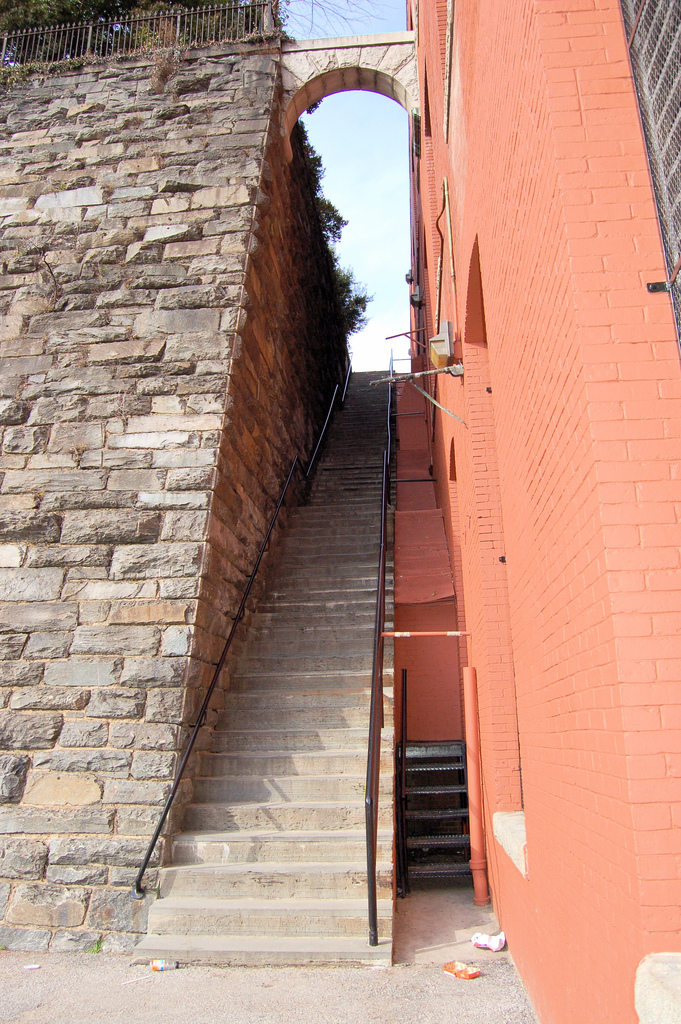
Made famous by the 1973 horror movie, the "Exorcist Steps" run between Prospect and M St just west of where the Key Bridge deposits people into D.C. In addition to grisly ends to men and devils, the steps are popular among Georgetown students looking for a serious workout during their daily jog along the Potomac.
The Exorcist steps are concrete stairs, continuing 36th Street, descending from the corner of Prospect St and 36th St NW, down to a small parking lot, set back from the intersection of M Street NW, Canal Rd NW, and Whitehurst Freeway NW in the Georgetown neighborhood of Washington, D.C., famous for being featured in the 1973 film The Exorcist. The steps were built in 1895 by George Killeen, a prominent local Democratic figure, during construction of the adjacent Capital Traction Company Barn for cable cars, serving as a lightwell and public right of way. There is a family legend of George Killeen that the wall's construction was a handshake agreement and that Killeen was never paid for its completion. Before the Exorcist association, the stairs were informally called "Hitchcock steps" for famed suspense and horror film director Alfred Hitchcock.
© OpenStreetMap contributors
The bridge opened in 1889 and was used to transport boats between the C&O and Alexandria canals. The bridge was demolished in 1933, after the construction of the Key Bridge and the closing of the canals. Now, it is a grassy, peaceful area with great views of the Key Bridge and some unique graffiti!
It's hard to notice anything on this very large quadrangle other than the enormous Healy Hall (1897), a national historic landmark, whose high-set Flemish-Romanesque towers loom over the neighborhood, and even the city. It is named after Patrick Healy, who had an impressive career of firsts: the first African-American president of a major U.S. university, the first African-American with a PhD, and the first African-American Jesuit priest. During the day you can wander inside the building to appreciate the interior—Gaston Hall at the north end of the third floor should be your main objective, as it is both beautiful and has hosted endless visits by foreign and domestic heads of state. In the summer, these visits are often free to the public and not very well attended, so you might be able to get in and talk foreign policy with a king or two. Check the university's events website.
This quadrangle was the original land purchase upon the founding of the university. The chapel (1893) at the south end, beautiful inside and out, is best known to the world for its role in The Exorcist, where the priests discovered the defaced statue of the Virgin Mary. The oldest building on the quad is Old North (1795) on the north side, from which Abraham Lincoln gave his speech in 1861 to Union soldiers stationed here. The best time to visit is undoubtedly at the end of the cherry blossom season, when the petals are beginning to fall throughout the quad.
Built in 1796 as a neighborhood pub, the City Tavern is the oldest commercial structure in the city, and the second oldest building following the Old Stone House. The interior is a beautiful trip back to the 18th century, but it is closed to the public, except for private event bookings.
A 10-acre National Park that traces the path of the Potomac River from the Key Bridge to the Washington Harbor Complex. The park itself features an interactive fountain, water steps, lawns to relax upon, and walking/cycling paths. There are also scenic river overlooks and a labyrinth to explore.
Built in 1765, this is the oldest original structure in Washington, D.C. For a while it was a used car dealership, but since the 1950s it has been operated by the National Park Service as a house museum showcasing pre-revolutionary colonial life in Georgetown, as well as a small English garden in the back.