//

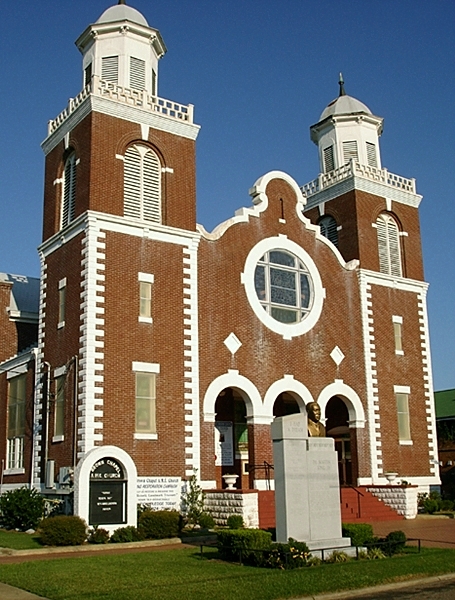
Photo: Altairisfar, Public domain via Wikimedia Commons
This house of worship is a historical site of essentially where the Voter Registration Act began with such visionaries as Reverend Ralph Abernathy, statesman John Lewis, and Dr. Martin Luther King, Jr meeting to start the grassroots campaign, and where the latter spoke on the topic of redress, in defiance of the authorities. The church is in a bit of a rough neighborhood, so use common sense.
Brown Chapel A.M.E. Church is a church at 410 Martin Luther King Jr. Boulevard in Selma, Alabama, United States. This church was a starting point for the Selma to Montgomery marches in 1965 and, as the meeting place and offices of the Southern Christian Leadership Conference (SCLC) during the Selma Movement, played a major role in the events that led to the adoption of the Voting Rights Act of 1965. The nation's reaction to Selma's "Bloody Sunday" march is widely credited with making the passage of the Voting Rights Act politically viable in the United States Congress.
© OpenStreetMap contributors
The Edmund Winston Pettus Bridge was the scene of the Selma to Montgomery March in 1965. The demonstrations that occurred here led to the U.S. Voting Rights Act of 1965. The bridge was erected in 1939 and named after U.S. Senator Edmund Winston Pettus.
A Greek Revival mansion of outstanding quality built in 1856, if you're wanting to explore an antebellum era property.
Another antebellum-type home. The third floor has been restored to a mid nineteenth century hospital.
Discover here the original capital of the Cotton State, from 1819-1826, beside the muddy Alabama River. Very rustic, like Alabama's very own ghost town.