//

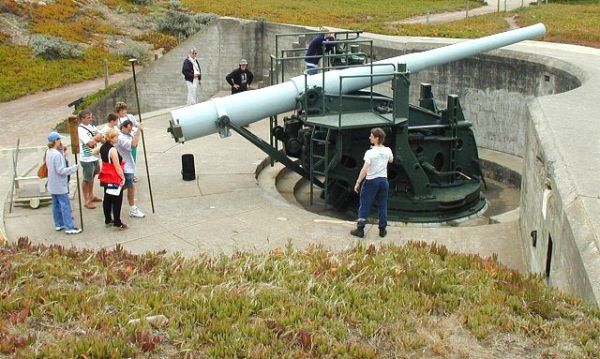
Photo: National Park Service, Public domain via Wikimedia Commons
Battery Chamberlin, built near Baker Beach in 1904, was constructed as part of a modernization effort to accommodate the lighter, stronger, more powerful coastal defense weapons developed in the 1880s. Today Battery Chamberlin holds the last 6-inch "disappearing gun" of its type on the West Coast.
Battery Chamberlin is an artillery battery in the Presidio of San Francisco, San Francisco, California, United States. The battery is named in honor of Captain Lowell A. Chamberlin, who had served with distinction in the Civil War. It was added to the National Register of Historic Places on November 7, 1976.
© OpenStreetMap contributors
A beautiful, immaculately kept 1-mile stretch of beach, set just behind the Golden Gate Bridge. Unfortunately, due to strong currents, the beach is not very safe for swimming, but for "land-lovers" it does have many outdoor barbeques and designated picnic areas to eat and relax at. Toward the northern end of the beach there is also an unofficial nude section that mainly seems to attract gay men. It has free parking and clean restrooms.
One of three memorials on U.S. soil dedicated to missing service members of World War II, the West Coast Memorial is a curved wall of California granite set in a grove of Monterey pine and cypress. Overlooking the Pacific Ocean, it bears the names of 413 members of the Armed Forces who lost their lives or were buried at sea in the offshore Pacific coastal waters.
Contains the last free-flowing stream in San Francisco, which provides water to the inhabitants of the Presidio.
Beaches and rocky shoreline lie at the base of the coastal bluffs, while their tops provide expansive views of the Pacific coastline. The Coastal Trail extends along the wind-swept coastal bluffs, where some of the most intact natural habitat in the Presidio harbors rare plants adapted to serpentine soil and cool foggy conditions.
Built in 1875, the Public Health Service Hospital tended the needs of merchant seamen. Eventually the hospital also cared for members of the U.S. Coast Guard and other governmental agencies, Native Americans and Vietnam refugees. In addition, important research on plague diseases was conducted here. A new hospital replaced the old in 1932, and two wings were added in the 1950s. The hospital closed in 1981 and was transformed into apartments.
Situated near the gun batteries of the coastal bluffs, Fort Scott was established in 1912 to serve as headquarters for the Coastal Artillery Corps of the San Francisco Bay area. Spanish Revival style buildings, the first of this style to be built on the Presidio, characterize the post, and the U-shaped parade ground breaks from traditional quadrangular design. The post was eventually converted to an Army Education Center.