//

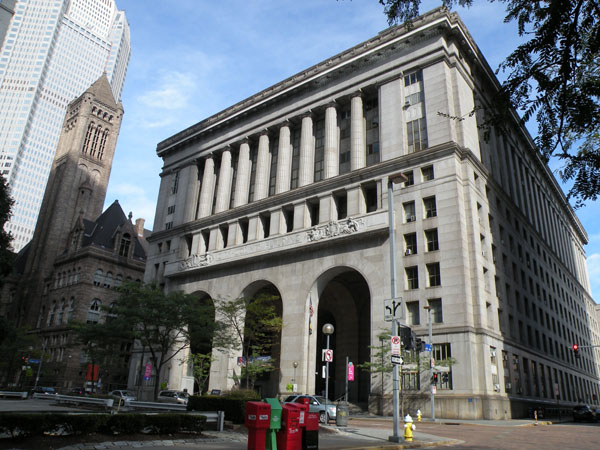
Photo: Lee Paxton, CC BY-SA 4.0 via Wikimedia Commons
Built in 1917, the City-County Building is a grand structure which still serves as the seat of government for the city of Pittsburgh. Come during the holidays for full decoration and the community gingerbread house contest (displayed in the lobby). For those interested in the more prosaic functions of government, show up on a Tuesday or Wednesday morning to see a City Council meeting in their majestic fifth floor chambers, and maybe even a press conference on the portico.
The Pittsburgh City-County Building is the seat of government for the City of Pittsburgh, and houses both city and Allegheny County offices. It is located in Downtown Pittsburgh at 414 Grant Street. Built from 1915 to 1917 it is the third seat of government of Pittsburgh. Today the building is occupied mostly by Pittsburgh offices with Allegheny County located in adjacent county facilities. It also contains a courtroom used for the Pittsburgh sessions of the Supreme Court of Pennsylvania.
© OpenStreetMap contributors
A gorgeous stone building built in 1884 that serves as the seat of the Allegheny County government. You can walk into the lovely courtyard with its fountain, overshadowed by the building's prominent tower. The building is listed on the National Register of Historic Places and widely regarded as one of the most beautiful courthouses in the nation.
A 20-story building constructed by the industrialist Henry Clay Frick in 1902. The building sports many lavish features, such as marble ceilings, intricate grillwork, and stained glass windows.
A gleaming white set of buildings, the tallest of which is the city's fifth tallest. At night they are lit up rather nicely.
A sleek 55-story building which holds the title of the city's second tallest building. It is situated directly across from the U.S. Steel Tower, separated by only a street and a small park, standing as if to challenge the older and larger lion that is the Steel Tower. One of its unique features is the building's eight-sided design.
A gorgeous Flemish-Gothic structure built in 1916 by Henry Clay Frick, the structure is decorated with a steep mansard roof, terra cotta dormers, and two chapel-like towers. The church-like appearance of the structure owes to the previous use of the land, a nineteenth century catholic cathedral.
Fourth Avenue used to be the financial center of Pittsburgh, and a lot of great architecture remains on Fourth even if most of the banks have moved to taller, shinier buildings. However, a branch of the Dollar Savings Bank remains, with impressive classical architecture in dark stone and lion statues flanking the entrance.