//

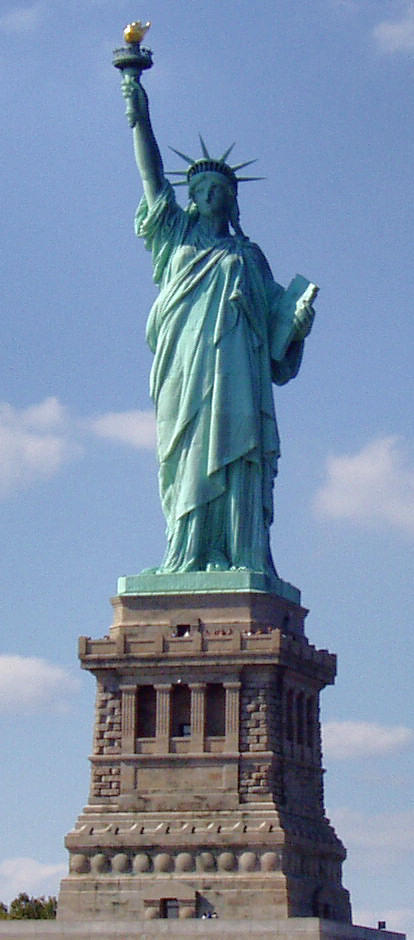
Photo: via Wikimedia Commons, Public domain
One of the most famous and iconic landmarks in the USA, if not the world. A gift from the people of France to celebrate the centennial of the United States, stands upon Liberty Island and is one of the most famous symbols of the nation and has been inscribed on the UNESCO World Heritage list. Upon departing the ferry, you can visit the Visitor Information Station, which has a schedule of the day's events. Visitors can also meet at the Liberty Island Flagpole (behind the statue) for a ranger-led tour of the island. You can also visit the monument lobby, museum (where you'll see various exhibits on the statue, the old torch, and the famous "New Colossus" sonnet), and outside to the promenade and Fort Wood (the 11-point star-shaped structure the statue stands upon). You can also take a trip to the pedestal observation deck (though not up into the statue itself, unless you have a Reserve with Crown ticket); visitors can look upward to view the interior of the statue (there are four marked viewing locations); and the pedestal observation deck provides a 360-degree view, which includes the New York City skyline. Security checks are rigorous, so travel as light as possible. Backpacks and other large bags are not permitted on the tours but can be stored in lockers for a fee. On busy days there may be long waits. Visitors with the Reserve with Crown ticket are allowed to climb up a circular staircase from the base of the statue to the crown, but tickets are very limited and should be reserved three or four months (up to one year) in advance. Children must be at least 4-feet tall, and must be able to walk up and down the stairs by themselves, and all ticket holders must show a photo ID to match the name on their tickets. The design of Lady Liberty's torch evokes the universal symbol of enlightenment, which lights the way to freedom, showing immigrants the path to liberty and justice.
The Statue of Liberty is a colossal neoclassical sculpture of a robed and crowned woman on Liberty Island, part of New York City, in New York Harbor. The copper-clad statue, a gift to the United States from the people of France, was designed by French sculptor Frédéric Auguste Bartholdi, and its metal framework built by Gustave Eiffel. The statue was dedicated on October 28, 1886.
© OpenStreetMap contributors
Ellis Island was home to the nation's primary federal immigration station, with over 12 million immigrant steamship passengers passing through from its opening in 1892 to its closing in 1954. Today, over 40 percent of America's population can trace their ancestry through Ellis Island. The island is home to the American Family Immigration History Center, which contains manifests of 25 million immigrants, passengers, and crew members who entered New York Harbor. The Immigration museum at Ellis Islands has details about "Peopling of America" and if you are an avid history lover, this museum will need at least 3-4 hrs of your time. Since the ferry ride takes you to both Ellis Island as well as the Liberty Island, you will have to plan your day well.
Governors Island has a long military history, home to headquarters and military posts of the United States Army from 1794 until 1966, then a complex for the U.S. Coast Guard before becoming a historic district open to tours.
The only means of access to Liberty and Ellis Islands; the ferries depart from Battery Park at the southern tip of Manhattan or from Liberty State Park in Jersey City. Be prepared for airport like security screening with similar restrictions (no food or open liquids, no knives, etc.) before boarding the boat. One ticket is good for sailings to both islands and return to starting point. Tickets are limited in number and can be obtained on the day from the ferry company or in advance by calling the ticket office on the phone number above or online. If leaving from Manhattan, you may need to arrive at Battery Park 2 hours before your timed tour to allow for security screening and ferry travel, so it is best to arrive at Battery Park early in the morning.
A memorial to the Holocaust.
At the southern tip of Manhattan, Battery Park is a waterfront green space, named for the artillery batteries which were installed here to protect the settlement of New York when it was under Dutch, then British rule. In the lead-up to the War of 1812, Castle Clinton was constructed as a fort to protect the city, and is now operated as a small museum. There are several memorials in the park, including The Sphere, a public art piece originally housed on the World Trade Center site which survived the events of September 11 and was moved to Battery Park. Ferries departing to the Statue of Liberty and Ellis Island (see below) depart from here.
Exhibits on the history of highrise and skyscraper construction.