//

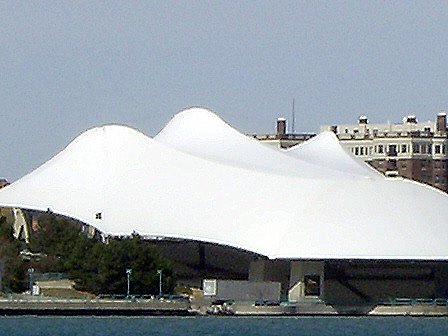
Photo: Mikerussell at en.wikipedia, CC BY-SA 3.0 via Wikimedia Commons
Detroit's riverfront is a 5½-mile (8.8 km) promenade along the Detroit River running from the Ambassador Bridge to Belle Isle, encompassing a multitude of parks, restaurants, retail shops, skyscrapers, and high rise residential areas. The path is directly on the river and is 62 feet (18¾ m) wide in most places, with separate lanes for pedestrian and bicycle traffic. Pavilions, fishing piers, and there are benches at intervals along the path. The east RiverWalk connects various riverfront developments, including Hart Plaza, the Renaissance Center, GM Plaza and Promenade, Tri-Centennial State Park, Stroh River Place, Chene Park, and Gabriel Richard Park. The nearest People Mover station to the riverfront is the Joe Louis Arena Station, which is inside Joe Louis Arena.
The Detroit International Riverfront is a tourist attraction and landmark of Detroit, Michigan, extending from the Ambassador Bridge in the west to Belle Isle in the east, for a total of 5.5 miles along the Detroit River. The International Riverfront encompasses a cruise ship passenger terminal and dock, a marina, a multitude of parks, restaurants, retail shops, skyscrapers, and high rise residential areas along with Huntington Place. The Marriott at the Renaissance Center and the Robert's Riverwalk Hotel are also situated along the International Riverfront.
© OpenStreetMap contributors
This park is an open, mostly hard-surfaced park along the Detroit River. It is more or less on the site where Antoine de la Mothe Cadillac landed in 1701 when he founded Fort Pontchartrain du Détroit, the settlement that became Detroit. The 14 acres (5.7 ha) plaza, which is named after the late U.S. Senator Philip Hart, opened in 1975 and has a capacity of 40,000 people. The park conatians several sculptures and monuments, including: Dodge Fountain, which is at the center of the park; Transcending, which is a Michigan Labor Legacy Landmark, at the entrance of the park; Monolith, a sculpture by Isamu Noguchi; a statue of George Washington; and the Joe Louis Memorial, which is a gigantic sculpture of Joe Louis' fist. The nearest People Mover station to Hart Plaza is the Financial District Station, on Larned, between Shelby and Griswold Street.
The Spirit of Detroit is a city monument with a large bronze statue situated in front of the Coleman A. Young Municipal Center, home to Detroit's city hall. It was commissioned in 1955 for a cost of $58,000, and dedicated in 1958. In its left hand, the statue holds a bronze sphere with rays to symbolize God. In its right hand, is a family group symbolizing human relationships. The 26-foot (7.9-m) sculpture is frequently dressed in sports jerseys when local professional teams are in the playoffs. The nearest People Mover station to the monument is the Millender Center Station, which is inside the Millender Center on the 5th floor.
The Old Mariners' Church is an independent, Anglican-style church completed in 1849. Established to serve mariners (hence the name), the church holds a Blessing of the Fleet every March for those going out to sea and a Great Lakes Memorial Service for those who have lost their lives at sea every November. It's perhaps most notable in American and Canadian popular culture as the "Maritime Sailors' Cathedral" mentioned in the lyrics of Gordon Lightfoot's 1976 hit "The Wreck of the Edmund Fitzgerald". An Underground Railroad tunnel under the building was discovered in 1955 when the church was moved to make way for a civic centre. The nearest People Mover Station to the church is Millender Center.
Comerica Tower
Comerica Tower is the second tallest building in Detroit, after the Renaissance Center, rising 619 ft (189 m). The building was constructed from 1991 to 1993. The building is famous for its postmodern architectural design topped with neo-gothic spires, which makes it blend in with the older buildings in Detroit. Built in 1993, visitors are often surprised to learn of the building's young age.
Built in 1929, the building is a bold example of Art Deco architecture, including art moderne designs. At the top of the Guardian Building's spire, is a large American flag, complementing the four smaller flags atop nearby 150 West Jefferson. The Guardian Building's interior is lavishly decorated with mosaic and Pewabic and Rookwood tile. The semi-circular exterior domes are filled with Pewabic Pottery. The building was designated a National Historic Landmark in 1989. It was used as headquarters for production during World War II.
This group of seven interconnected skyscrapers contains the tallest building in Michigan and is considered a symbol of Detroit. The entire complex is owned by General Motors as its headquarters. The central tower, a Marriott hotel, was built as the tallest hotel in the world, rising 73 stories at 727 feet. Free tours of the complex are offered Monday through Saturday at 10AM, noon, 2PM, and 4PM. The tour covers the main highlights of the complex as well as a glass elevator ride of the 72 floor which offers great views that extend 30 miles (48 km) in all directions. The GM Wintergarden, a tropical atrium, overlooks the Detroit River and Windsor, Ontario. The GMnext Showroom is a display of classic and concept cars at the centre of the complex. The "Borealis" Glass Sculpture, at the Jefferson Avenue entrance, is the tallest vertical glass sculpture in the world. The complex also features a plaza on the riverfront with fountains, stages, and seating. The Renaissance Center has its own station on the People Mover in Tower 200 on level 2.