//

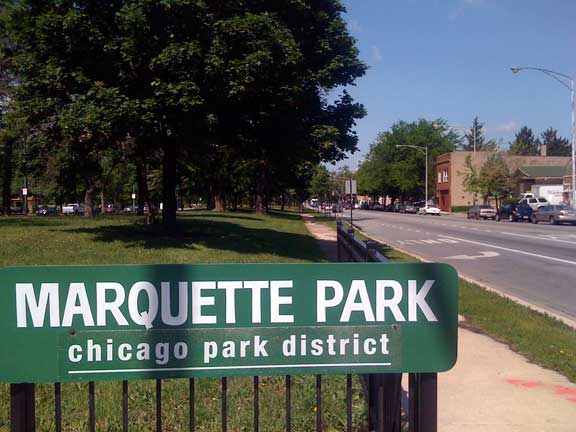
Photo: User:Nicopanico, Public domain via Wikimedia Commons
Marquette Park is huge and is a good place to get away from the urban commotion of the city. Ice skating (on the lagoon) and cross-country skiing are both possibilities during the winter. During the summer, it's likely the South Side's favorite place for a picnic or a pick-up game of soccer (or more accurately in these parts, futból). The park is also home to the Ashburn Prairie, a fine specimen of the native plant species of the area.
Marquette Park, the largest park on the southwest side of Chicago, Illinois, at 323 acres (1.31 km2), is located in the city's Chicago Lawn neighborhood. The park is named for Father Jacques Marquette (1637–1675).
© OpenStreetMap contributors
The hidden gem that is Marquette's public golf course is considered one of Chicago's most beautiful. You will feel miles away from the city. Nine holes, 3,187 yards.
The Balzekas Museum has a fine collection of Lithuanian antiques, folk art, armor, coins, rare historical maps, amber jewelry, and other items exhibited chronologically. The center also includes a state-of-the-art audio-visual center and an impressive research facility for Lithuanian history and genealogy. And the gift shop is a great shopping spot for Lithuanian items.
The Indian Building
Forget the store, this place is famous for the giant stereotypical-looking Indian statue of Wayne's World fame on the roof. In the movie, his hand is raised in greeting, but he has an arrow through his back. The Midwest Eye Clinic has usurped the cigar sellers, and adopted the Indian as a billboard — the arrow is gone, he now wears large glasses, and bears an odd sign reading "Eye can see now."
The enormous Midwest branch of the National Archives is hidden away in the middle of nowhere, but its collection of records is enormous. The public has free and instant access to the census records, for those interested in their family genealogy, while historic federal documents are searchable only by researchers who have applied for a pass in advance.
Although lesser known than Marquette Park, this 60-acre (24 hectares) park is historically and aesthetically its equal. Designed by architects Daniel Burnham & Co and landscape artists the Olmsted Brothers and on a rather unsafe stretch of historic Garfield Boulevard, this park provides open green space and a beautiful lagoon, classically designed architecture, and a glimpse into the past and the future of the Back of the Yards area.
The largest mural in the city (500 ft), painted by Hector Duarte and Mariah de Forest, on the south wall of the Swap-O-Rama building. You can't really see it from the street — you'll need to wander deep into the parking lot for a good look.