//

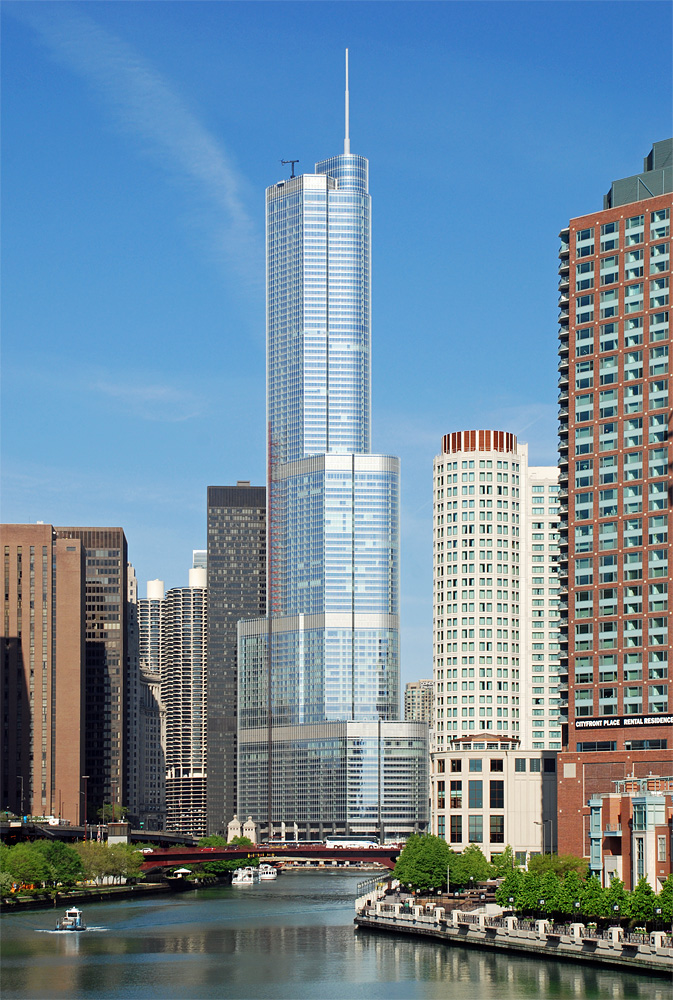
Photo: https://www.flickr.com/photos/solarwind-chicago/, CC BY 2.0 via Wikimedia Commons
1362 ft. The Trump Hotel and luxury residential building is both the newest member of the Chicago skyline, completed at the beginning of 2009, and the tallest after the Sears Tower — indeed, it is the fourth tallest in the United States. The Donald intended for it to be the tallest in the world, but decided to scale back following the 9/11 terrorist attacks. The design features three prominent setbacks at the height of nearby buildings: the Wrigley Building, Marina City, and 330 N Wabash, which, combined with its singularly reflective exterior, allow this supertall to blend into the skyline, almost to the point where you could overlook it. As intended, the building reflects and interacts with the Chicago skyline, rather than imposing itself upon it with its great height. Regardless, you will not likely miss this building, and it's plenty interesting to examine — its asymmetric form ensures that you will see something quite different from any different vantage point.
The Trump International Hotel and Tower, or simply the Trump Tower, is a skyscraper condo-hotel in the Near North Side community area in downtown Chicago, Illinois, United States. The building, named for Donald Trump, was designed by architect Adrian Smith of Skidmore, Owings and Merrill. Bovis Lend Lease built the 100-story structure between 2005 and 2009, which reaches a height of 1,388 feet (423.2 m) including its spire, its roof topping out at 1,169 feet (356 m). It is next to the main branch of the Chicago River, with a view of the entry to Lake Michigan beyond a series of bridges over the river. The building received publicity when the winner of the first season of The Apprentice reality television show, Bill Rancic, chose to manage the construction of the tower over managing a Rancho Palos Verdes–based Trump National Golf Course & Resort in the Los Angeles metro area.
© OpenStreetMap contributors
The Skokie-based museum has a temporary exhibit here while its main building is under renovation.
A small museum spread over the five floors of the southwest tower of the Michigan Avenue Bridge. Visitors can see displays on the history of Chicago's famously abused river, and also check out the machinery used for raising the bridge. Tower tours are Fridays and Saturdays at 11AM and 2:30PM beginning in June, book online. The bridge lift times depends on tides, but is usually between 10AM and 1PM on W and Su.
No tours available, unless you're cheeky enough to fill out a fake rental application (24 hours in advance), but these iconic twin buildings are worth a photo. (You might recognize them from the cover of Wilco's Yankee Hotel Foxtrot, among many others.) Designed to be "a city within a city," they include a wildly overpriced bowling alley and the House of Blues (see Drink below). If you like Marina City, be sure to visit the South Loop for two more of architect Bertrand Goldberg's corncob structures.
Built in 1925, the walls of the Tribune Tower contain rocks from many famous world landmarks, including: the Taj Mahal, the Parthenon, the Great Pyramid, the Cathedral of Notre-Dame, the Great Wall of China, the Berlin Wall, and from the New York World Trade Center, demolished in 2001. The Tribune Tower even managed to get its hands on a moon rock, but so far NASA hasn't allowed it to add the rock to the wall.
Adorning the first floor are decorative arts from the collection of the museum's namesake, Richard H. Driehaus, with plenty of Tiffany stained glass. But it's the restored 1883 mansion itself that garners glowing reviews; inside are 17 different types of marble, hand-painted ceilings, carved exotic wood wainscoting and other marks of superior 19th-century craftsmanship. If you're interested in historic architecture and interior design, this is still a hidden gem without crowds.
Easy to miss, as it's on a side street without much in the way of signage (or advertising), but this gallery has a long history — it opened in 1916, and hosted Pablo Picasso's first art show in the U.S. Visitors will find three public art shows each year, usually of exceptional quality. Note the Mies van der Rohe central staircase, which was transplanted from the club's previous Mies-designed location.