//

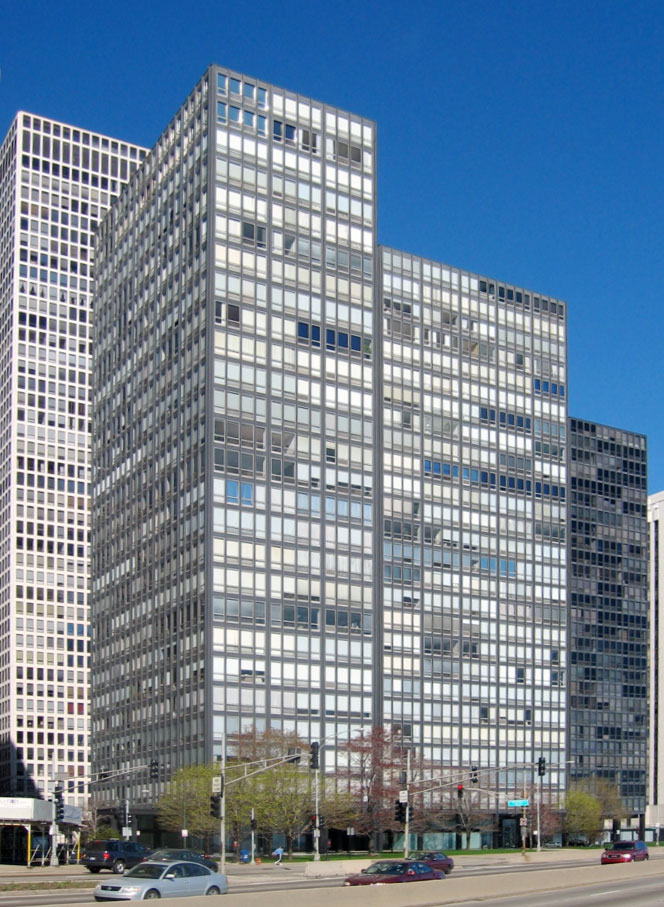
Photo: User:JeremyA, CC BY-SA 2.5 via Wikimedia Commons
These glass and steel towers may look commonplace, but they were some of the first glass and steel towers, a concept copied everywhere. The 26-story apartment towers were built in 1949-1951 to a design by Ludwig Mies van der Rohe (a nearby street bears his name). The neighbouring 900-910 Lake Shore Drive were also designed by van der Rohe and built in 1955 as one of the first towers to use glass curtain walls. The towers house apartments and the interior is not open.
860–880 Lake Shore Drive are a pair of glass-and-steel apartment towers along Lake Shore Drive in Chicago, Illinois, United States. Located in the Streeterville neighborhood, within the Near North Side community area, the buildings were designed in the International Style by Ludwig Mies van der Rohe and were his first high-rise design. Holsman, Holsman, Klekamp & Taylor and Pace Associates were also involved with the design as the associated architects. Each of the towers is identical in shape and materials, measuring 270 feet (82 m) tall with 26 stories. The buildings are listed on the National Register of Historic Places and are designated as a Chicago Landmark.
© OpenStreetMap contributors
Contemporary art from around the world. The MCA has a great location and plenty of financial backing, but it's still fighting for recognition in the museum world; while not an upper-tier institution as yet, that has resulted in some interesting exhibitions. There isn't much of a permanent collection, so check what's on before you go. Also, Marisol is the museums' Latin- inspired all day café, that's quickly become a draw in a part of Streeterville, not exactly known for its cuisine.
Hancock Observatory
360-degree view from the 94th floor. Not quite as high as the Sears Tower Skydeck, but with a better view, and from January to March, an ice-skating rink! For drinks, see the Signature Room below.
Known for their inventive, acrobatic shows; their repertory production of "Lookingglass Alice" is a knock-out. It's worth peeking inside even if you don't plan to see a show, though, to check out the insides of the old Pumping Station; unlike the Water Tower, its more famous sibling across the street, there's some interesting old machinery to see.
A Gothic Revival church built in 1912 provides a contrast to the surrounding bustle.
In 1871, when Mrs. O'Leary's cow kicked over the lantern in her barn — or was framed for the act, depending on who you ask — the Gothic Revival spires of Water Tower were only two years old. Today, along with the Pumping Station on the other side of the street, the Water Tower is the last, dream-like symbol of the Old Chicago that disappeared in the Fire. Surrounded by hotels and colossal department stores, it's also the icon of the new city that arose. At night, the Water Tower is lit from within, and it's a memorable sight. Inside, the vintage machinery is long gone (along with the water), and the plain interior is occasionally used as a gallery space.
Chicago Red Line
Right next to the Water Tower, LUMA is best known for its exhibits on sacred art and architecture, but it occasionally veers into modern art as well, such as an installation of Andy Warhol's silver balloons.