//

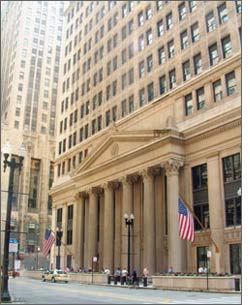
Photo: via Wikimedia Commons, Public domain
Currency wonks can study various denominations and practice counterfeit detections. Guided tours every day at 1PM.
The Federal Reserve Bank of Chicago is one of the twelve Federal Reserve Banks of the United States. It is responsible for the Seventh District of the Federal Reserve System, which encompasses the northern portions of Illinois and Indiana, southern Wisconsin, the Lower Peninsula of Michigan, and Iowa. The district is headquartered in Chicago and has a branch office in Detroit. The bank's chief executive officer and president is Austan Goolsbee.
© OpenStreetMap contributors
Burnham & Root, 1888
The Rookery is gorgeous to the point of absurdity, with delight to be found in details in the rustic lower walls and the triumphant upper walls. (Note the helpful street names carved in the corners.) Named for pigeons' habit of roosting in the then-new skyscrapers, this was the first Loop building to be granted preservation status in 1972. The lobby was remodeled in 1907 by enfant terrible Frank Lloyd Wright, adding his own touch to the interior.
van der Rohe, 1964/1975
This plaza includes Mies' Dirksen Federal Building and Kluczynski Federal Building (built eleven years apart), with a low-rise post office enveloped in their sleek black lines. But the buildings are not quite as famous as the gigantic red constructivist flamingo statue by Alexander Calder in the plaza in front of the post office. An adventurous raccoon may have set a raccoon world climbing record by reaching the scaffolding on the 36th floor in 2006.
Holabird & Roche, 1894
It's partially obscured by renovations, but this first-wave skyscraper still makes an immediate contrast with the modern Federal Center across the street. The lobby is decorated with Tiffany mosaics and bronze carvings of Pere Marquette, an early French explorer. There is plenty of first-floor retail to allow trips inside.
Burnham & Root, 1891
Named appropriately for a mountain in New Hampshire, the Monadnock was the last tall building to be supported by its own walls (not a metal frame, although the 1893 addition by Holabird & Roche does use one). It's a masterpiece of simplicity and power in form. The block-long hallway that serves as a lobby has incredible ambiance: it's always kept at a level of brightness that suggests gas lamps, and the small stores on the first floor (a coffee shop, a shoe-shine, a restaurant) are all turn-of-the-century tile-and-polish.
287 ft. While not very tall, this 1975 brutalist structure is one of the most distinctive and curious in the Chicago skyline. As its name suggests, it is a vertical prison skyscraper and its sharp triangular shape is designed to minimize the amount of time that it takes to patrol its corridors. Its prisoners have some of the prison world's best views as their exercise yard is on top of the roof, although the narrow slits serving as windows do not allow such nice views from the cells. The prison houses male and female convicts of all security levels, waiting for transport to the courthouse nearby.
1007 ft. Built by Adrian Smith in 1989, the granite-clad AT&T Corporate Center is one of the city's more distinctive skyscrapers for its massive size, spiked roof pinnacles, and a style evocative of both Gothic and Japanese architectural styles. It's not well-known, but it is the eighth tallest building in the U.S.