//

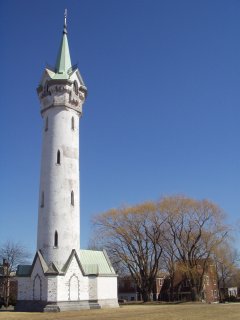
Photo: Brian Corr, CC BY-SA 3.0 via Wikimedia Commons
This site once contained earthwork fortifications built by the Continental Army during the Siege of Boston, and its clearly defendable location still offers sweeping views of downtown Boston. Fort Hill, the neighborhood's modern name, was inspired by these earthworks. The small park contains the Cochituate Standpipe, also known as Fort Hill Tower, built in 1869. It was once used to provide water pressure to area residents, but was only in use for a few decades. The tower makes a good point of reference when navigating Roxbury. Keep checking its location when you're worried about getting turned around.
Roxbury High Fort is a historic fort site on Beech Glen Street at Fort Avenue in the Roxbury neighborhood of Boston, Massachusetts. The site now contains a small park and the Cochituate Standpipe, also known as Fort Hill Tower, built in 1869. The fort site was added to the National Register of Historic Places in 1973. The site inspired the name of the Fort Hill neighborhood, which surrounds the area of the High Fort.
© OpenStreetMap contributors
Dillaway-Thomas House
This heritage park is located in the John Eliot Square area of Roxbury, originally the center of town after its founding in 1630. The Dillaway-Thomas House here was built in the Georgian style during 1750 for the pastor of the First Church of Roxbury. Which still stands today just across the street. In April 1775, John Thomas, an American commander in the Continental Army, took possession of the house. Using it as a base of operations during the siege of Boston. By early March 1776, Henry Knox had transported cannons from Fort Ticonderoga in New York and through Roxbury, when Thomas led the charge to fortify Dorchester Heights. He and his men used the cannons to force the evacuation of the British from Boston on March 17. The house returned to the ownership of Pastors and Educators until was eventually purchased by the City of Boston in the 1920s, and slated for demolition. Activism by Roxbury residents saved the structure, and it began its current path to restoration in the 1930s.
Bigfoot Research Institute
Volunteer and teach the next generation of poets and writers. Also sells a variety of "Big Foot" souvenirs, alongside books by local authors.
The house was built in 1747 as a summer home for William Shirley (1694–1771), Royal Governor of the Province of Massachusetts Bay. It is one of the last remaining mansions of royal governors in the United States. After the Revolutionary War, the home was seized as "Loyalist property" in 1778 and sat unoccupied for four years. For the next 100 years the home would pass through the hands of many wealthy Bostonians, Ambassadors, and Governors. Eventually it fell into being used as a tenement building, and in 1911 it was once again abandoned. Two years later, the founder of the Society for the Preservation of New England Antiquities took on a new role, and began the work of preserving the house. The structure was again extensively renovated during the 1980s. The work included an award winning restoration to the grounds, including an orchard, period perennial beds, parterre gardens, and a large formal lawn. Today it is used as a living museum, be sure to check the events calendar for what's new.
Franklin Park Zoo, founded in 1912, is a 72-acre site nestled in Boston’s historic Franklin Park. This zoo contains a combined 10,000 sq ft of playground area and uses play to teach children about conservation and wildlife. In addition, it has an Australian bird aviary, a bird world's exhibit, an African lions exhibit, a tigers exhibit, a tropical forest environment, an outback trail, a butterfly tent, barn houses with farm animals, expansive giraffe and zebra savannah, a camel trek, a carousel, a train ride, a stationary jeep ride, picnic areas, a southwestern-themed grill concession stand, and a children's zoo!
The crown jewel in Frederick Law Olmstead's Emerald Necklace system of parks, Franklin Park brings together rural scenery, a woodland preserve, and areas for recreation and sports. Although funding for upkeep has been inconsistent over the years, the park's 485 acres provide thousands of city dwellers with unmatched green space. Take your time and investigate the old stone bridges and ruins scattered along the 15+ miles of rustic walking/hiking paths. Urban explorers shouldn't miss the Long Crouch Woods, site of Boston's first zoo, or the historic White Stadium, built in 1949, home of nearby public high school Boston Latin School's football team, and host of a large Black Panther rally back in 1969. A grand staircase, deteriorating for a century, arcs up to reveal a long arcade lined with giant bear cages built of iron. If you're looking for a more focused undertaking, check out the entries for the golf course and modern zoo below.