//

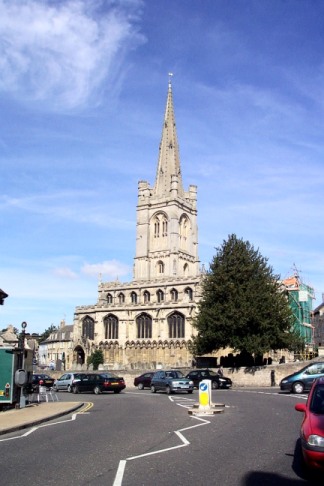
Photo: Geoff Pick, CC BY-SA 2.0 via Wikimedia Commons
This Anglican church is mainly 13th century, renovated in the 15th.
All Saints' Church, Stamford is an historic parish church, of the Church of England, in Stamford, Lincolnshire, England. It is a Grade I listed building. It is on the north side of Red Lion Square.
© OpenStreetMap contributors
A redundant Anglican church, its congregation joined All Saints in 2003, but the building remains accessible. The Tower is maybe 14th century, most of the rest is 15th. It has a finely-carved internal roof with angel bosses.
The Victorian Corn Exchange is now a community-run 400-seat theatre. The staple fare is tribute bands.
This almshouse was built in 1475 and still has 12 residents, though they're no longer required to attend chapel twice a day to pray for the founder. (They were called "bedesmen" as they counted off their devotions on their rosary beads.) Vacancies occur through natural causes, so you can apply if you're indigent and genteel enough. As it's a residence not a zoo there is seldom public access, but see the website for an online tour and occasional guided tour.
This was built in the 12th century, with the tower added in the 13th and spire in the 14th. It doesn't lean, but the spire has creaked and tottered and been reinforced for six centuries. The fine Corpus Christi or North Chapel has a decorated medieval wagon vault. The church was refurbished in the late 19th century under Arts & Crafts influence, especially seen in the stained glass window of the Lady Chapel. An ornate tomb holds Sir David Philips (d 1506), ally of Henry VII. The church follows the "High Anglican" tradition of the Victorian Oxford Movement, when English Protestants re-discovered the attractions of Catholic smells and bells.
This is what you get when hubris and property development outweigh piety. It dates at least back to Norman times, though much altered in later centuries, especially in 1832 when a reformist vicar had the internal pillars removed. But these were supporting the tower, and down the whole thing came. The church was rebuilt within four years in neo-Gothic style, and served until 1974 when it became redundant. Developers ripped into the structure and turned it into a parade of shops, while most of the graveyard became a car park.
This 18th century building hosts a 166-seat theatre-cinema, a gallery, cellar bar, a cafe and a large ballroom. Other multifunctional rooms are available to hire. The town tourist office is also based here.