//

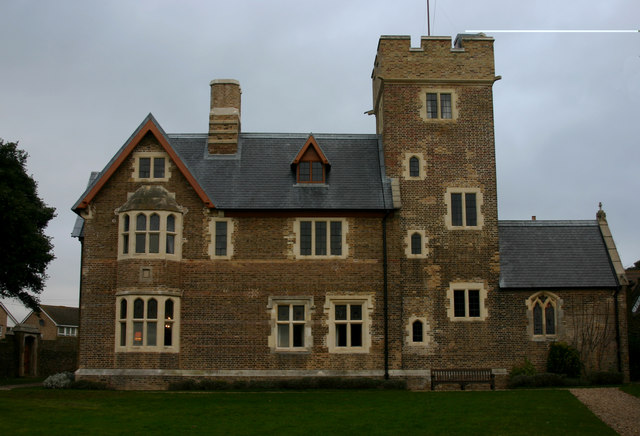
Photo: David Kemp, CC BY-SA 2.0 via Wikimedia Commons
Augustus Welby Pugin's Gothic house built in 1845, The Grange can be seen in St Augustine's Road on the Westcliff (it is now rented out by the Landmark Trust). There are occasional opportunities to visit the house but these are few and far between. The house was the subject of a substantial renovation some years back by the Landmark Trust and appeared on a special episode of Channel 4's archaeological series Time Team.
The Grange is a house in Ramsgate, Kent, on the south coast of England. It was designed as his own home by the Victorian architect and designer Augustus Pugin, and built between 1843 and 1844. The Grange is built in Gothic Revival style, Pugin intending it to be both a home and a manifesto for his architectural philosophy. Rescued from demolition by the Landmark Trust in 1997, the Grange is a Grade I listed building.
© OpenStreetMap contributors
Built by Augustus Pugin in 1847 in the neo-Gothic style, St Augustine's serves the Catholic community of the town and the adjacent abbey. It is situated next to The Grange in St Augustine's Road.
Established in the mid-19th century, the abbey is one of only four Benedictine abbeys in the UK.
The town of Ramsgate has the only designated Royal Harbour in the whole of the United Kingdom. The harbour dates back to the 18th century and was given its royal status by King George IV in 1821 when he received a rapturous reception by the townspeople after he chose the port as his point of departure and return for a trip to his native Hanover with the Royal Yacht Squadron. An obelisk commemorating the King's trip stands near the Maritime Museum. The construction of the harbour began in 1749 and was completed in 1850 after several different stages of development. Some aspects of the harbour were the work of John Shaw and his son, John Shaw Jnr, most prominent among these being the lighthouse on the western harbour arm. The harbour was an important embarkation point during the Napoleonic Wars and played a vital role during the 1940 Dunkirk Evacuations: it was from here and Dover that many of the "Little Ships" plied their way across the English Channel to help rescue the stranded Allied forces from the beaches at Dunkirk in the face of the oncoming Nazi hordes; in the harbour stands a memorial to the event and moored at the nearby George IV memorial pontoon is the MY Sundowner, one of the "Little Ships" that was once owned by the 2nd Officer of the Titanic, Charles Lightoller. Today, the harbour has one of the most vibrant yacting marinas on the south coast and, thanks to the nearby offshore Thanet Wind Farm, remains a working harbour. An extension to the harbour allows cross-channel ferries to berth at Ramsgate and LD Lines (cars only) TransEuropa Ferries (predominantly freight) run services to Oostende in Belgium.
As the Second World War approached, Ramsgate Borough Council embarked on ambitious but controversial plans to create a network of Deep Shelter tunnels linking to a former Railway Tunnel which would provide shelter for 60,000 people. Despite resistance from government the plan was given the go-ahead and the network was formally opened by the Duke of Kent on 1 June 1939. The tunnels are again open to the public. You can now explore the tunnels and experience how people sheltered and lived in the town below the town. Tours last about an hour, and operate from Wednesday to Sunday every week.
Dominant over much of the harbour is the characteristic Maritime Museum. Built in 1817 by Benjamin Wyatt and George Louch, the building was built as the harbour clock house. In the 1980s, it was turned into the town's maritime museum, containing four galleries examining the maritime history of the local area and describing the development of the eponymous harbour. Also featured are many artefacts from the various shipwrecks of the treacherous Goodwin Sands. The building is also the site of the unique Ramsgate Meridian, where the town's own Mean Time was calculated as being 5 minutes and 41 seconds ahead of Greenwich.
Focused on experimental and obsolete scientific and musical technology.