//

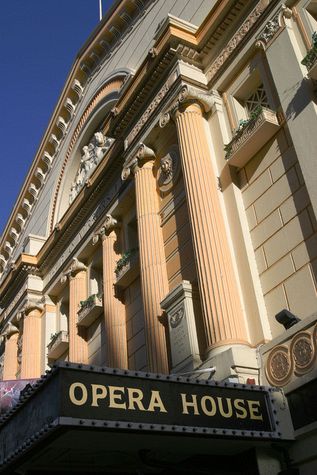
Photo: via Wikimedia Commons, CC BY-SA 2.5
Sister theatre to The Palace Theatre. Host to touring musicals, ballet, concerts.
The Opera House in Quay Street, Manchester, England, is a 1,920-seater commercial touring theatre that plays host to touring musicals, ballet, concerts and a Christmas pantomime. It is a Grade II listed building and one of the main theatres in Manchester. The Opera House and its sister theatre the Palace Theatre on Oxford Street are operated by the same parent company, Ambassador Theatre Group.
© OpenStreetMap contributors
After closing for refurbishment, the John Rylands Library is now open to the public. It now has access to all floors and a new entrance and cafe to the side of the building on Spinningfields. The John Rylands library is a beautifully-dark Gothic archive bang in the middle of the new business district. It is home to a number of special collections, many of which are now on display including the celebrated St. Johns Fragment, Papyrus P52 — possibly the oldest piece of the New Testament in existence. The library's magnificent Reading Room has been opened up so visitors are free to wander around it. There is also an exhibition floor which shows off some of the jewels of the collection. Don't confuse this library with John Rylands University Library, which is the library at the university and is not at all interesting (or open) to tourists.
This little museum down by the river on the border of Manchester and Salford aims to document the way the lives of ordinary people have developed since the industrial revolution. The museum owns many artifacts and documentation from the history of socialism in Britain, not least the building where the Trades Union Congress held its first meeting, on Princess Street, which it now uses as a public archive.
This little traditional Catholic church dates from 1794, making it the oldest purpose-built post-Reformation Catholic church in England. It is an active church, with the largest congregation of any of the city-centre churches in Manchester. Inside is a modern "Stations of the Cross" by Norman Adams that is considered one of the greatest works of art in Manchester. Please remember that this is a place of Roman Catholic worship: modest dress is expected and photography is forbidden. The church is closed to tourists during services.
This imposing and beautiful neo-Gothic masterpiece by Alfred Waterhouse is the official headquarters of the Manchester City Council, but its job is largely ceremonial now. Most of the offices have moved to the more practical extension next door. The Town Hall shows the power Manchester commanded during the peak of the Industrial Revolution with its grand rooms and lavish decoration, including the famous Madox Murals in the Great Hall. Closed for refurbishment until 2024.
You can't miss this striking circular neo-Classical building when passing through St. Peter's Square. Following a major renovation completed in 2014, Central Library is well worth visit, if not for its vast selection of resources and interactive archive but for its beautiful architecture, especially evident in the circular Wolfson Reading Room on the first floor. The Henry Watson music library was the place of re-discovery of the manuscripts of Vivaldi's celebrated 'Manchester' concerti.