//

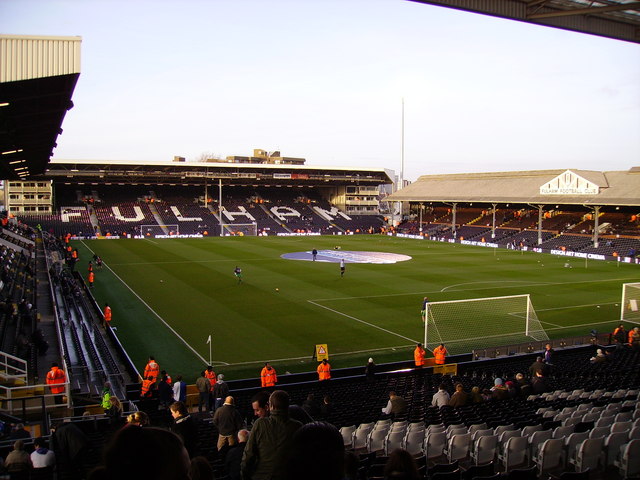
Photo: Kenneth Yarham, CC BY-SA 2.0 via Wikimedia Commons
Fulham was promoted in 2022, so they play soccer in the Premier League, the top tier. Tours of their quirky old stadium (capacity 25,000) on non-matchdays are fun.
Fulham Football Club is a professional football club based in West London, England. The club competes in the Premier League, the top tier of English football. Founded in 1879, they have played home games at Craven Cottage since 1896. Fulham contest West London derby rivalries with Chelsea, Brentford and Queens Park Rangers. The club adopted a white shirt and black shorts as its kit in 1896, which has been used ever since.
© OpenStreetMap contributors
The area surrounding Fulham Palace was given by the Church of England as a public recreational ground.
The former retreat of the Bishops of London until 1973 now incorporates Bishop's Park and is a lovely green area in a heavily built part of London as well as home to some important historic buildings. Also a museum which charts the history of the palace back to the 11th century (and the area itself back to prehistoric times). Of note in the museum includes an entire room dedicated to Bishop Henry Compton's botanical exploits where he would gather all kinds of plants from the North American colony and grow them in the palace garden. Sadly the garden itself was destroyed when "Capability" Brown's landscaping became fashionable and Compton's codex of plants is missing with exception of a few preserved copies of its pages. There is a small cafe.
A large open park which is mainly sports pitches. It does though have some lovely frontage right onto the Thames and makes for a lovely walk for that reason.
Riverside Studios is a production studio, theatre and independent cinema on the banks of the River Thames in Hammersmith.
hosts the traditional men's warm-up tennis competition, before the Wimbledon Championship. This grand Victorian structure is home to other racquet sports such as badminton and squash. A new National Tennis Centre has been built further west at Roehampton, to hopefully end the Wimbledon English-winner drought.
A charming green iron and steel suspension bridge designed by Joseph Bazalgette and built in the 1880s. It marks the halfway point on the famous Oxford/Cambridge university boat race. Ordinarily connecting Hammersmith to Barnes on the south bank of the River Thames, the bridge has been declared unsafe due to structural issues which stem partly from the volume of road traffic it carried, far exceeding what Bazalgette could ever have imagined or designed for, and partly due to three separate attempts by the IRA (in 1939, 1996, and 2000) to blow it up which caused damage to the structure without destroying it.