//

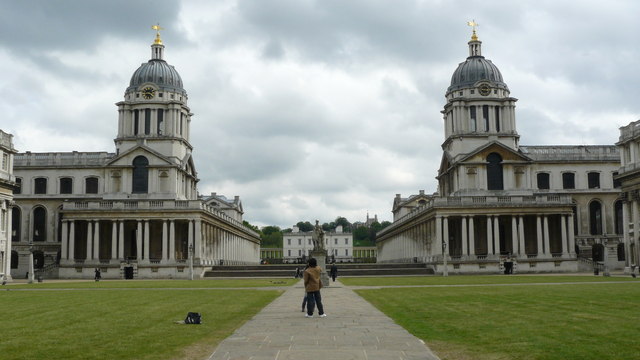
Photo: Peter Trimming, CC BY-SA 2.0 via Wikimedia Commons
Built by Christopher Wren in 1694 as the Greenwich Hospital for the relief and support of seamen and their dependents and for the improvement of navigation. It became the Royal Naval College in 1869. In 1999 the University of Greenwich moved in, and was joined by Trinity College of Music in 2001. Best known for its Painted Hall, with elaborate ceiling and wall paintings executed by Sir James Thornhill between 1707 and 1726.
The Royal Naval College, Greenwich, was a Royal Navy training establishment between 1873 and 1998, providing courses for naval officers. It was the home of the Royal Navy's staff college, which provided advanced training for officers. The equivalent in the British Army was the Staff College, Camberley, and the equivalent in the Royal Air Force was the RAF Staff College, Bracknell.
© OpenStreetMap contributors
Operated by the Greenwich Tour Guides Association, the original guiding organisation that has operated in Greenwich for 25 years. Walking tours take place twice a day (every day, excluding 24-26 Dec, 1 Jan and London Marathon Day). No need to book in advance, buy tickets on the day from the meeting point at the Discover Greenwich Tourist Information Centre. Runs two tours: The Meridian Tour (noon) which includes a scenic walk to the top of the hill in Greenwich Park - more energetic of the two walks but doesn't go into any attractions. The Greenwich Highlights Tour (2:15PM) which doesn't go up the hill but enters the chapel of the Royal Naval College.
Museum devoted to the maritime role in Britain's history. Contains the UK's national collection of Maritime artefacts (although do not expect much in the way of whole ships). One of the buildings housing the museum is the Queens House, built by Inigo Jones as the first Palladian building in England.
Runs a range of more in-depth tours including Greenwich Day Tour, Greenwich Highlights Half Day Tour, Greenwich Food Tour and National Maritime Museum Tour. Tickets must be booked in advance and tours leave from outside the Greenwich Visitors Centre. Pub lunches are generally included, as is admission to attractions.
A preserved tea and wool clipper built in 1869 which set the record for passage from Australia under sail. The ship was damaged by fire on 21 May 2007, but much of the ship's structure and rigging had already been removed as a conservation and renovation project had been underway since 2006. The site reopened in 2012 with changes to the display of the ship including raising the entire vessel so that now visitors can walk underneath.
A masterpiece of early classical architecture designed by Inigo Jones in the early 17th century. Often described as the first fully classical building in England, it now houses the National Maritime Museum’s fine art collection, including maritime paintings and portraiture.
A beautiful Baroque church designed by Nicholas Hawksmoor (and is rumoured to have links with Occultists, Freemasons and such-like). Hosts classical music concerts and organ recitals. Its Christmas choir is enjoyable also.