//

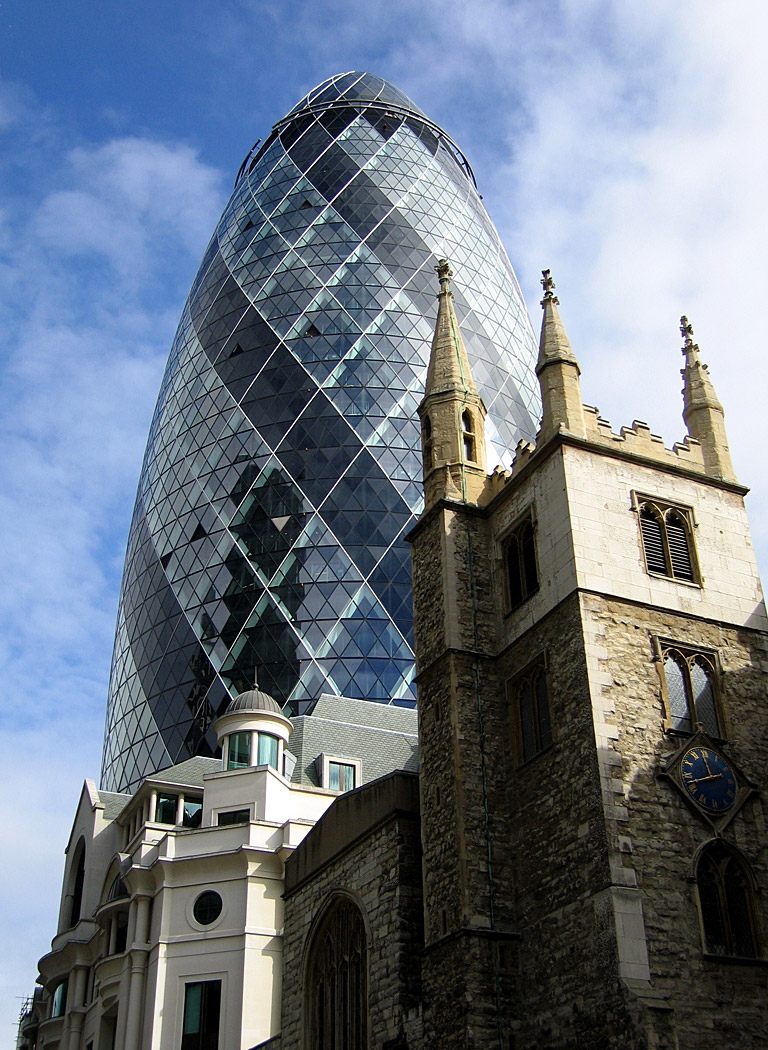
Photo: Andrew Dunn, CC BY-SA 2.0 via Wikimedia Commons
Designed by one of Britain's leading architects, Sir Norman Foster, this curved glass skyscraper was the 2004 recipient of the Stirling Architectural Prize for Best Building. It was built on the site of the Baltic Exchange building, destroyed in 1992 by an IRA bomb which killed three. On the Bury Street side of the Gherkin by some black stone benches is the Tomb of the Unknown Girl for a teenaged Londoner who died 1,600 years ago (see infobox above), marked with a marble laurel wreath and inscription. Searcy's Restaurant (from £50) at the top takes bookings up to five weeks in advance and you have to go through security before going up.
30 St Mary Axe, previously known as the Swiss Re Building, is a commercial skyscraper in London's primary financial district, the City of London. It is nicknamed The Gherkin after the vegetable of the same name due to its shape. It was completed in December 2003 and opened in April 2004. With 41 floors, it is 180 metres (591 ft) tall and stands on the sites of the former Baltic Exchange and Chamber of Shipping, which were extensively damaged in 1992 in the Baltic Exchange bombing by a device placed by the Provisional IRA in St Mary Axe, a narrow street leading north from Leadenhall Street.
© OpenStreetMap contributors
The world's main marketplace for ship broking.
Another Richard Rogers creation, nicknamed the Cheesegrater. Completed in 2014. Also opposite Lloyd's.
The LME is the leading centre for non-ferrous metals trading. It is also the last financial market in London which still retains open outcry trading.
London's highest viewing platform that is free to the public. Sitting at the 58th floor of an office building, and the tallest building in City of London proper, it gives visitors a 300-degree view of London.
Completed in 2008 opposite Lloyd's of London.
The headquarters of world's most famous insurance market, housed in a revolutionary (at the time) bizarre, Matrix-like glass-and-steel building designed by Richard Rogers, with all support services (lifts, ventilation, etc.) suspended outside. Recognised as a masterpiece of exoskeleton architecture.