//

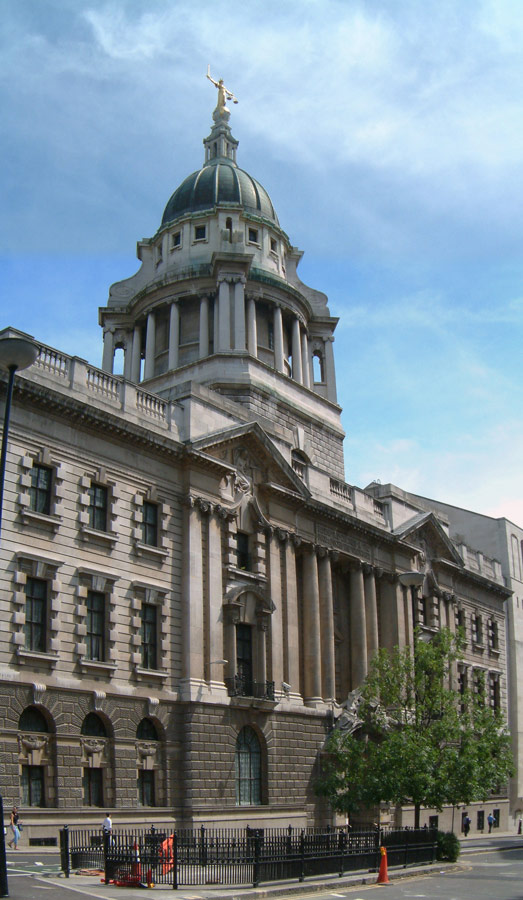
Photo: Nevilley at en.wikipedia, CC BY-SA 3.0 via Wikimedia Commons
This is probably the most famous criminal court in the world, and has been London's principal criminal court for centuries. It hears cases remitted to it from all over England and Wales as well as the Greater London area. The present building dates largely from 1907 (a new block was added from 1970 for more modern facilities) and stands on the site of the infamous medieval Newgate Gaol. The Central Criminal Court is of course best known today for its association with John Mortimer's Rumpole of the Bailey character, novels and television series. Daily case listings are available at The law pages. No bags, cameras, drinks, food or mobile phones—no facilities for safekeeping. Children under 14 are not admitted.
The Central Criminal Court of England and Wales, commonly referred to as the Old Bailey after the street on which it stands, is a criminal court building in the City of London, one of several that house the Crown Court of England and Wales.
© OpenStreetMap contributors
Church of the Holy Sepulchre (Holborn)
Grade I listed Saxon church founded before the 12th century. The exterior was mostly constructed in the 15th century, and the interior in the 19th. The north side of the church houses a musician's chapel opened in 1955. In addition to the services, there are often evening (chargeable) concerts.
After leaving its brutalist skyscraper on Old Broad St, the London Stock Exchange now resides on Paternoster Sq. Dating back to 1698, it is one of the world's oldest and largest stock markets.
Quirky medical museum. Only open to the public for scheduled evening events.
The great domed cathedral of St Paul's, designed by Sir Christopher Wren to replace the Gothic medieval cathedral destroyed in 1666 in the Great Fire of London, was built between 1675–1710. Of the most famous London sights, St Paul's is the one most conveniently located for the Barbican. It's a significant building in British history, having been the site of the funerals of several British military leaders (Nelson, Wellington, Churchill), and significantly held peace services marking the end of the two world wars. The cathedral is also famous for its Whispering Wall, as well as its stunning view over the city. The crypt is also open to the public, holding the tombs of Nelson, Wellington and Christopher Wren. It is possible to sidestep the admission charge by entering for one of the midday services, even if you don't take part, or for the daily choral evensong in the late afternoon. However, you'd still need a ticket to get to the top. Photography is not allowed.
This specialist small library houses an impressive range of books on graphic design, typography, bookbinding and papermaking. The books cannot be borrowed but can be photocopied or photographed (with permission). An essential visit for any graphic design student.
Postman's Park is three parks combined, bringing together the gardens of St Botolph's Aldersgate, Christ Church Greyfriars and St Leonard, Foster Lane. One of the largest parks in the City of London, Postman's Park contains the Memorial to Heroic Self Sacrifice; a memorial to ordinary people who died saving the lives of others and might otherwise have been forgotten.