//

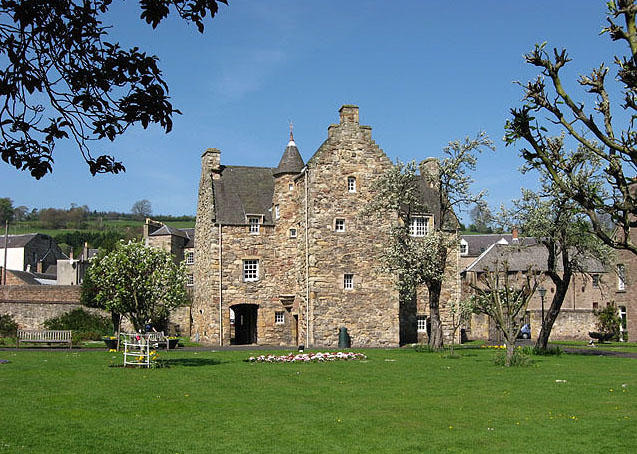
Photo: Walter Baxter, CC BY-SA 2.0 via Wikimedia Commons
This is a 16th-century tower house. In 1566 Mary, Queen of Scots stayed here, and made a long excursion to visit the wounded Earl of Bothwell out at Hermitage Castle. On return she was taken seriously ill, the cause isn't known, but she eventually recovered and returned to Edinburgh. There are "Mary QoS slept here" sites all over Scotland, but that was normal for a peripatetic medieval ruler, especially one with multiple enemies that she needed to stay ahead of.
Queen Mary's House is a listed sixteenth-century building in Jedburgh which is where Mary, Queen of Scots, stayed for a few weeks in 1566. The building has been open to the public since 1930 as a museum. There is some doubt whether the queen stayed in this particular building. The museum has concentrated on telling Queen Mary's story for the last thirty years.
© OpenStreetMap contributors
A charming 16th-century bridge over Jed Water mid-town. It's now just a footpath, but it was the main road into town until about 1800.
This ruined but imposing Augustinian abbey was founded in 1138 and was a frequent target for invading English armies. It continued in use as a parish church at the Reformation in 1560, saving it from wreckage, and it served until 1871 when a new town church was built. There is a cloister and herb garden, and a visitor centre with 8th-century carvings and artefacts excavated from the abbey grounds. In 2022 the abbey interior is closed for building safety, but you can see plenty from the street.
south across the main road from the abbey was the replacement of 1875. This was the mainstream Church of Scotland, but there were great schisms and sects and separate churches in that era; they made up and re-united in 2007.
Craft workshops and classes, try your hand at a huge variety including glass engraving and pottery painting.
The castle was demolished in 1409, but the site was rebuilt as a prison in 1823, and it's been restored to that period. The jailer's house depicts town history. "Jedburgh Justice" (hanging first, trial later) was a much earlier practice: lynch law for cattle rustlers.
It is a 15th-century L-plan fortified mansion. It's been much smashed up but restored in the 19th and 20th centuries. It can be visited by pre-booked guided tour in July, and occasionally hires out for functions at other times.